Carlos de Aldecoa


Carlos de Aldecoa Bueno was born in August of 1973. His grandfather, Carlos de Aldecoa Fernandez, established a coffee business in Madrid during the 1920s. The Spanish Civil War forced the family to leave Spain for Mexico, where the modest coffee enterprise was rebuilt in Veracruz. There, it expanded rapidly into coffee farming, roasting, retailing, and decaffeination. The founder’s son, Carlos de Aldecoa Pereda, was born in Córdoba, Veracruz, in 1941 and was raised in his father’s coffee business. Pereda assumed leadership of the business in 1963 when his father stepped back, and continued expanding its Mexican operations before moving the family enterprise to Houston, Texas in 1985. Carlos de Aldecoa Bueno, the third generation, consequently inherited both a family trade and an example of how an established company could survive disruption by adapting its skills to a new place. Bueno has four sisters who have also held important positions within the family’s companies, making theirs a true family-run enterprise.
De Aldecoa Bueno attended the University of Houston, earning a Bachelor of Science degree in industrial engineering in 1996 while working for the family’s coffee process operation. One year later, de Aldecoa and his father organized Eximius Coffee LLC as a Houston-based sales company representing the family’s coffee-processing, manufacturing, and importing operations. In 1998, they founded Cadeco Industries and established it in a former Uncle Ben’s rice-processing plant on Clinton Drive in East Houston. The immense industrial building, originally constructed during the 1940s, offered the space and infrastructure required for a large manufacturing concern. Cadeco developed it into a major independent coffee-processing complex, while Eximius eventually roasted more than 30 million pounds of coffee annually and produced both private-label products and family-owned brands.
De Aldecoa continued to enlarge the family’s industrial reach. At the end of 2006, he formed Maximus Coffee Group, which developed into an integrated roasting, decaffeination, soluble-coffee, and packaging operation. In 2009, the family began marketing Café Diario in the United States, selling roasted, ground, instant, regular, and decaffeinated coffee. By then, de Aldecoa had gained substantial experience in ingredient purchasing, process control, high-volume production, packaging, regulatory compliance, and the management of complex beverage operations.
A turning point arrived in 2014, when de Aldecoa sold Maximus Coffee Group to a global commodity-trading company and directed part of his attention toward distilled spirits. The new venture began under the name Buffalo Bayou Distilleries, receiving a federal distilled-spirits permit and a Texas distiller’s permit during 2014 and 2015. Gulf Coast Distillers became the company’s operating name in 2015, and de Aldecoa converted part of the Clinton Drive coffee complex into a distillery rather than constructing an entirely separate operation. The transition from coffee to whiskey was a change of product, but it retained many familiar industrial disciplines. Both trades begin with agricultural materials whose quality, storage, processing, and transformation must be closely controlled. De Aldecoa applied his industrial-engineering background and large-scale beverage experience to the new business, overseeing the company and taking responsibility for securing high-quality grain. The distillery has emphasized non-GMO Texas grain and direct relationships with Texas farmers as foundations of its grain-to-glass whiskey program.
The physical whiskey operation took shape during 2016 and 2017, when three pot stills, a mash tun, and fermentation tanks were installed. De Aldecoa brought in Dave Pickerell, the late Maker’s Mark master distiller who also helped establish WhistlePig, to assist with the plant’s design, mash bills, and distillation procedures. Distillation began, a second bottling line was installed, and Julian Giraldo, an engineer and longtime employee of the family organization, developed his distilling knowledge under Pickerell and former Yellow Rose distiller Troy Smith. Giraldo became the head distiller responsible for daily whiskey production, while de Aldecoa remained President and the central business and operational leader. The distillery reached its 1,000th barrel in 2018. In 2019, it opened to visitors with public tours and a tasting room known as Ben’s Den, a name that preserved a link to the building’s Uncle Ben’s history. The site grew into an unusually broad beverage campus, incorporating coffee, distilling, brewing, bottling, hospitality, food, and private-event operations within the historic East Houston complex.
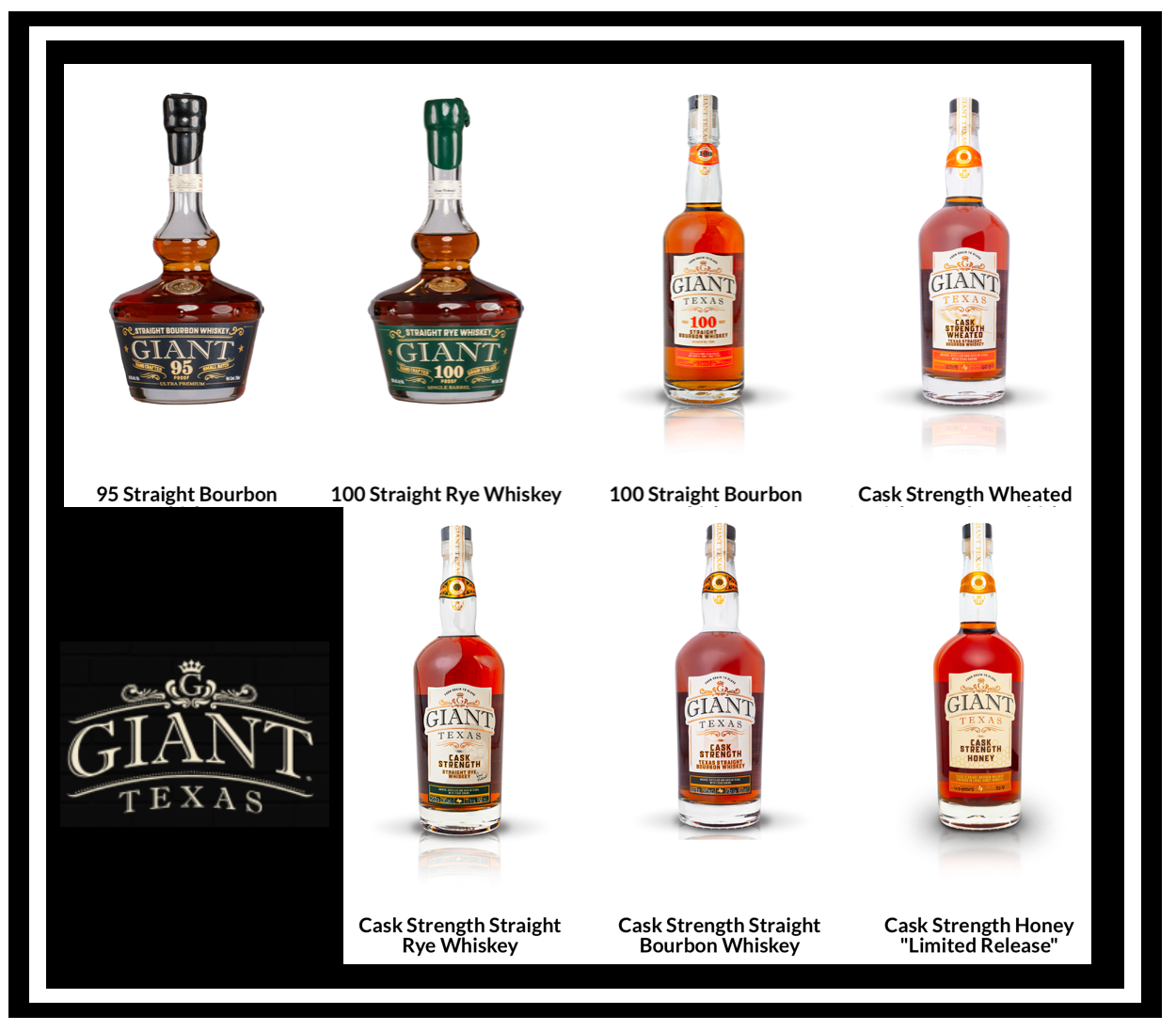
Bourbon quickly became the heart of the distillery’s own whiskey identity. Made from Texas grain and distilled in the company’s pot stills, Giant Texas Bourbon ages for at least two years and is bottled at 95 proof. The same mash bill supports other expressions that demonstrate how proof, barrel selection, and aging can change the presentation of a whiskey. Giant Texas 100 Straight Bourbon is bottled at 100 proof after at least three years of maturation. The distillery’s cask-strength straight bourbon is bottled without being reduced to a standard proof after more than three years in oak. A wheated cask-strength bourbon replaces the rye with wheat, and an aging period of approximately two to three years. Rye whiskey provides another important part of the portfolio. Giant Texas 100 Straight Rye is a single-barrel, pot-distilled whiskey. Produced from non-GMO Texas grain and aged for at least two years. The distillery has also released cask-strength rye, allowing the whiskey to retain the concentrated proof and flavor at which it leaves the barrel.
Gulf Coast Distillers was renamed Giant Texas Distillers in 2022, bringing the corporate identity into alignment with Giant Texas Whiskey. That year, the University of Houston Engineering Alumni Association honored de Aldecoa with its Entrepreneur/Innovator Award. By this stage, the operation held more than a dozen alcoholic-beverage brands and had developed production capabilities extending beyond its own labels into contract distilling, private-label manufacturing, and bottling. De Aldecoa has also served Houston through positions with the Greater Houston Partnership, Houston Hispanic Chamber of Commerce, East End Development District, Houston Zoo, Boys and Girls Country, and Amegy Bank’s advisory board.
De Aldecoa is married to Kristin Eger and now has a son, Carlos IV, who is currently 11 (as of 2026). De Aldecoa hopes that IV will take the reins of Giant Texas at the appropriate time, ushering in the fourth generation of de Aldecoa leadership in the family business. Meanwhile, the DeAldecoa family group remains close, and many of them work together nearly every day, but also enjoy spending their free time in each other’s company as well. Their journey began with coffee in Madrid, survived forced relocation to Mexico, and expanded into industrial manufacturing in Houston. Carlos de Aldecoa Bueno carried that history into whiskey without abandoning the operational principles that sustained the family for three generations. Inside a former rice plant, grain now moves through mash tanks, fermenters, copper stills, barrels, and bottling lines on a scale seldom found in American craft distilling, giving Giant Texas a name that describes both its origin and its ambition.
Sources:
Giant Texas Distillers official website, gianttexas.com
University of Houston Department of Industrial and Systems Engineering, “De Aldecoa Bueno Honored with Entrepreneur/Innovator Award at UH EAA Gala,” February 2022, ie.uh.edu
Houston Chronicle, “Houston Brewery Confirms Move into Buffalo Bayou Space,” Timothy Malcolm, May 3, 2024, chron.com
Contributed by Tracy McLemore, Fairview, Tennessee