Tom Adams


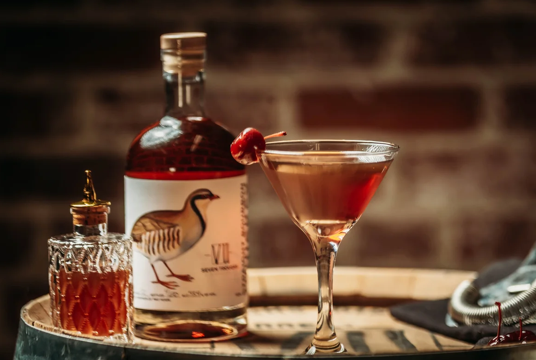
Thomas James “Tom” Adams built Seven Troughs Distilling Company around a demanding proposition: whiskey from Nevada should carry the character of Nevada. It should be made from regional grain, connected to the state’s history and produced by methods that predated modern industrial distilling. From its beginning in Sparks, Seven Troughs became an expression of Adams’s lifelong fascination with distillation and his determination to recover an early American whiskey tradition that had nearly disappeared.
Adams was born in 1974 and raised in Reno, where Nevada history became one of his enduring interests. He developed a fascination with distilling while still young. Yet before entering the spirits business, he worked as a geological engineer and designed roadways, experience that accustomed him to technical planning, mechanical problems and large projects.
Adams founded Seven Troughs Distilling Company in 2012 with his wife, Jessica. He deliberately built his distillery’s whiskey identity around historic nineteenth-century production techniques, including direct-fire pot distillation. The distillery’s name came from the Seven Troughs Mining District in Pershing County, where gold was first discovered in 1905. By 1907, four mining camps were established that made up the Seven Troughs Mining District. The district was prosperous and produced almost two million dollars in gold between 1908 and 1921. Unfortunately, as in many other mining towns, a decline started. By 1940, mining and milling operations came to an end and the towns simply faded back into the sandy desert. Even so, Adams chose the moniker to reflect the distillery’s deep roots to the state of Nevada and to honor those who came to the state seeking fortune and independence.
Establishing a profitable small distillery in Nevada before 2013, however, presented a legal obstacle. Distillers could distill, but they generally could not conduct tastings nor sell bottles directly to visitors. That wholesale-only system placed small producers at a serious disadvantage because they lacked the volume and distribution strength of established national companies. Fortunately, Nevada’s 2013 passage of Assembly Bill 153 created a workable craft-distillery framework, permitting qualifying producers to offer tastings and limited direct sales. Seven Troughs opened its Sparks distillery for tours and tastings shortly thereafter, becoming Washoe County’s first distillery and one of the first licensed distilling operations in the Great Basin since the nineteenth century. Its first commercial product was Recession Proof Moonshine, an unaged white whiskey made from corn and wheat grown near Winnemucca. The whiskey followed a nineteenth-century sweet-mash approach and immediately established the company’s central idea: Adams was not merely attaching Nevada names to conventional spirits, but constructing the products from regional ingredients and historical methods. The Seven Troughs process deliberately rejected many industrial efficiencies. Grain fermented in open wooden hogsheads, and the resulting wash passed through a direct-fired pot still rather than a modern steam-heated system. Adams designed the unusual still himself, drawing upon his technical experience, even though he was not a mechanical engineer. Direct fire and small batches demanded close attention, produced modest yields and made consistency more difficult, but they also preserved the full, forceful flavors Adams sought in early American-style whiskey.
The company gradually expanded beyond its original white whiskey to produce rum, vodka, and gin, yet whiskey remained central to Adams’s work. Seven Troughs Straight Bourbon Whiskey aged for at least three years after a production cycle that took roughly six days from grain through distillation. Adams valued the bourbon for its concentrated flavors, substantial alcoholic strength and underlying sweetness. Its weight and texture reflected the old production methods he had chosen rather than an attempt to imitate the lighter uniformity of mass-produced whiskey.
But Adams’s most ambitious historical project emerged from his study of Old Commissary, a barley whiskey produced in Nevada’s Ruby Valley beginning around 1862. The original spirit had served customers associated with Fort Ruby and the transportation routes crossing the region, but the distillery disappeared after railroads brought greater quantities of Kentucky bourbon westward. No working recipe, production handbook or known surviving bottle supplied Adams with an easy route to re-creation. He therefore approached Old Commissary as both an engineering problem and a historical investigation.
Adams released his recreation of Old Commissary in March 2015. The whiskey used 100-percent barley and fermented in wooden barrels whose interiors were treated with food-grade lime to add calcium and approximate the mineral character of Ruby Valley water. It was grain-forward, raw and markedly different from bourbon, with little emphasis on oak sweetness. Some of the whiskey went into Winter’s individually-made ceramic jugs, while later quantities were bottled in glass.
Nearly a decade-and-a-half later, Adams has established Seven Troughs Distillery as a beloved and well-supported member of the Sparks community. Its importance rests not on industrial volume but on the coherence of its purpose. Adams connects Nevada-grown grain, frontier research, mechanical ingenuity and hands-on production in a single distilling program. The result is a Nevada whiskey operation whose identity begins with the raw material, continues through the still and ends in bottles that preserves a deliberate link to the state’s past.
Sources:
Sparks Tribune, “Sparks Distillery Combines ‘Old School’ Process with Nevada’s ‘Enthralling’ History”, Kayla Anderson, March 29, 2017, sparkstrib.com
Northern Nevada Business Weekly, “That’s the Spirit: New Law Brings Boutique Distilleries”, November 11, 2013, nnbw.com
Moonshine Ink, “Distill, My Heart,” March 11, 2015, moonshineink.com
Travel Nevada, “Thirsty Nevada,” Eric Cachinero, November–December 2015, travelnevada.com
Contributed by Tracy McLemore, Fairview, Tennessee