Earl Brown


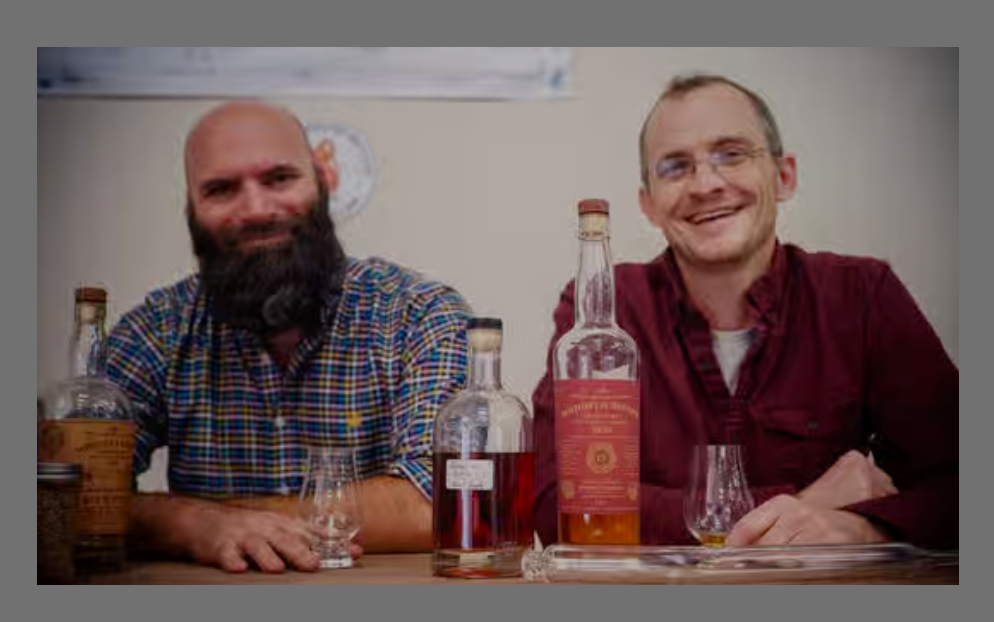
Earl W. Brown’s path into California whiskey began far from Oakland, in the Mattole Valley of Humboldt County along Northern California’s remote Lost Coast. Brown and Daniel Wright grew up together there as childhood friends, surrounded by farming families and a rural culture that emphasized growing, making, and preserving food. That background eventually became a foundation for their whiskey business: grain would be treated as an agricultural product with a distinct place of origin, not merely as an anonymous source of fermentable starch.
Brown and Wright maintained their friendship into adulthood and developed a shared interest in traditional spirits production. On a trip to Kentucky, they visited the Jim Beam distillery and saw a towering column still governed through computerized controls. Their own venture took a deliberately different direction, emphasizing small batches, direct sensory judgment, and a copper pot still. They founded Wright & Brown Distilling Company in 2014 and established it in West Oakland, becoming the first distillery to operate legally in Oakland since before Prohibition
Opening a distillery required patience before the first barrel could even begin to mature. California and federal law prohibited Brown and Wright from informally practicing distillation at home, yet regulators required them to install equipment at a licensed facility before final approval. Brown reported that the permitting process took approximately a year and a half. Once production began in 2015, the partners still faced whiskey’s defining business problem: everything they produced needed time in wood before it could generate revenue.
The centerpiece of the new operation was a 250-gallon copper pot still built by Vendome Copper & Brass Works. Brown concentrated on the company’s administrative and broader business responsibilities, while Wright served as head distiller, but Wright & Brown remained an exceptionally small and hands-on enterprise. Milling, mashing, fermentation, distillation, barreling, aging, and bottling all took place at the West Oakland facility. Friends and relatives helped with bottling during the company’s early years, and the founders waited nearly two years between launching production and having a mature product available for sale.
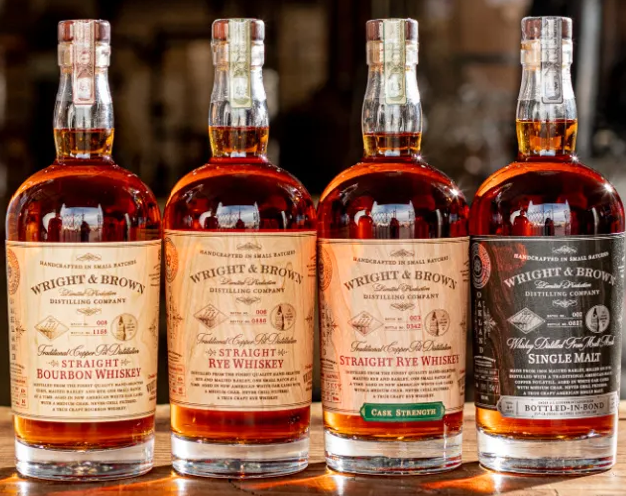
Wright & Brown released its first rye whiskey in October 2016. Made from scratch in Oakland, it was the city’s first legally-produced whiskey since Prohibition. The rye established the production principles that Brown and Wright continued to follow: pot distillation, non-GMO grain, substantial use of malt, on-site production, and maturation in new charred American oak. Rather than relying on external enzymes during fermentation, they used a high proportion of malted barley, allowing the malt’s natural enzymes to convert the grain’s starches into fermentable sugars.
Brown connected the distillery even more closely to his Humboldt County upbringing by obtaining grain from his family’s farm in the Mattole Valley. The farm grew organic, unmalted heritage rye varieties, which contributed floral and grassy qualities to the whiskey. When the family farm produced an insufficient yield, the distillery purchased rye from other organic family farms in Northern California. Additional malted rye came from Weyermann in Germany, while malted barley was sourced from California and Ireland.
The regular Wright & Brown Straight Rye eventually settled into a mash bill of 70 percent rye and 30 percent malted barley. It was aged for at least three years in No. 3-charred American white-oak barrels, bottled at 90 proof, and released without chill filtration. Its honors included a silver medal from the American Craft Spirits Association in 2018, a silver medal from the American Distilling Institute in 2020, a Good Food Award in 2022, and a gold medal at Whiskies of the World in 2024. These awards validated Brown and Wright’s belief that Northern California grain could give rye whiskey a recognizable regional identity.
The distillery followed its rye with bourbon in 2017. Wright & Brown Straight Bourbon used a high-rye formula of 65 percent corn, 23 percent rye, and 12 percent malted barley. The spirit was double-distilled in the Vendome pot still and matured for more than two years in 30- and 53-gallon No. 3-charred American oak barrels. Its balance of corn sweetness, rye spice, and malt richness distinguished it from bourbon purchased in bulk and bottled under a local label, because Wright & Brown produced the whiskey entirely in Oakland.
Brown’s agricultural connections later became central to a more specialized Heritage Bourbon. That whiskey combined organic corn grown in Woodland, California, with heirloom Gazelle rye grown on his family’s Mattole Valley ranch and malted barley grown in California. A 2024 Distillers’ Pick release from barrel No. 326 had matured for seven years in a 53-gallon, char-three American oak barrel and was bottled at its natural strength of 122.2 proof. It received a gold medal in the cask-strength bourbon category at the 2024 Whiskies of the World competition.
In the end, Earl Brown’s most consequential contribution lies in joining an urban distillery to the farming country in which he was raised. Through his family’s heritage rye, relationships with California growers, administrative leadership, and insistence on grain-to-glass production, he helped return legal whiskey making to Oakland and gave that whiskey a direct connection to Northern California soil.
Sources:
East Bay Express, “Oakland Has Its First Whiskey Distillery Since Prohibition,” Luke Tsai, September 29, 2015, eastbayexpress.com
San Francisco Chronicle, “Oakland’s First Whiskey Since Prohibition Hits Shelves,” Ethan Fletcher, October 14, 2016, sfchronicle.com
Alameda Magazine, “East Bay Whiskey Arrives From Home Base Spirits and Wright & Brown Distilling Co.,” Kristan Lawson, 2019, alamedamagazine.com
Wright & Brown Distilling Company, “About Us,” no author given, accessed August 30, 2026, wbdistilling.com
Oakland Voices, “West Oakland Distillery Wright & Brown Is Keeping It Clean by Producing Hand Sanitizer for First Responders,” Iris Crawford, April 6, 2020, oaklandvoices.us
Contributed by Tracy McLemore, Fairview, Tennessee