
Park Beam


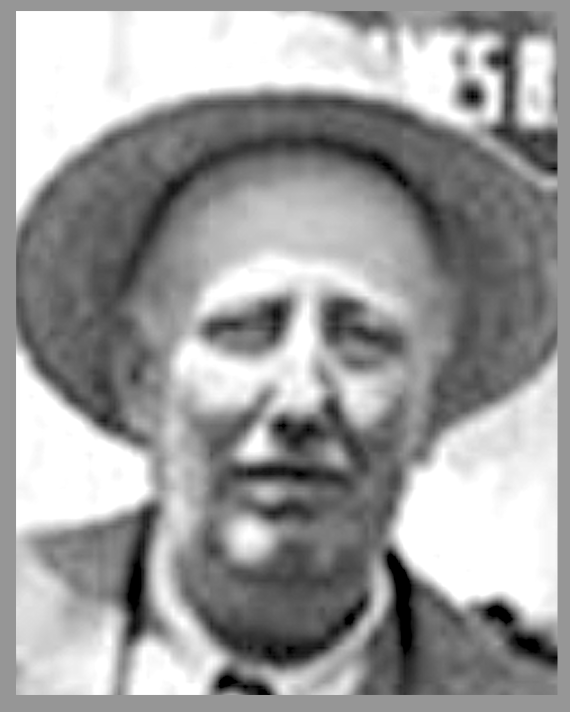
Photo of Park Beam provided by Beam Distilling
William Parker “Park” Beam spent much of his career in the shadow of his older brother, James Beauregard “Jim” Beam, whose name became synonymous with Kentucky bourbon. Yet Park was an accomplished master distiller in his own right who played a central role in the family's whiskey business during its expansion in the late nineteenth and early twentieth centuries. While Jim concentrated on the commercial operations, Park supervised the production of the whiskey itself, increasing output fourfold during his career. His contributions extended beyond his own work at the distillery through two sons who continued the family's whiskey-making tradition, and helped establish the next generation of American bourbon producers.
Park was born in 1868 in Nelson County, Kentucky, the son of David M. Beam, a third-generation whiskey distiller whose family had been producing spirits in Kentucky since the eighteenth century. His grandfather, David Beam, and great-grandfather, Jacob Beam, had established the foundation of a business that developed into one of the most enduring family enterprises in whiskey history. Park grew up alongside his older brother Jim and their other siblings in a household closely associated with whiskey production. Their sister Nannie later married Albert Hart, who also became involved in the family business.
The family's whiskey-making heritage had begun in 1795, when Jacob Beam began commercially selling whiskey produced from grain grown on his Kentucky farm. His son David expanded the operation during the early nineteenth century, increasing production as demand for Kentucky whiskey grew. In 1853, David M. Beam assumed control of the business and subsequently relocated the distillery to Nelson County, positioning it near railroad transportation. This decision allowed the family's Old Tub whiskey to reach markets beyond Kentucky and helped establish the brand's reputation throughout the country.
Park thus entered the whiskey business during an era when bourbon production was becoming increasingly industrialized. Larger distilleries, improved equipment, and expanding railroad networks allowed established producers to manufacture and distribute whiskey on a greater scale than any generations had ever achieved before. The Beam family participated in this development while maintaining the production methods that had distinguished its whiskey for decades. Park learned the practical requirements of operating a distillery, including grain preparation, fermentation, distillation, and the production of whiskey suitable for maturation in oak barrels.
In 1889, Park married Susan Mary Smith, commonly known as Mary. The couple subsequently became the parents of two sons, Earl Beam, born in 1906, and Carl Beam, born in 1909. Both sons eventually entered the whiskey industry and became important figures in Kentucky bourbon production as well. Their careers would extend the family's distilling heritage into the middle decades of the twentieth century and beyond.
In 1892, David M. Beam retired at the age of fifty-nine and transferred control of the family distillery to his sons Jim and Park. Their brother-in-law Albert Hart joined Jim in managing the commercial side of the enterprise, while Park assumed responsibility as master distiller. The arrangement established a division of responsibilities that allowed the business to concentrate on both whiskey production and commercial expansion of whiskey produced in greater quantities.
Unfortunately, in January 1920, the implementation of National Prohibition brought the family's commercial whiskey production to a halt. The Eighteenth Amendment and the Volstead Act prohibited the manufacture and sale of alcoholic beverages for ordinary commercial purposes, forcing the distillery to close. Park, Jim, and other members of the Beam family were compelled to pursue occupations outside their established whiskey business. The interruption ended nearly three decades of Park's leadership as master distiller at the family's Nelson County operation.
Prohibition remained in effect until December 1933, when ratification of the Twenty-first Amendment restored the legal manufacture and sale of alcoholic beverages. By that time, Jim Beam was approaching seventy years of age, but he remained determined to reestablish the family's whiskey enterprise. He joined Park and his son, T. Jeremiah “Jere” Beam, in acquiring the former Murphy-Barber Distillery property at Clermont, Kentucky. The location offered access to the same railroad branch serving the family's earlier operation, with the additional advantage of being closer to the main railroad line.
The Beam family reconstructed the distillery and resumed whiskey production during the mid-1930s. Their efforts brought together several generations of family experience, including Park's extensive knowledge of distillation and the contributions of his sons Earl and Carl. The operation became the James B. Beam Distilling Company, and its whiskey was marketed under the family name. Financing the revived distillery required outside investment, and the company obtained capital from Harry Homel, Oliver Jacobson, and Harry Blum. The arrangement provided resources necessary to sustain production while newly distilled bourbon matured in barrels before it could be sold. The business subsequently developed under the leadership of Jere Beam, while Park's sons became increasingly involved in its distilling operations.
Park eventually left the Clermont operation and accepted employment at the Shawhan Distillery in Bardstown, Kentucky, which later became associated with the Waterfill & Frazier name. But his departure from Jim Beam did not end his family's involvement in the company. His son Carl, affectionately known as “Shucks,” became master distiller at Clermont, while Earl served as assistant master distiller. Their responsibilities continued the technical tradition established by their father and earlier generations of Beam distillers. Carl's sons, Baker and David Beam, subsequently entered the industry, extending the family's direct involvement in whiskey production yet another generation.
Park Beam's achievements received formal recognition in 2015 when he was inducted posthumously into the Kentucky Bourbon Hall of Fame. The honor acknowledged his contributions as a master distiller, his role in expanding the family's whiskey production, and his place in the multigenerational history of Kentucky bourbon. His induction placed him alongside other distinguished members of the Beam family whose work helped establish and preserve the state's whiskey-making heritage.
Although Jim Beam became the public identity of the family business, Park Beam's career demonstrated the importance of the distiller working behind that name. He supervised the production of Old Tub bourbon during a period of substantial growth, participated in rebuilding the family enterprise following Prohibition, and passed his knowledge to sons who became accomplished distillers in their own right. His contributions helped establish the manufacturing foundation of the modern Jim Beam organization while extending the Beam family's influence throughout Kentucky's bourbon industry. Park Beam's legacy remains an important part of the history of American whiskey, representing the technical knowledge, production experience, and family continuity that sustained the Beam distilling tradition for more than two-and-a-quarter centuries.
Sources:
Beam Family Reunion, “The Beams, America's First Family of Bourbon”, Charles K. Cowdery, 2001, beamreunion.com
Oxford University Press, “Jim Beam”, The Oxford Companion to Spirits & Cocktails, spiritsanddistilling.com
James B. Beam Distilling Company official website, beamdistilling.com
Beam Suntory, “Jim Beam: Brand DNA and History”, founders.beamsuntory.com
Contributed by Tracy McLemore, Fairview, Tennessee
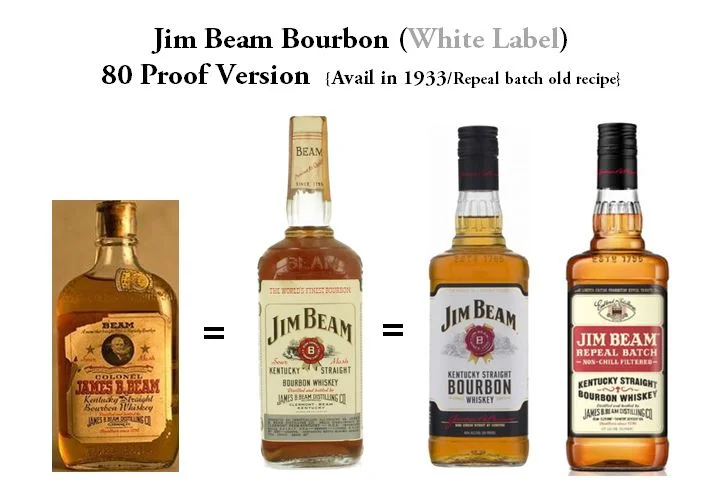
Original Version of James Beam in 1933, 1980s version of Jim Beam White, and both the current bottle for Jim Beam White and the Jim Beam Repeal Batch (using the Original recipe and Non-Chill filtered). All four versions are bottled at 80 Proof and aged 4 Years.


Original Version of Bonded Beam in 1933, 1980’s Version of Jim Beam Bonded (Gold Label) and the current bottle for Jim Beam Bonded (Gold Label). All three versions are Bottled at 100 Proof and Aged 5 Years.
Original Version of James Beam Rye introduced in 1938, 1980s Version of Jim Beam Rye (Beige Label), and the current bottle for Jim Beam Rye Pre-Prohibition Style (Green Label). All three versions are made with exactly 51% Rye Grain and Bottled at 80 Proof and aged 3 to 4 Years.