Phil Brandon


Phillip D. Brandon is a fifth-generation Arkansan who built Rock Town Distillery on a plain, stubborn premise: Arkansas had the grain, the water, and the climate to make serious American whiskey. It made no sense that the state was without a legal distillery to prove it. By the time Rock Town opened in Little Rock in 2010, it was widely described as Arkansas’ first legal distillery since Prohibition, a nearly unbelievable fault that was righted because Brandon decided to trade corporate certainty for the slow, capital-heavy logic of whiskey.
Phil was born in Little Rock in June of 1964, and raised there, with family roots that stretch back as far as the flat Arkansas horizon. That local identity was not decorative in his story; it became the reasoning behind Rock Town’s name itself, chosen to mirror “Little Rock,” as well as point out the distillery’s long-running emphasis on being a true grain-to-glass operation anchored in Arkansas agriculture. Phil’s formal education includes a BS in Electrical Engineering from Texas A&M University, and an MBA from the University of Arkansas. That engineering-and-business pairing matters in a distillery founder because it maps neatly onto the two jobs that whiskey demands: make consistent spirit, and keep the enterprise financially alive long enough for barrels to mature.
After school, Brandon built a career in corporate America, specifically in working for Alltel, the Little Rock-based telecommunications firm. The company’s 2009 purchase by Verizon was a hinge that forced a new career path. Brandon chose a completely different route, at that point, leaving his corporate job to pursue distilling. Finally, 2009 would be the year that Arkansas would be put on the whiskey map. One year later, Rock Town Distilling was born.
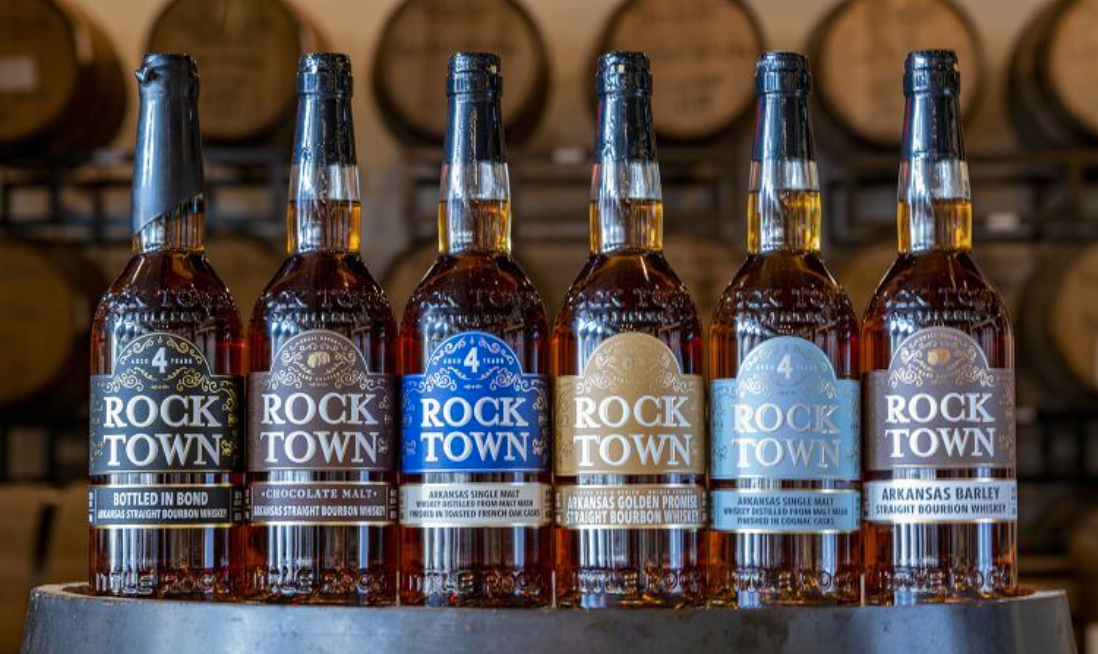
When Rock Town opened in downtown Little Rock, it was immediately framed as a whiskey-first distillery, even though a young distillery often has to sell other spirits while whiskey ages. His basic argument was simple: Arkansas sits in a maturation climate broadly comparable to Tennessee and Kentucky. So Brandon studied the use of other levers, such grain selection and mash-bill experimentation, to shape and refine a distinct Arkansas profile. But the early years were also about proving legitimacy in an industry where medals and ratings function like currency. 2013 was the first time the distillery gained major internationalrecognition, including awards for its bourbon at the San Francisco World Spirits Competition. The distillery’s Arkansas Bourbon also won high-profile recognition as “US Micro Whiskey of the Year” in Jim Murray’sWhisky Bible. Whatever one thinks of awards culture, the practical effect is real: it gave Rock Town credibilitybeyond Arkansas and helped validate Brandon’s bet that Arkansas could compete in a category dominated by older states.
As the distillery matured, Rock Town’s whiskey identity widened without abandoning its core. Brandon used anniversaries as moments to expand what “Arkansas whiskey” could mean, most notably with a ninth-anniversary release described as the state’s first-ever single malt. That kind of release says something specific about Brandon’s operating style—he treats Rock Town not as a single flagship bourbon line, but as a workshop where mash bills, barrel programs, and categories can evolve over time. The way Brandon talks about Rock Town across interviews and profiles also reinforces an engineering mindset applied to flavor. His technical training applies to his passion for whiskey, and it captures a key Rock Town mantra: “We’re makers, not fakers,” a direct statement of grain-to-glass intent. The statement also leans into what Rock Town built its name on in the whiskey world: local grain, on-site milling, and a willingness to demonstrate through “flavor grain”releases and mash-bill variations how small percentage shifts can push bourbon in different directions.
Brandon lives in Little Rock, with his wife Diana, to whom he has been married for 35 years (at the writing of the source article). Their partnership also appears publicly through civic life. The Arkansas Symphony Orchestra announced Phil and Diana Brandon as co-chairs for its Opus Ball XLI, and included specific personal details about music: Phil grew up playing the flute, and Diana holds a degree in organ performance from the University of North Texas. In other words, whiskey is not the only craft discipline in the Brandon household, and their public philanthropy centers on music education as well as local community leadership.
The most revealing part of Brandon’s arc, though, is the timing. He left corporate life in 2009, founded Rock Town in 2010, and then did the one thing whiskey founders cannot fake: he kept the business alive year after year while barrels quietly turned new make into something worth bottling. By the time Rock Town was releasing anniversary whiskeys and building a national reputation, the distillery was no longer simply “the first since Prohibition.” It has now become what Brandon set out to build in the first place: a working Arkansas whiskey house with the credibility that only time, repetition, and proof in the glass can supply.
Sources:
Distilled Spirits Council of the United States (DISCUS), “Phil Brandon”, distilledspirits.org
Rock Town Distillery official website, “About Us”,rocktowndistillery.com
Arkansas Money & Politics, “AMP Influencers: Phil Brandon, Rock Town Distillery” January 15, 2026, armoneyandpolitics.com
About You Magazine, “An Arkansas Whiskey Tradition”,Dustin Jayroe, July 30, 2019
Distiller.com, “Rock Town Distillery: A Decade of Hometown Spirits…”, Jake Emen, February 4, 2021
Arkansas Symphony Orchestra, “ASO Announces Phil & Diana Brandon as Opus Ball XLI Co-Chairs”, arkansassymphony.org
Arkansas Business Leadership Academy, “2022 Spring Speakers”, ableadershipacademy.com/2022-spring-speakers
RackHouse Whiskey Club, “Arkansas Bourbon is the next big thing”, July 9, 2023, rackhousewhiskeyclub.com
Contributed by Tracy McLemore, Fairview, Tennessee