Ryan Burchett


Ryan Paul Burchett did not grow up in the distilling industry, nor did he begin his working life intending to make whiskey. He grew up in Eastern Iowa and graduated with BS degrees from both Iowa State University and Mississippi State University. After college, Ryan, who was born in September of 1974, built his career in television, working as an on-screen meteorologist, forecasting the weather for multiple communities along the Mississippi River. His broadcasting career included positions at KIMT in Mason City, Iowa; KGAN in Cedar Rapids; KLFY in Lafayette, Louisiana; and KWQC in the Iowa/Illinois ‘Quad Cities’ area. He eventually served as KWQC’s chief meteorologist, becoming a familiar presence on the television sets of Eastern Iowa and Western Illinois.
Meanwhile, Ryan’s brother Garrett, who is seven years younger than his brother, became a civil engineer, designing and constructing roads in Texas. Yet during the national revival of small, independently-owned spirits producers in the late 2000s, the brothers decided to investigate the possibilities of operating their own distillery. They spent approximately two years researching the industry, obtaining training and preparing a business plan. Neither brother had professional distilling experience when the process began, but their study turned an unusual idea into a viable proposal. When local financial institutions were willing to help finance the plan, both men left their established careers and committed themselves to the venture which they aptly named Mississippi River Distilling Company.
Te Burchett brothers’ distilling venture opened in Le Claire, Iowa, in late 2010, with Ryan and Garrett Burchett acting as its co-owners and distillers. Its location on North Cody Road placed the operation directly beside the Mississippi River near the birthplace of William “Buffalo Bill” Cody. The company name established its geographic identity, while the Cody Road name connected its principal whiskey line to Le Claire’s history. Using a German-built hybrid still they named “Rosie,” Garrett brought an engineer’s practical knowledge to the new operation. The arrangement thus united two markedly different professional backgrounds in a company built around Iowa grain and Mississippi River water.
The distillery initially produced clear spirits while its whiskey matured, but whiskey became the center of its long-term identity. Ryan and Garrett developed a grain-to-glass system in which the company controls production from raw grain through milling, fermentation, distillation, maturation and bottling. Corn, wheat, rye and barley come from nearby farmers, and the company identifies the agricultural sources associated with its batches. The grain is milled into flour, cooked, fermented for approximately a week and distilled in Rosie. Ryan uses a narrow distillation cut to select the portion intended for maturation, after which the spirit enters barrels stored at the distillery. Bottles carry batch and bottle numbers, allowing consumers to trace the whiskey and the grain behind it.
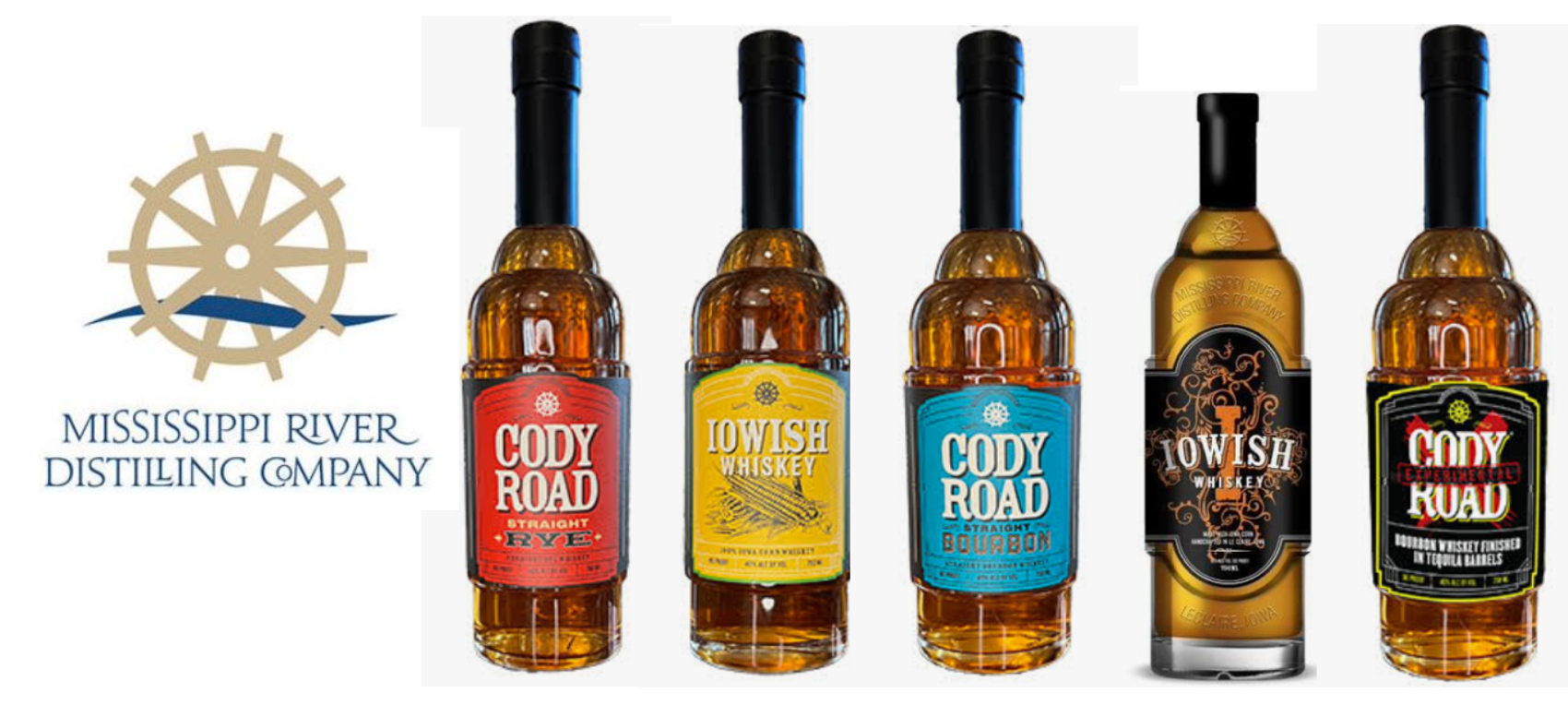
Rosie’s construction gives the Burchetts considerable latitude as distillers. Built specifically for Mississippi River Distilling Company, the still combines a German boiling pot with two rectification columns whose plates can be engaged or disengaged. The brothers can configure it for pot-still-style whiskey production or use additional plates when making a cleaner, higher-proof spirit. That flexibility supported experimentation, but the company’s principal whiskey eventually took recognizable form as Cody Road Bourbon. The distillery also developed Cody Road Rye and a range of limited and seasonal whiskeys. Its Stone Fence expression combined rye whiskey with local apple cider rather than relying exclusively on water for proofing, linking one experimental release to a drink associated with Buffalo Bill Cody.
Building a whiskey company in Iowa required Ryan to work outside the stillroom as well. When Mississippi River Distilling Company opened, state law sharply restricted what a small distillery could offer visitors. Guests could receive only two quarter-ounce samples, and purchases were limited to two bottles per person per day. Distilleries could not operate in the same manner as Iowa breweries and wineries, making it difficult to create a destination where customers could remain, order drinks and return regularly. Ryan and Garrett spent roughly five years pressing for legislative change. Finally, a law signed in May 2017 and effective July 1 of that year allowed Iowa distilleries to sell spirits by the glass, transforming both their own business and the opportunities available to other producers in the state. Mississippi River Distilling Company was among the first Iowa distilleries prepared to use the new privileges. After passage of the law, the brothers were able to add indoor seating and a patio, and the Cody Road Cocktail House turned the Le Claire production site into a place where guests could have a mixed drink, attend live music and spend time overlooking the river. The legal change also made new products possible. A bourbon Old Fashioned created for the bar became so popular that the company now bottles it as a ready-to-drink cocktail. Bourbon, sugar and bitters are blended, returned to oak for an additional period and then filtered and bottled. The product grew into Iowa’s leading ready-to-drink cocktail, while Cody Road Bourbon remained the distillery’s best-selling straight spirit.
Ryan, who is also an Ordained Deacon and remains very active in his church, is married to Monica Burchett (née Stuart) who also works at the distillery as the Event Manager. The Burchetts enjoys their three children, and despite their nearly nonstop duties at their company, both Ryan and Monica list family time with each other and with their kids, along with their faith, as the most important and rewarding aspects of their lives.
More than fifteen years after he abandoned a successful broadcasting career, Ryan Burchett had helped establish Mississippi River Distilling Company as an enduring Iowa spirits producer. The business remained family-owned, concentrated its distribution in the Midwest and continued to perform its core production work on-site. Its whiskey carried the names of local farmers, local grain and a road tied to one of Le Claire’s most famous historical figures. Burchett’s work also extended beyond his own bottles: his campaign for modernized state laws helped create a more workable hospitality model for all Iowa distilleries. The meteorologist who once interpreted the conditions surrounding the Mississippi River ultimately built a second career from the water, agriculture and history found along its banks.
Sources:
Beverage Master, “Mississippi River Distilling Company: Driving Success Through Authenticity,” Gerald Dlubala, September 30, 2024, beverage-master.com
RackHouse Whiskey Club, “Whiskey on the River at Mississippi River Distilling Company,” September 5, 2018, rackhousewhiskeyclub.com
KWQC, “Local Business to Celebrate New Iowa Distillery Law,” Ashley Holden, July 7, 2017, kwqc.com
Iowa PBS, “Keeping the Doors Open in Creative Ways—Ryan Burchett,” Paul Yeager, February 2, 2021, iowapbs.org
Craft Spirits Magazine, “Mississippi River Distilling to Add Second Location in Davenport, Iowa,” staff, March 16, 2022, craftspiritsmag.com
Mississippi River Distilling Company, “Meet Our Team,” accessed August 27, 2026, mrdistilling.com
Contributed by Tracy McLemore, Fairview, Tennessee