Marc Christensen



Marc Edward Christensen was born in February of 1966 and grew up in Nampa, Idaho, in a family whose livelihood placed him surprisingly close to the agricultural roots of distilling. His father owned an agricultural-supply business that sold pumps, pipe, hydraulic hoses, irrigation equipment and other supplies to farmers, ranchers and wineries in southwestern Idaho. Christensen’s first job was working in his father’s warehouse, and after obtaining an Idaho driver’s license at age 14, he began delivering irrigation equipment to farms and wineries around the region. His father was also an amateur winemaker, making small amounts of wine at home, so fermentation was familiar to Christensen long before it became a profession.
In about 1983, Christensen’s parents moved from Nampa to a home along the Snake River, below Ste. Chapelle Winery in what became Idaho’s Snake River Valley wine region. A few years later, two men from Ketchum established a nearby distillery making European-style eaux-de-vie from local fruit. Christensen was then in college and pursuing an entirely different career, but the distillery and its Austrian still fascinated him. He later attended the University of Utah, studying economics, and during his years in Utah watched the state’s craft-beer industry develop. The idea of creating a distillery remained with him even as his professional life moved in another direction.
In 1993, Christensen founded the company that became OTW Safety, a manufacturer of plastic traffic and event barricades, and developed it into a substantial business. When he eventually decided to pursue distilling seriously, he did not rely solely upon the knowledge he had absorbed around Idaho wineries. He attended distilling courses at Heritage Distilling in Gig Harbor, Washington, and the Artisan Craft Distilling Institute, and traveled through Kentucky meeting distillers and studying the industry.
The company that became Dented Brick began under the considerably less colorful legal name Salt Lake City Distillery, LLC. Finding a suitable site near downtown Salt Lake City proved difficult, and Christensen spent roughly eight months working with a real-estate agent before being summoned one morning to a property at 3100 South Washington Street in South Salt Lake. The property contained an old brick house and had been occupied by a family of well-drillers. Most important for a future distillery, it possessed its own artesian well, nearly 300 feet deep and with approximately 28psi of head pressure. The naturally-mineralized water proved well-suited to fermentation and became central to Christensen’s plans for the distillery.
The old house also supplied the new company with its name. While examining the building before construction began, Christensen and his associates noticed bullet damage across bricks at the front of the house. Research into the property’s history revealed that one of the well drillers had been killed in a gunfight there. Christensen decided to preserve some of the damaged bricks and incorporate them into the new distillery building. Those bullet-scarred bricks became the inspiration for the name Dented Brick Distillery, tying the new business directly to the property and, particularly, to the well that made the location so attractive.
There was another historical connection waiting to be uncovered. Research by the distillery found that pioneer Hugh Moon had once owned the land. Moon, an English immigrant who arrived in America with other converts to the Church of Jesus Christ of Latter-day Saints, distilled whiskey in nineteenth-century Utah and purchased the property in 1856. The historical connection eventually provided Dented Brick with both inspiration and names for its whiskey. The company produced Hugh Moon White Whiskey and later Moon’s Best Rye Whiskey, linking a modern Utah distillery with one of the state’s earliest recorded whiskey makers.
Construction eventually produced a purpose-built, approximately 14,000-square-foot distillery equipped with a 500-gallon Vendome copper still. Dented Brick first distilled spirits on Leap Day, February 29, 2016, and formally opened in March. Its initial commercial emphasis included Antelope Island Rum, followed by vodka and gin, while whiskey required patience because barrels needed time to mature. From the beginning, however, grain whiskey was part of Christensen’s plan; contemporary accounts reported that the company intended to begin filling whiskey barrels during its first year.
Rye ultimately became Dented Brick’s principal locally-distilled whiskey. Moon’s Best was made from 100-percent rye and distilled on the company’s Vendome equipment before aging in charred oak. By 2021, Christensen identified Moon’s Best as the Dented Brick product of which he was particularly proud. The whiskey had been aged at the distillery for more than two years, and its identity combined the grain, the Salt Lake City property and the Hugh Moon story into a product distinctly connected with Utah. Moon’s Best earned a gold medal at the 2021 SIP Awards and a silver medal at the 2021 Bartender Spirits Awards.
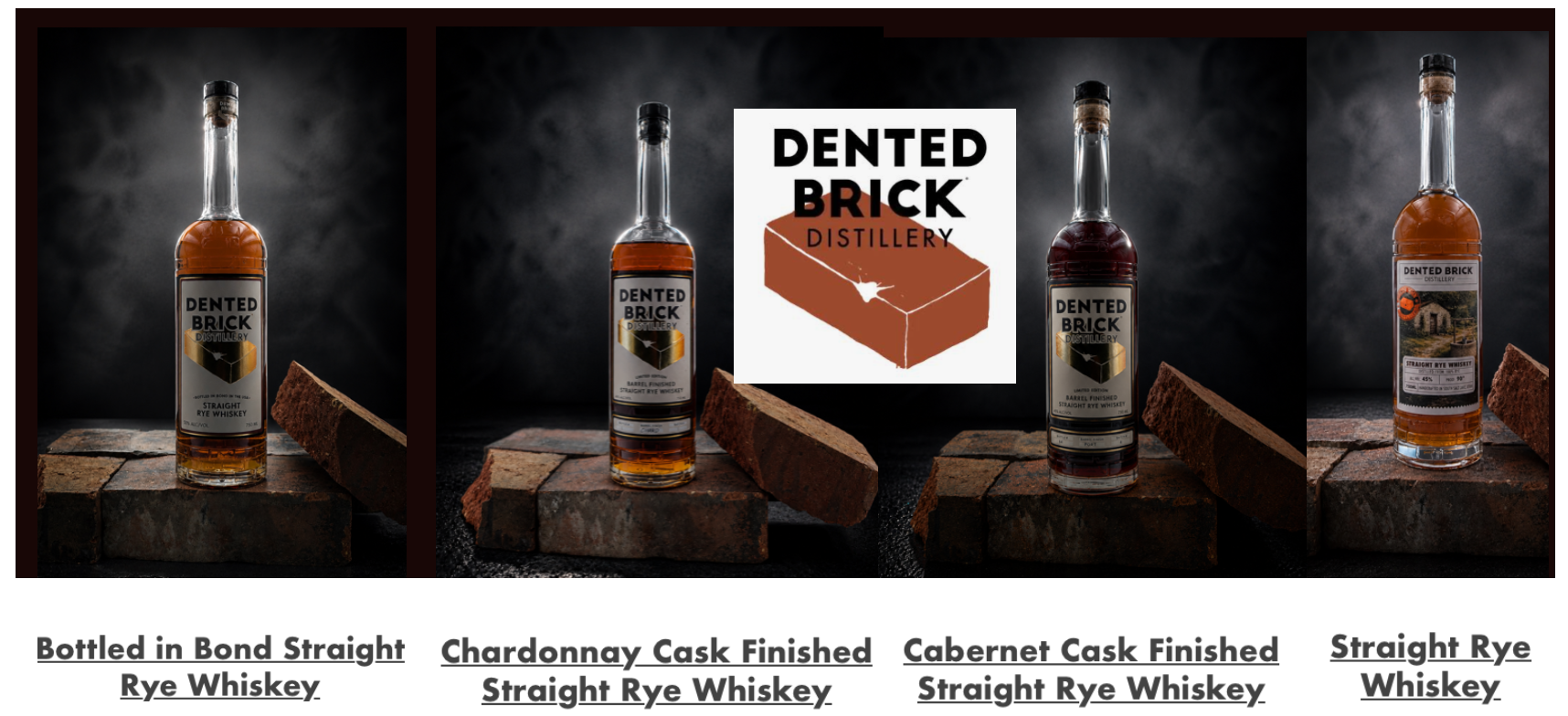
The whiskey program subsequently expanded beyond Moon’s Best. Dented Brick’s current Straight Rye Whiskey uses a mash bill of 100-percent unmalted rye, milled, mashed, fermented and distilled at the South Salt Lake facility. It spends at least two years in new American oak barrels before being proofed with the distillery’s limestone-filtered artesian water. Dented Brick has also developed Cabernet-, Chardonnay- and Port-cask-finished versions of its straight rye, extending the maturation of its rye whiskey in former wine barrels.
Perhaps the clearest evidence of the maturation of Dented Brick’s whiskey operation is its Bottled-in-Bond Straight Rye Whiskey. That expression is distilled and bottled at Dented Brick, aged for a minimum of four years and bottled at the required 100 proof. In 2026, the distillery also released a single-barrel Bottled-in-Bond Straight Rye selected from an individual barrel, demonstrating how far its whiskey inventory had developed from the barrels Christensen was preparing to fill a decade earlier. The company additionally offers Dented Brick Craft Whiskey, which combines bourbon sourced from Indiana with Dented Brick’s own rye and is proofed with the same artesian water that originally attracted Christensen to the property.
By 2026, Dented Brick had reached its tenth year of operation at its original South Salt Lake location. What began with memories of Idaho vineyards, an intriguing Austrian still and an interest in fermentation eventually became a Utah distillery whose identity rests heavily on grain, water and place. The old brick house is gone, but some of its damaged bricks survive in the distillery walls, while water from the well beneath the property continues through the mash, fermentation and proofing of Dented Brick’s whiskey.
Sources:
Got Rum? Magazine, “Exclusive Interview with Marc Edward Christensen, Salt Lake City Distillery, LLC (dba Dented Brick Distillery),” Margaret Ayala, July 10, 2019, gotrum.com
Utah Stories, “Dented Brick Distillery – A Well, A Will and Sweet Serendipity,” Pepper Provenzano, May 26, 2016, utahstories.com
Utah Stories, “The Great Story of Dented Brick Distillery,” Heather L. King, November 4, 2021, utahstories.com
Dented Brick Distillery official website, dentedbrick.com
Bartender Spirits Awards, “Dented Brick Distillery – 2021 Winners”, 2021, bartenderspiritsawards.com
U.S. Securities and Exchange Commission, “Salt Lake City Distillery, LLC, Form D,” 2025, sec.gov
Contributed by Tracy McLemore, Fairview, Tennessee