Steven Day



Steven A. Day was born in June of 1975 and grew up in a small, rural town in Illinois which was, ironically, “dry.” It was an unlikely beginning for a future whiskey maker. But science attracted him early, and he took advanced biology courses in high school before eventually pursuing medicine. Day attended medical school at the University of Minnesota, which is where he first met his future wife, Debra (née Poulin). Day then completed an internship in internal medicine and a neurology residency at Washington University in St. Louis. He subsequently completed a fellowship in electrodiagnostics and neuromuscular medicine at the Cleveland Clinic and became board-certified in neurology and neuromuscular medicine.
By then Steven and Debra had married and they moved west together in 2007, and Portland, Oregon was the place they chose to put down roots. Debra brought her own professional background to the partnership as a certified public accountant, expertise that would eventually become extremely valuable in calculating the ever-changing assets and liabilities associated with operating a distillery. Steven and Debra have no children, a detail Day has addressed humorously by referring to the whiskey barrels as the couple’s children.
Portland introduced Day to a thriving craft beverage culture. He had been a homebrewer, but his preference by then increasingly turned toward whiskey, helped along by Portland bartenders who were reviving historic and pre-Prohibition cocktails. Once he had fully acquired the “whiskey bug,” Day approached whiskey much as he had medicine: he studied it very seriously, collecting books, magazines, and technical material, visited distilleries, then he began learning both the science and practical realities of whiskey production. Soon he supplemented his independent study with formal and practical instruction by attending a course at Portland’s New Deal Distillery. He then spent a week learning at Dry Fly Distilling in Washington, and then later attended a course at KOVAL Distillery in Chicago, followed by courses at Moonshine University in Kentucky. He also traveled to Scotland, touring distilleries and observing a whiskey culture in which production facilities were often situated in rural areas rather than urban industrial districts. The experience helped shape his conviction that his own distillery should stand close to the farms producing its grain.
In 2013, Steven and Debra purchased property near Dayton, Oregon, roughly 30 miles southwest of Portland in the heart of the Willamette Valley. The location placed their future distillery amid the agricultural landscape that Day wanted his whiskey to represent. The facility eventually included a new production building and an existing barn converted for barrel storage, with a tasting room added as the whiskey became ready for sale. The distillery was licensed in 2016, and its name—Branch Point—expressed the idea of an unexpected decision that changes the direction of a person’s life. For Day, becoming a distiller while continuing his medical career was precisely such a change.
From the beginning, Branch Point differed from many craft distilleries by concentrating exclusively on whiskey rather than producing vodka or gin to generate revenue while barrels aged. Day also rejected sourcing finished whiskey. Approximately 75 percent of Branch Point’s grain comes directly from local Oregon farms. Once it arrives at Branch Point, the grain is mashed, fermented, and distilled into whiskey. Then it is matured, and eventually bottled onsite.
Day designed his production methods around traditional whiskey making rather than technological shortcuts. Branch Point uses grain-in fermentation, distillers malt, open-top fermenters, relatively slow fermentation, double copper-pot distillation, low barrel-entry proofs, and non-chill filtration. His stills were built by Vendome Copper & Brass Works in Kentucky and configured as relatively simple pot stills suited specifically to whiskey.
One of Day’s most important decisions resulted from an agricultural obstacle. He initially wanted to make a local rye whiskey, but Willamette Valley farmers producing soft white winter wheat, and regarded rye as a contaminant. As such, they were reluctant to grow it nearby. So Day instead turned to triticale, a hybrid of wheat and rye that he had encountered while learning at Dry Fly. A neighboring farmer was already growing the grain, giving Branch Point the local ingredient Day needed. The resulting TRIT Straight Whiskey became the distillery’s signature expression, combining some of rye’s spice with characteristics closer to wheat and earning 90 points from Whisky Advocate as well as medals at several spirits competitions.
Branch Point’s whiskey program has continued to expand beyond TRIT. Day developed Oregon Wheat Whiskey from locally grown soft white winter wheat and a Single Pot Still Oregon Whiskey inspired by the Irish tradition, using a combination of malted and unmalted barley. The Single Pot Still expression also earned 90 points from Whisky Advocate. The objective remained consistent across the range: Day wanted the grains and agricultural character of Oregon to remain evident rather than imitate whiskey already made elsewhere.
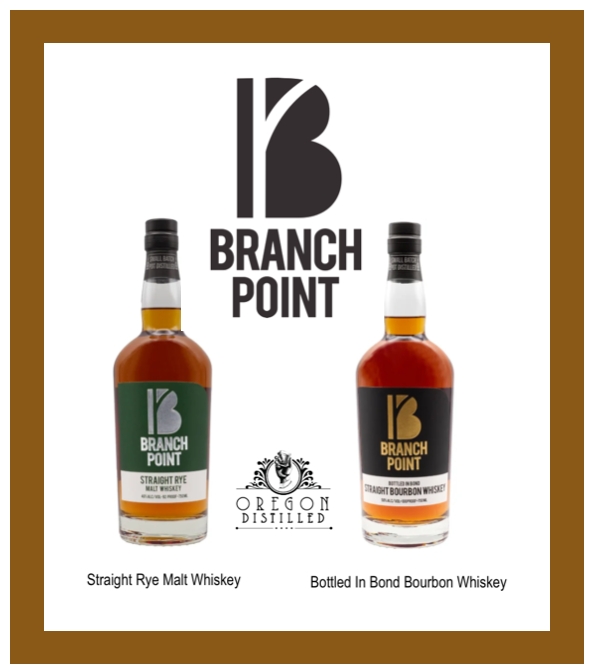
Bourbon eventually became another part of that philosophy. Branch Point’s current Bottled in Bond Straight Bourbon uses 67 percent organic sweet white corn, 18 percent local triticale, and 15 percent distillers malted barley. It is double-distilled in copper pot stills, enters new American oak at 110 proof, and the eight-year expression is matured in #3-char barrels before bottling at the federally prescribed bottled-in-bond strength of 100 proof. The unusual inclusion of locally grown triticale allows Day to produce an unmistakable bourbon while maintaining Branch Point’s emphasis on Oregon agriculture.
Day has continued practicing medicine while running Branch Point with Debra. Yet, a decade after Branch Point began distilling, Steven Day remains its distiller, and the company continues operating at its rural Dayton location. Its whiskey portfolio now also includes older limited releases, smoked-malt expressions, and specialty cask finishes. The development of eight-year whiskey is particularly significant for a craft distillery founded only in 2016: Day has remained in place long enough for barrels filled near Branch Point’s beginning to mature into some of its most important releases. His original branch point has therefore become something considerably more permanent—a decade-long effort to establish whiskey made from Oregon grain, distilled in Oregon, matured in Oregon, and intended to taste like it came from nowhere else.
Sources:
Branch Point Distillery official website, branchpointdistillery.com
American Mash & Grain, “Branch Point Distillery”, Meghan Swanson, September 1, mashngrain.com
Sip Magazine, “Branch Point Distillery Zeros in on Oregon Whiskey”, Rusty Rae, May 3, 2019, sipmagazine.com
Whisky Advocate, “Oregon’s Whiskey Makers”, whiskyadvocate.com
Empower Clinical Research, “Steven A. Day, MD,” accessed August 16, 2026, empowerclinicalresearch.com
Contributed by Tracy McLemore, Fairview, Tennessee