Matt Eau Claire


Matthew D. Eau Claire was born in May of 1974. Although little public information has been shared regarding his early personal life, he spent the first quarter-century of his professional life in software programming, data and enterprise architecture. It was work that gave him business and technical experience before he even thought of entering the spirits industry as a career. Away from work, however, Eau Claire developed an increasingly serious interest in food and fine spirits. A taste of single-malt Scotch at a friend’s house became an important early experience: the quality and smoothness surprised him and encouraged him to explore spirits meant to be appreciated on their own rather than simply mixed into cocktails.
Eau Claire’s interest developed over more than 20 years of travel. He and his wife, Stephanie, visited distilleries while traveling in the United States and abroad, including trips to Scotland and France, and Eau Claire became an enthusiastic collector of premium spirits. He also experimented with brewing beer before turning to distillation. Eventually, friends recognized the depth of his interest and pooled their money to give him a small still for Christmas, providing the equipment that transformed years of curiosity into hands-on experimentation.
His first experiment established the unconventional approach that later defined Clear Water Distilling. Eau Claire fermented apples, pears and other fruit and combined the resulting wash with red and white wines before distilling it, essentially beginning with the components of sangria. The result impressed his friends enough to encourage further experimentation. Eau Claire initially regarded the spirit as an eau-de-vie, but as he altered the formula by incorporating molasses and briefly conditioning the spirit in oak, it became increasingly difficult to place within a traditional spirits category. That difficulty did not discourage him however; in fact, it became the foundation of his business idea.
Clear Water Distilling Company emerged from Eau Claire’s belief that spirits did not always need to remain inside the familiar boundaries separating whiskey, rum, brandy, gin and other categories. The company name was also unusually personal. “Eau Claire” translates from French as “clear water,” making Clear Water Distilling essentially an English rendering of the founder’s surname. Matt and Stephanie originally hoped to locate the distillery in Lehi, Utah, where they lived, but zoning requirements eventually led them to an industrial space at 564 West 700 South in neighboring Pleasant Grove.
Opening a distillery there required Eau Claire to enter largely unexplored territory. But in 2019, Pleasant Grove approved his requests for the licenses necessary to manufacture and sell spirits, and Clear Water subsequently became Utah County’s first legal commercial distillery of the modern era. Eau Claire financed the developing company partly through equity crowdfunding, attracting more than 1,000 investors during an early offering. Clear Water opened in March 2020, almost exactly as the COVID-19 pandemic began shutting down businesses across the country. Matt remained involved in software consulting during the company’s early period, while Stephanie, then a sixth-grade teacher, worked alongside him at the distillery.
Clear Water’s earliest products demonstrated Eau Claire’s determination to avoid predictable categories. Josephine Eau-de-Vie grew from his fruit-based experiments, while Lorenz combined ideas associated with cane spirits and botanical distillation. His goal was not simply novelty; Eau Claire wanted spirits with enough flavor and balance to be consumed neat. The company consequently built its identity around experimentation rather than attempting to reproduce established styles already represented by hundreds of competing brands.
Whiskey nevertheless became an increasingly important part of that experimentation. One of Clear Water’s most distinctive creations was René Rye-Magnac, a blend of American rye whiskey and French Armagnac. Rather than finishing rye in a former Armagnac barrel, Eau Claire combined the two mature spirits directly, producing a hybrid that did not fit comfortably within conventional whiskey or brandy categories. The name honored French jurist René Cassin, a principal contributor to the Universal Declaration of Human Rights and recipient of the 1968 Nobel Peace Prize. Clear Water connected the product with Cassin’s humanitarian legacy and pledged support to a related charitable cause.
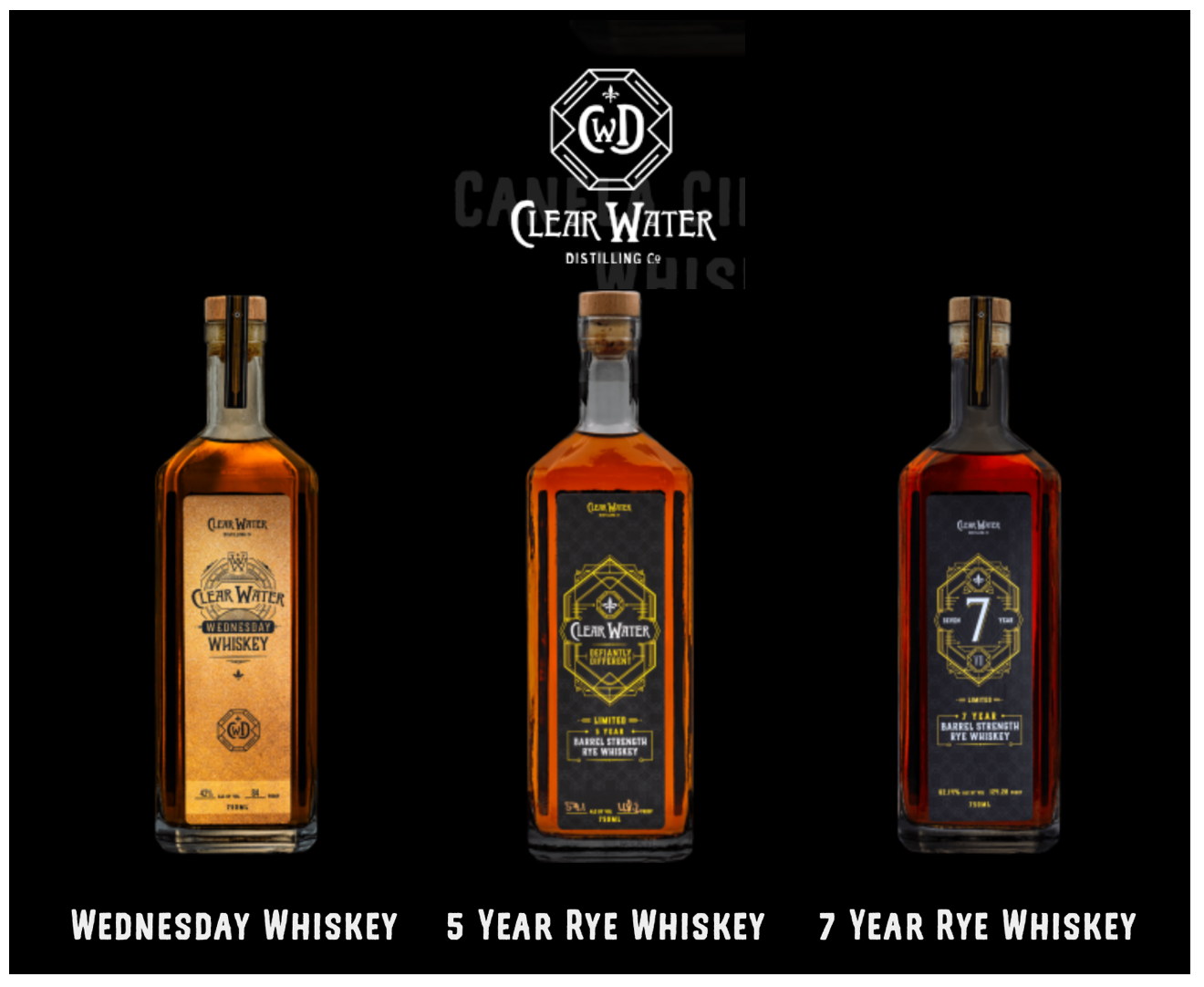
The company subsequently broadened its grain-spirit offerings with Wednesday Whiskey, conceived as an approachable whiskey for ordinary occasions rather than a bottle reserved for celebrations. Wednesday is a batch-based blend assembled from selected whiskeys, and its composition can change from one batch to another. The current expression is bottled at 84 proof. The playful name reflects the idea behind it: making it through an ordinary Wednesday is reason enough to pour a whiskey, without waiting for a birthday, anniversary or other special event.
Another product, Canela Cinnamon Whiskey, took a category frequently associated with heavily sweetened flavored whiskey in a different direction. Clear Water produces Canela without added sugar, emphasizing cinnamon oils and whiskey rather than syrupy sweetness. The product became part of an expanding whiskey range that eventually included older rye expressions as well as limited releases. By 2026, Clear Water listed five- and seven-year rye whiskeys among its products, illustrating how much larger the grain-based portion of the portfolio had become since the distillery’s experimental beginnings.
Eau Claire pushed that whiskey program even further with Alfred’s Vault, a series of small, changing releases built around unusual barrels, finishes and whiskey profiles. The inaugural documented expression was a four-year-old whiskey made from a mash bill of 54 percent corn, 45 percent wheat and 1 percent barley, bottled at 120.48 proof after finishing in an Amburana barrel. Matt described Alfred’s Vault as intentionally non-repeating: individual batches can employ different whiskeys and finishes rather than following a permanent formula. The series gave Eau Claire another outlet for the same experimental philosophy that had prompted him to distill his sangria-like mixture years earlier.
The business continued to develop beyond its difficult pandemic-era beginning. Matt and Stephanie returned to formal education through the University of Utah’s David Eccles School of Business and completed the Master of Business Creation program in 2024, using their existing company as the subject of their coursework. In April 2025, Clear Water strengthened its production team by hiring nationally recognized distiller Molly Troupe as master distiller. Eau Claire remained chief executive, providing continuity between the experimental home still that started the project and a company selling spirits well beyond Utah.
Clear Water Distilling and Matt Eau Claire had entered a brand-new Utah industry after 25 years in technology, and that unconventional route ultimately became part of Clear Water’s character. In the end, the man whose surname literally supplied the company’s name built his second career around curiosity, ambition, and refusing to let familiar brands determine the limits of what could go into a bottle of good whiskey.
Sources:
Clear Water Distilling Company official website, clearwaterdistilling.com
University of Utah, Lassonde Entrepreneur Institute, “19 Founders Graduate… Summer 2024”, lassonde.utah.edu
PR Newswire, “Trailblazing Master Distiller Molly Troupe Joins Clear Water Distilling Co.,” April 2, 2025, www.prnewswire.com
Utah Department of Alcoholic Beverage Services, “February 2026 Numeric Price List,” February 2026, abs.stage.utah.gov
Contributed by Tracy McLemore, Fairview, Tennessee