James Fowler


James I. Fowler was born in September of 1971, and grew up in Bountiful, Utah. When he was fifteen years old, James was part of a program that sent teenage boys from Utah to Maui to pick fruit in the pineapple fields. There, the boys experienced the hard life of a harvester, living and working together in the fields and sleeping on military-style bunk beds, but at the same time, developing a deep camaraderie that was forged through shared experience. “We all worked together ten hours every day; we all went to the beach together; we all ate together; we all went to school together,” reminisces Fowler. “It was the hardest and best thing I ever did.” It was also there that James had his first experience with spirits—homemade fermented pineapple juice in a two-liter bottle, made with brown sugar. He was fascinated.
A few years passed, but back in Utah, that curiosity had stuck with James. He threw himself into home brewing, spending much of his weekends learning about beer, testing and tasting, so much so that in 1994, Mountain Home Brewing recognized him as “Home Beer Brewer of the Year”. He was a licensed pilot, but his paying job was in purchasing. However, when 9/11 happened, his career evaporated. So, pivoting, James went into chemical and adhesive sales. He eventually moved with his wife, Danielle, to Dallas, Texas. At the point, James was traveling across the country and kept finding himself drawn to places that were doing things differently. It was at that time that the idea for a distillery began to take root. He was struck by how many distilleries sourced their product. Though he respected their efforts, he personally felt it was a somewhat deceptive practice. He decided to put his extensive experience in brewing and his ideas for spirits production to work.
In 2013, Fowler received federal approval to establish Sugar House Distillery at 2212 South West Temple in Salt Lake City, followed by state approval the following year. Fowler took his enterprise’s name from Salt Lake City’s Sugar House area, a title with roots stretching back to Utah’s pioneer period. A ‘sugar house’ was the name for a nineteenth-century sugar-beet processing operation, and the neighborhood had retained the moniker long after the original sugar enterprises disappeared. Fowler’s distillery sat along the western edge of that historic district, giving Sugar House Distillery ties to a native geographical name, well known to locals.
Fowler had a clear production philosophy from the beginning. Sugar House would be a genuine grain-to-glass operation rather than a company purchasing bulk whiskey from another producer and bottling it under a Utah label. Grain would be milled at the distillery, mashed and fermented and distilled there, then placed into barrels onsight and matured there. Fowler also emphasized regional agriculture, sourcing much of his corn, rye and barley in Utah or elsewhere in the Intermountain West. Even the spent grain remained connected to the local agricultural economy, going to a nearby farmer as livestock feed.
Sugar House began commercial production with vodka in 2014, but whiskey was already central to Fowler’s plans. The first whiskey released later that year was made from 100 percent malted barley, establishing American malt whisky as one of the distillery’s earliest specialties. Fowler and his distilling team adapted elements of Scottish malt-whisky production to an American operation, eventually settling on a combination of Pale, Vienna and Honey malts. The spirit went into charred virgin American oak rather than following the more familiar Scottish practice of relying heavily on previously-used barrels, creating what Sugar House described as an American interpretation of malt whisky.
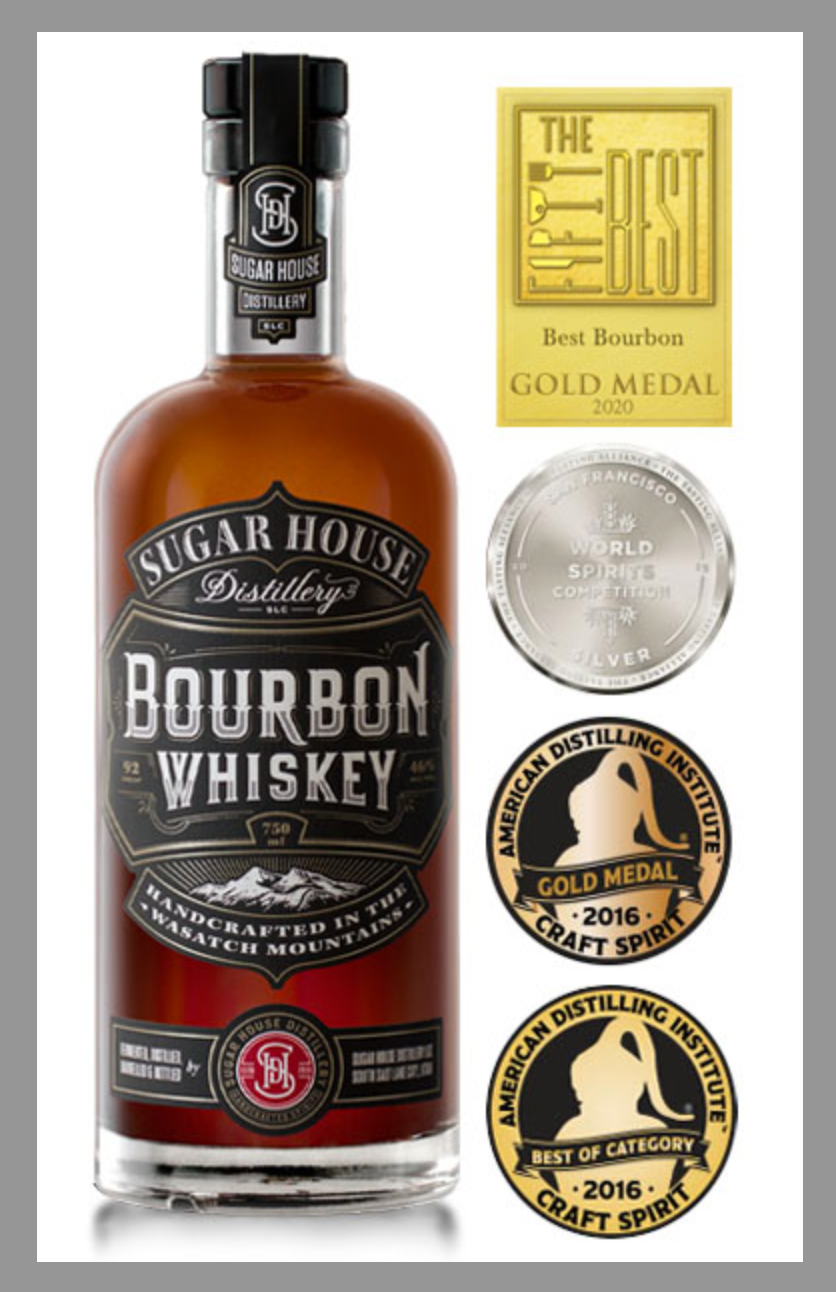
Bourbon followed after sufficient stocks had matured. Sugar House Bourbon begins with Utah corn, rye and regionally sourced malted barley, with the established mash bill consisting of 75 percent corn, 20 percent rye and 5 percent malted barley. After fermentation and distillation in Salt Lake City, the whiskey matured in charred new American oak and was bottled at 92 proof. Fowler’s insistence on producing the whiskey himself soon brought significant recognition: Sugar House Bourbon received a gold medal and Best of Category honors at the 2016 American Distilling Institute competition.
Rye provided another expression of Fowler’s grain-focused approach. Sugar House Rye Whiskey is made entirely from regionally sourced rye rather than simply adding enough rye to meet the legal requirement for the category. It is fermented and distilled at Sugar House, aged in new American oak and bottled at 92 proof without chill filtration. The whiskey later received a silver medal from the American Distilling Institute in 2017, a gold medal from The Fifty Best in 2019 and a silver medal at the 2019 San Francisco Spirits Competition.
Fowler’s earlier life as a brewer eventually supplied the idea for one of Sugar House Distillery’s most interesting whiskey projects. The Boilermaker Series paired Sugar House bourbon with Utah craft breweries, completing a circle between brewing and distilling. Fowler’s team transferred mature bourbon from its original new American oak barrels into barrels that had subsequently held beer from local breweries. Uinta Brewing’s Cockeyed Cooper Bourbon Barrel Barley Wine became one example: bourbon barrels went to the brewery, held beer, and then returned to Sugar House so bourbon could be finished in them. The resulting whiskey carried influences from both industries that had shaped Fowler’s professional life.
American malt remained especially important to him. Fowler has identified Sugar House’s malt whiskey as a personal favorite, and the spirit accumulated substantial recognition, including a gold medal at the 2019 San Francisco World Spirits Competition and double-gold honors from The Fifty Best in 2020. Sugar House later used mature malt whiskey for more experimental releases. In 2021, the distillery introduced its first Barrel Master Series release, beginning with malt whiskey that had aged for more than five years before receiving additional barrel treatment. That release also became Utah’s first bottled-in-bond whiskey, extending a product Fowler had begun making during Sugar House’s first year into a more mature expression of the distillery’s capabilities.
The whiskey operation continued expanding rather than abandoning its original principles when Fowler developed wine-barrel-finished malt releases and other Barrel Master experiments. In 2023, its American Single Malt appeared at the American Single Malt Whiskey Commission’s Grand Tasting with a mash bill of 90 percent two-row pale malt, 5 percent Vienna malt and 5 percent Honey malt, matured in No. 3-char new American oak. Sugar House described the whiskey succinctly as malt whiskey viewed through the eyes of a bourbon distiller—a description that captures the intersection of Fowler’s brewing background and his years making American whiskey.
James I. Fowler entered whiskey from an unusually appropriate starting point. Two decades spent brewing taught him that the character of a finished drink begins well before it reached a barrel, and he carried that principle into distilling by controlling his whiskey from the local milling of the grain through bottling. Sugar House Distillery therefore became more than a Utah company selling whiskey with a local name—it was built around the proposition that Utah grain could become Utah whiskey without leaving the hands of the people making it, and more than a decade later, that grain-to-glass principle remains at the center of the distillery Fowler founded.
Sources:
Sugar House Distillery official website, sugarhousedistillery.net
The Salt Lake Tribune, “Two New Distilleries to Open in Salt Lake City,” Kathy Stephenson, January 28, 2014, sltrib.com
Utah Farm Bureau Federation, “From Grain to Glass,” Aubree Thomas, June 8, 2022, utahfarmbureau.org
Visit Utah, “Utah Spirits Tours: The Locavore — Sugar House Distillery,” accessed September 28, 2026, visitutah.com
Utah Stories, “Sugar House Distillery Crafting the Award-Winning American Single Malt Whiskey,” Heather L. King, November 9, 2021, utahstories.com
SLUG Magazine, “In High Spirits: Sugar House Distillery’s Boilermaker Series,” Steve Goemaat, October 3, 2019, slugmag.com
Salt Lake Magazine, “Single Malt Whiskey Doesn’t Just Mean Scotch,” Mary Brown Malouf, August 12, 2019, saltlakemagazine.com
American Single Malt Whiskey Commission, “2023 Grand Tasting — Sugar House Distillery,” 2023, americansinglemaltwhiskey.org
Utah’s Own, “Sugar House Distillery — James Fowler, Founder & Owner,” accessed September 28, 2026, utahsown.org
Contributed by Tracy McLemore, Fairview, Tennessee