José Hernandez


José A. Hernandez was born July 2, 1962. Not much is known of Hernandez’s early life, but as an adult, he spent many years working as a prosperous architect. Despite his career success, by 2012, Chicagoan Hernandez had developed an interest in producing distilled beverages. About that time, he struck up a conversation with neighbor Fred Robinson, a PGA golf professional. The two men learned that they both shared an entrepreneurial outlook and a fascination with handcrafted spirits. Even though their backgrounds could hardly have been more different, they found common ground in the emerging craft-distilling movement that was beginning to take hold across America; they decided to go into the distillery business together in the summer of 2012.
Rather than attempting to replicate the large-scale industrial production methods of major liquor companies, Hernandez and Robinson embraced a small-batch approach. They began experimenting with recipes on a modest still, testing various formulations and refining products until they were satisfied with the results. Much of that early work was conducted in Hernandez's garage, a setting that recalls the humble beginnings of many successful American craft businesses. But before long, the garage space was outgrown and the duo began looking for suitable digs. Serendipitously, one day soon after, Hernandez was talking with the owner of a car repair shop, lamenting about his problems in finding a suitable distillery location. The owner offered Hernandez his storage facility next door, and Hernandez was able to verify that it had all the necessities for a startup distillery. The hereto unnamed facility was thus established in the central business district of Lake Zurich, Illinois.
Both partners liked the word ‘copper,’ and both agreed that it needed another phrase, but they didn’t know what to use for the second word. Then Hernandez told the story of his wife Nancy’s violin. The family heirloom was about to be tossed, but when their daughter expressed an interest in playing violin, they instead took it to be restored. The instrument turned out to have been made by hand in Chicago in 1906, and Hernandez was shocked to find that it was actually worth a significant amount of money. One thing led to another; ’violin’ became ‘fiddle’ and the name ‘Copper Fiddle Distillery’ stuck. Next, the pair needed labels, bottles and a logo, when, again, fate stepped in. Hernandez’s daughter happened to be dating an accomplished graphic artist who offered to design what has since become award-winning label artwork.
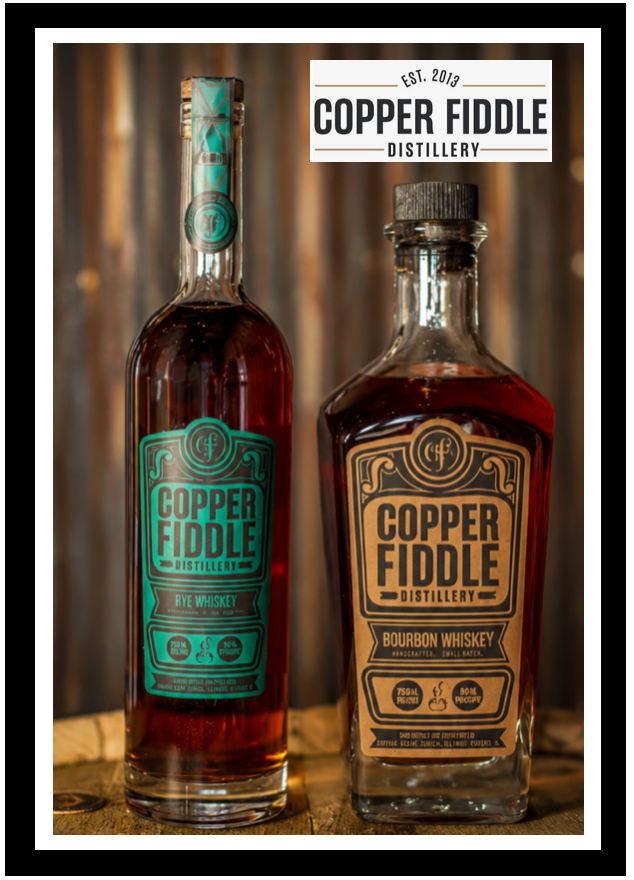
Although Copper Fiddle Distillery has earned attention for the breadth of its spirits portfolio, whiskey quickly became the foundation of its identity. Hernandez and his team produced bourbon and rye whiskey entirely in-house, following a grain-to-bottle philosophy that emphasized Midwestern ingredients and traditional copper-pot distillation. Their bourbon was distilled in an American-made copper pot still using a mash built from Midwest-grown corn, rye, and malted barley, then matured in small toasted and charred American white oak barrels that accelerated flavor development while preserving balance. The resulting whiskey quickly earned national recognition, including Gold and Double Gold medals from The Fifty Best, and was noted for rich caramel, vanilla, dark chocolate, honey, and toasted oak characteristics. Copper Fiddle's rye whiskey likewise reflected the distillery's regional focus, combining Illinois yellow corn with Minnesota rye before aging in used bourbon barrels and finishing on toasted oak to create a whiskey that did not deliver overwhelming grain intensity. By producing, aging, bottling, and serving its whiskeys under one roof, Copper Fiddle established itself as one of Illinois' first true grain-to-glass whiskey distilleries with an emphasis on small-batch whiskey production, local sourcing, and hands-on craftsmanship.
Under Hernandez and Robinson's leadership, Copper Fiddle soon expanded into other products as well, eventually producing multiple gins, rum, and later vodka. The timing of Copper Fiddle's emergence proved advantageous. During the 2010s, Illinois experienced a substantial increase in the number of licensed craft distilleries, yet consumers were becoming more interested in locally-produced spirits, while state regulations were gradually becoming more favorable to small producers. So Copper Fiddle benefited from that broader movement while contributing to it, helping establish Illinois as a serious center for craft distilling rather than merely a market for spirits produced elsewhere.
After several years of successful operation in which Hernandez claimed that Copper Fiddle was never once unprofitable, Hernandez and Robinson sold Copper Fiddle Distillery in September 2019 to another pair of newcomers, Andrew Macker and Jim Iverhouse. By that point the distillery had established a respected reputation within Illinois' craft-spirits community and had demonstrated that a small independent producer could compete through quality, innovation, and historical authenticity rather than scale. To this day, Copper Fiddle continues operating strongly under Macker and Iverhouse, a testament to the foundation its hard-working rookie founders had built, as well as to the quality spirits still being produced in the lazy suburb of Lake Zurich, Illinois.
Sources
Illinois Office of Tourism, “Copper Fiddle Distillery,” Enjoy Illinois, enjoyillinois.com
Copper Fiddle Distillery official website, “Fred Robinson and Jose Hernandez Stir Up Pre-Prohibition Spirits”, copperfiddledistillery.com
WineCompass, “Copper Fiddle Distillery in Lake Zurich, Illinois,” winecompass.com.
Best Tasting Spirits, “Review:Copper Fiddle…”, August 23, 2024, besttastingspirits.com
Northwest Quarterly, “Masters of their Craft…”, Eron Harvey, September 30, 2014, northwestchicagoland.northwestquarterly.com
Contributed by Tracy McLemore, Fairview, Tennessee