Tyler Halstead


Tyler Halstead did not grow up in whiskey country, nor did he begin his professional life intending to become a distiller. Born in March of 1989, Halstead grew up in La Mirada, California, a community along the Los Angeles–Orange County border. He was an athlete at La Mirada High School, and after graduation, he moved on to Chapman University in Orange, California, where he played defensive back on the university’s football team. His college activities also included serving as vice president of the Student-Athlete Advisory Committee and treasurer of a student service organization.
After his education had concluded, Halstead built a career that included technology, finance, and work connected with the film and entertainment business. He eventually became dissatisfied with the frenzied life he had built in the Los Angeles area and moved to Utah, trading the metropolitan environment of Southern California for a markedly different setting.
Halstead arrived in Utah just as another man was considering the future of a small distillery he had built largely by hand. Kirk Sedgwick, a diesel mechanic by trade, and his wife, Denise, had founded Outlaw Distillery in January 2015. Working with less than $90,000 of their own money, the Sedgwicks established the operation in a roughly 2,500-square-foot facility in Midvale. Kirk applied his mechanical skills to designing and building the distilling equipment while the business waited for its permits, and Outlaw developed around a grain-to-glass philosophy: local grain was mashed, fermented, distilled, aged, and ultimately bottled by the distillery rather than simply purchasing finished whiskey from an outside producer. The name itself drew from Utah history, particularly the Outlaw Trail associated with Butch Cassidy and other Western outlaws.
Halstead went to work with Sedgwick in 2020 at a pivotal moment for the company. Sedgwick was preparing to relinquish ownership, and the two men quickly developed a working relationship that gave Halstead something his previous career could not provide: firsthand knowledge of making spirits. Halstead already understood acquisitions and the buying and selling of businesses, but he entered the distilling industry with little practical knowledge of either spirits production or Utah’s unusually regulated alcoholic-beverage market. The sale was structured so that Sedgwick continued to provide support and mentorship, allowing Halstead to learn the business from the man who had created it. What Halstead acquired was not merely a spirits brand. Outlaw was already making whiskey from the grain forward, and Halstead retained that identity as one of the company’s defining principles. Utah farmers supplied the grain, much of it delivered directly to the distillery, and Outlaw handled the remaining processes itself. That distinction became increasingly important to Halstead as he developed the business.
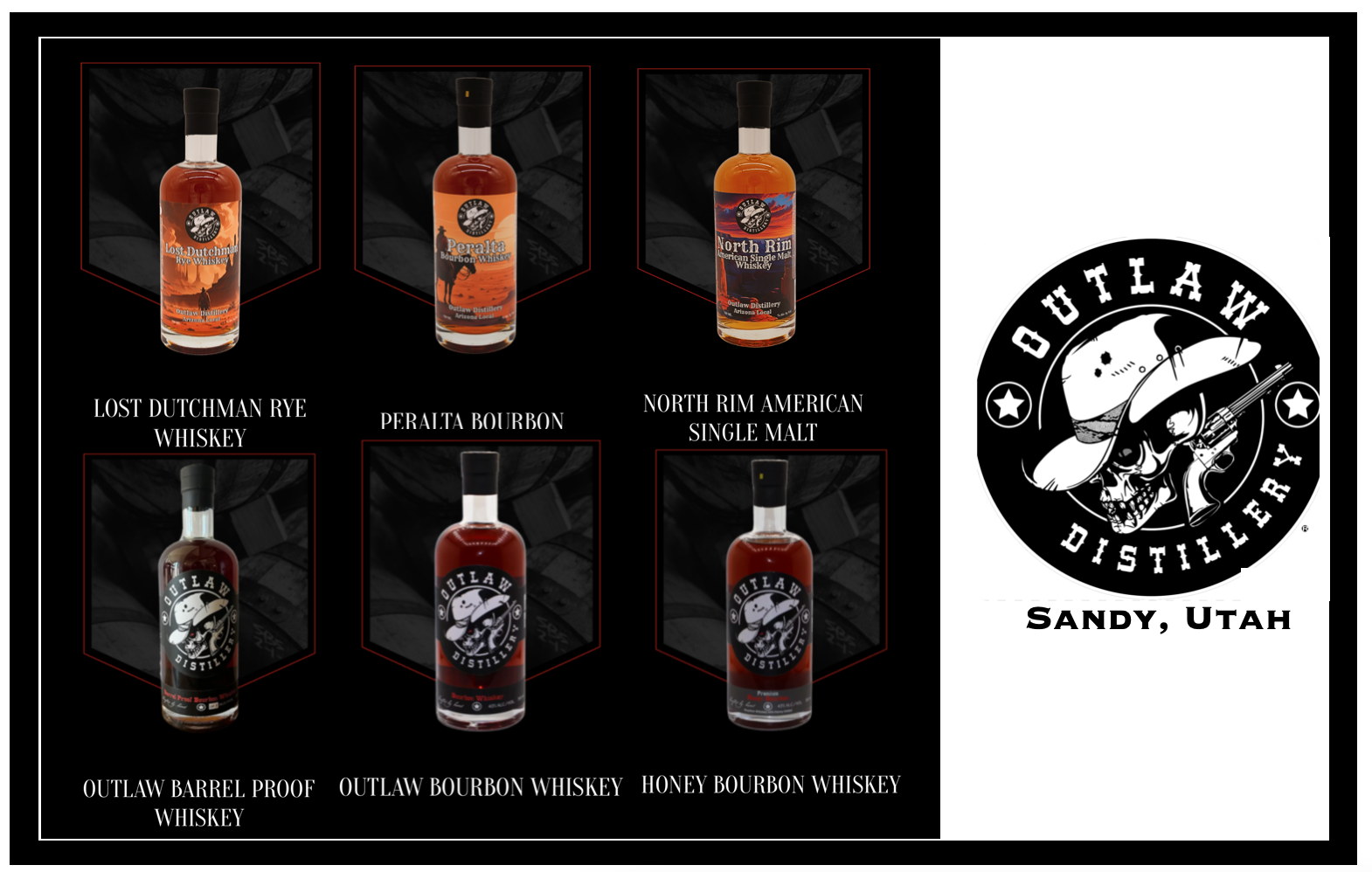
Bourbon became a particularly important expression of that approach. Outlaw’s standard Bourbon Whiskey is produced from corn and wheat and matured in American white oak with the additional influence of toasted French oak. Instead of relying exclusively upon a predetermined maturation date, the distillery evaluates barrels by taste, opening and sampling them regularly as they approach two years of age. The resulting bourbon emphasizes the naturally sweeter side of its corn-and-wheat mash, with the distillery identifying butterscotch and vanilla aromas and cinnamon, cherry, oak, caramel, and vanilla among its principal flavor characteristics.
Outlaw also developed a Barrel Proof Bourbon from particularly successful barrels that otherwise would have gone into its regular 86-proof bourbon. Those selected barrels are bottled at barrel proof rather than diluted to the standard bottling strength, preserving differences between individual batches. The underlying whiskey remains Outlaw’s own corn-and-wheat bourbon. Another variation, Premium Honey Bourbon, begins with Outlaw’s small-batch bourbon and is infused with local honey; in 2023, the expression earned 89 points and a silver medal at the Bartender Spirits Awards.
In October 2023, Tyler married his girlfriend, Allexis Bennett, whom he has credited with supporting him throughout Outlaw’s growth. About that time, Tyler also also strengthened the production side of the business, and Outlaw production increased fivefold under his leadership, while the overall business doubled and distribution began extending beyond Utah. As the whiskey program grew, Halstead added experienced distilling talent, including Conor Kelly, whose background included whiskey production at High West Distillery. Kelly became Outlaw’s head distiller and worked with Halstead on expanding the company’s whiskey production, with bourbon barrels intended to mature for at least roughly two and a half years. By 2024, Outlaw’s Bourbon Whiskey, Premium Honey Bourbon, and White Whiskey were among its entries recognized in the American Craft Spirits Association’s annual judging.
The next major change came in 2025. Halstead had previously visited Adventurous Stills in Tempe, Arizona, and admired a company whose grain-to-glass methods closely resembled Outlaw’s. In May 2025, Outlaw completed a six-figure acquisition of Adventurous Stills and rebranded the Tempe operation under the Outlaw name. Halstead retained the Arizona distillery’s emphasis on locally sourced grain and kept established products such as Peralta Bourbon, North Rim American Single Malt, and Picket Post Vodka in production. Peralta Bourbon uses local blue and yellow corn, Verde Valley rye, and specialty grains and is aged more than three years in new American white oak, while Lost Dutchman Rye combines Verde Valley rye, durum wheat, and roasted caramel rye before spending more than three years in new American oak.
The Arizona acquisition transformed Outlaw from a single Utah craft distillery into a two-state operation. The Utah facility remained the company’s principal production center, while Tempe provided another distillery, tasting room, cocktail bar, and a place for product development. Expansion continued in April 2026 when Outlaw announced a distribution agreement bringing its spirits into California—a notable development for Halstead because it took the business back into the state where he had grown up and begun his career.
Halstead’s place in Outlaw’s history is therefore different from that of the typical craft-distillery founder. He did not create the original stills, formulate the first Outlaw whiskey, or establish the brand; those accomplishments belonged to Kirk and Denise Sedgwick. Instead, Halstead entered an existing small distillery, learned the trade from its founder, retained its grain-to-glass principles, and turned the operation toward a larger scale without abandoning whiskey made in-house. By 2026, the company that began in a modest Utah industrial space had production in two states and distribution reaching into Halstead’s native California. For a former finance and entertainment executive who entered the business knowing little about commercial distilling, Outlaw had become not simply an acquisition, but a working whiskey company built around the demanding process of turning local grain into a finished bottle.
Sources:
Chapman University Athletics, “2008-11 Football Rosters,” Chapman University, athletics.chapman.edu
Voyage Utah Magazine, “Exploring Life & Business with Tyler Halstead of Outlaw Distillery,” February 23, 2022, voyageutah.com
Outlaw Distillery official website, outlawdistillery.com
Utah’s Own, “Outlaw Distillery,” Utah Department of Agriculture and Food, utahsown.org
Utah Stories, “Outlaw Distillery Distilling One of the Best Rums in America,” Heather L. King, October 25, 2021, utahstories.com
Voyage Utah Magazine, “Exploring Life & Business with Conor Kelly of Outlaw Distillery,” 2025, voyageutah.com
American Craft Spirits Association, “2024 American Craft Spirits Awards,” 2024, americancraftspirits.org
Contributed by Tracy McLemore, Fairview, Tennessee