Hayes Kelman


Hayes John Kelman was born in July of 1991 and grew up amid the corn, wheat, sorghum, and beans of his family’s Haskell County farm near Sublette, Kansas. Later, as a fifth-generation farmer himself, he learned hands-on agronomy on family acreage roughly 50 miles west of Dodge City. Farming was not simply an inheritance for Kelman; it became the foundation of an unusual plan to retain more of the value created by the grain his family raised.
At 19, Kelman enrolled at Kansas State University and studied agribusiness. He also studied briefly in Ireland, but graduated with a bachelor’s degree from KSU in the spring of 2015. His father, Roger, had encouraged him to attend college and consider possibilities beyond the farm, but Hayes intended to return to western Kansas. In doing so, however, he wanted to bring home an enterprise that could diversify the family operation rather than simply continue selling its grain into fickle commodity markets. Kelman noted early on that whiskey offered a way to transform an ordinary agricultural crop into a finished product with a distinct identity and greater value. He briefly considered brewing beer, but spirits made better use of the farm’s corn and wheat and offered a longer shelf life. The concept also gave the family more control over the price of its grain. Instead of accepting whatever the commodity market offered, the Kelmans could mill, ferment, distill, mature, bottle, and sell the grain themselves. Hayes approached distilling with the practical habits of a farmer: he attended distilling classes, studied the subject independently, and learned through full-scale experimentation.
In 2014, Hayes and Roger Kelman joined fellow multigenerational farmer Chris Holovach in establishing Boot Hill Distillery. They initially considered placing the operation in a shed on the farm or constructing a metal building outside Dodge City. A far more distinctive opportunity appeared when the city’s former municipal building, a deteriorating landmark scheduled for demolition, became available. The partners acquired the property and invested more than $1 million in its rehabilitation and in distilling equipment. The building gave the young company an immediate connection to Dodge City’s frontier history. It stood on the former Boot Hill Cemetery, where some early residents had been buried before their remains were moved to the municipal cemetery in 1878. Dodge City’s first multiroom schoolhouse subsequently occupied the site until it was razed in 1927. The municipal building that replaced it opened in 1929 and eventually housed city offices, a jail, judges’ chambers, the fire department, and other civic functions. Kelman and his partners gutted and restored the structure, turning a threatened public building into a working distillery, cocktail room, and visitor destination. Boot Hill finally opened its doors in July 2016 and sold its first product that November. The operation adopted the phrase “soil to sip” because the owners grew all the grain used in its spirits and retained control throughout production. Grain harvested on the farms traveled to Dodge City, where it was milled, mashed, fermented, distilled, and bottled. Production took place in 500-gallon batches with a hybrid still system and a separate stainless-steel column.
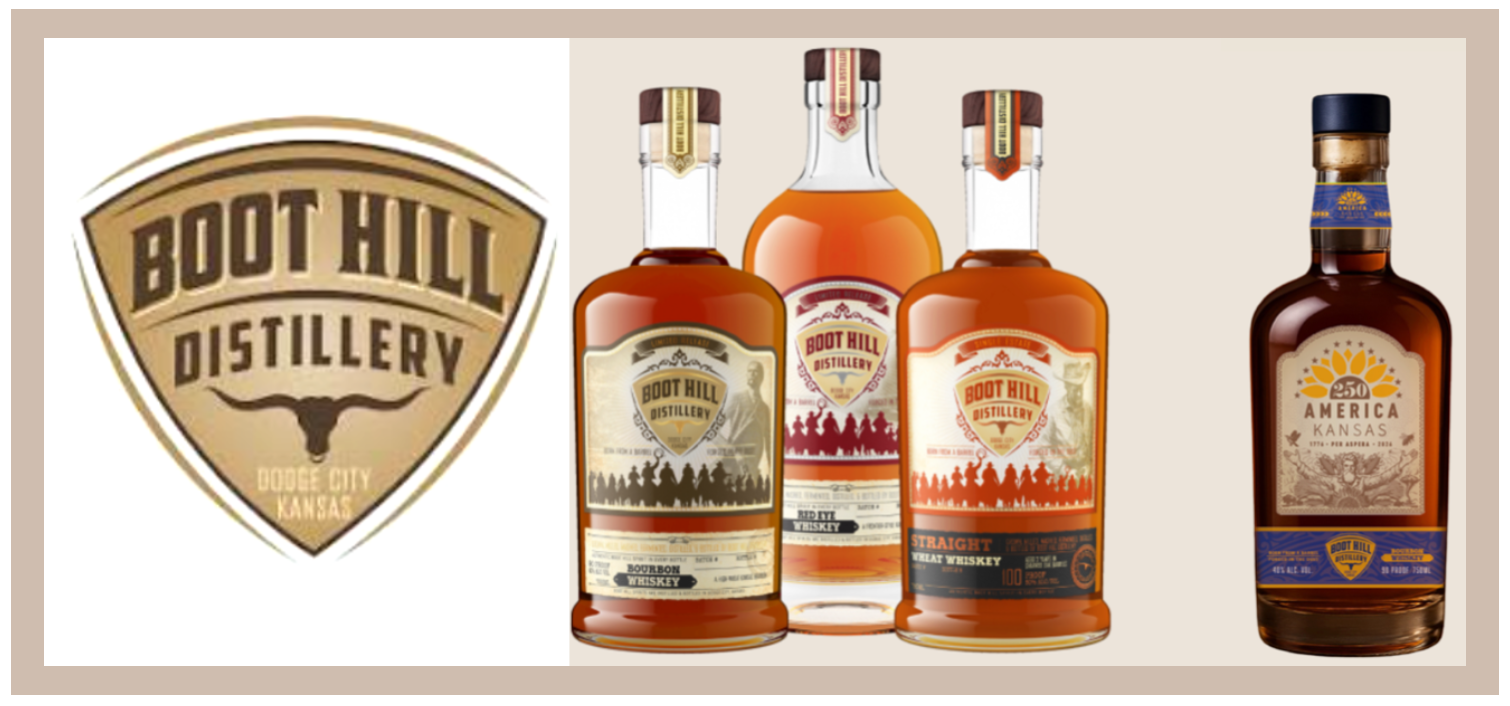
From the beginning, whiskey remained central to Kelman’s purpose. Boot Hill’s early Red Eye Whiskey was assembled from spirits matured in barrels of different sizes and ages, producing what the company called a frontier-style Kansas whiskey. It won the title of best Kansas whiskey at the 2017 Heartland Spirits Fest and received a silver medal there in 2019. Boot Hill’s bourbon, released as the distillery’s maturing stocks permitted, also earned a silver medal at the 2019 festival. Its mash bill—51 percent corn and 49 percent wheat—placed the family farm’s two principal grains at the center of the bottle. Bottled at 90 proof, the bourbon matured in new charred American white-oak barrels and expressed the distillery’s agricultural identity more clearly than a whiskey made from purchasedz could have done.
The company later expanded that identity through Straight Wheat Whiskey made entirely from Kansas-grown hard red winter wheat. Aged for more than two years in new American white-oak barrels and bottled at 100 proof, it transformed one of the state’s defining crops into a fully matured whiskey. The expression received a gold medal and an “Exceptional” designation from the Beverage Testing Institute in 2020, a silver medal at the 2021 American Craft Spirits Awards, and gold at the 2023 Bartender Spirits Awards. Although Boot Hill also developed vodka, gin, moonshine, and Prickly Ash Bitters, its wheat whiskey and bourbon remained the clearest expressions of Kelman’s original ambition to give western Kansas grain a finished identity.
In 2025, the Kansas State University Alumni Association selected Hayes Kelman for its Distinguished Young Alumni Award, recognizing both professional leadership and support of the community. Nearly a decade after Boot Hill opened, its spirits had moved beyond Kansas into Missouri, Oklahoma, and other markets, while its restored municipal building remained a visible part of Dodge City. Kelman’s accomplishment rests on a direct chain of production: Kansas seed, family farmland, grain harvested in Haskell County, whiskey distilled in Dodge City, and bottles carrying the name of the historic ground beneath the stills.
Sources:
Boot Hill Distillery official website, boothilldistillery.com
Successful Farming, “A Family Farm-to-Bottle Distillery”, Emma Henning, April 2, 2018, agriculture.com
Kansas Farm Food Connection, “Craft Distillery Serves Farm-to-Bottle Spirits in Dodge City”, February 19, 2019, kansasfarmfoodconnection.org
Craft Spirits Magazine, “Boot Hill Distillery to Release Two Single Barrel Straight Bourbon Whiskeys”, November 8, 2023, craftspiritsmag.com
Kansas State University College of Agriculture, “Hayes Kelman: Winner of the 2025 Distinguished Young Alumni Award”, April 10, 2026, ag.k-state.edu
Contributed by Tracy McLemore, Fairview, Tennessee