Clayton Mendel


William “Clayton” Mendel’s story is best understood the way many lives in the Eastern Sierra are understood—through geography first, then through the quiet accumulation of skills. He was born on May 16, 1980, and his life and professional identity are firmly rooted in Mammoth Lakes, California, a place where altitude, weather, and self-reliance shape both character and work ethic.
Mammoth Lakes is not a place that encourages abstraction. At more than 7,800 feet above sea level, daily life revolves around physical environment: snowpack, tourism cycles, gear, and preparation. Those realities shaped Mendel long before he ever distilled whiskey. His earliest public profile in Mammoth was not as a distiller, but as someone deeply embedded in the region’s outdoor and sporting culture; an individual comfortable with logistics, equipment, and systems that must perform reliably in demanding conditions.
By the early 2010s, Mendel was already a known figure in Mammoth’s civic and sporting orbit. In 2014, stewardship of the Mammoth Biathlon, a demanding endurance-and-marksmanship event tied closely to mountain and ski culture, passed to Clayton Mendel and collaborator John Manzano. The event’s requirements—precision, safety, physical stamina, and organizational discipline, mirror traits that later appear in Mendel’s approach to distilling. Around the same time, Mendel operated Eastern Sierra Armory, a business serving biathlon and outdoor communities, further reinforcing his early professional identity as someone grounded in equipment, process, and technical responsibility rather than branding or spectacle.
What is notable about Mendel’s transition into distilling is that it does not read as a dramatic pivot away from his earlier life, but rather as an extension of it. Distilling, especially whiskey distilling, rewards the same temperament required by mountain industries: patience, consistency, and respect for systems that cannot be rushed. When Devils Creek Distillery began operations in late 2015, Mendel emerged not simply as a founder, but as the individual responsible for the spirit’s core character.
Devils Creek is a family operation, with John and Luan Mendel holding ownership roles and Clayton Mendel serving as Head Distiller. That distinction matters. In American whiskey, the distiller’s hand is most evident long before a barrel is ever opened. Grain selection, fermentation parameters, cut points, and barrel pairing are not abstract decisions; they are choices that compound over years. In a high-elevation environment like Mammoth Lakes, those decisions carry additional weight, as temperature swings and thinner air influence maturation in ways that differ from lower-altitude rickhouses.
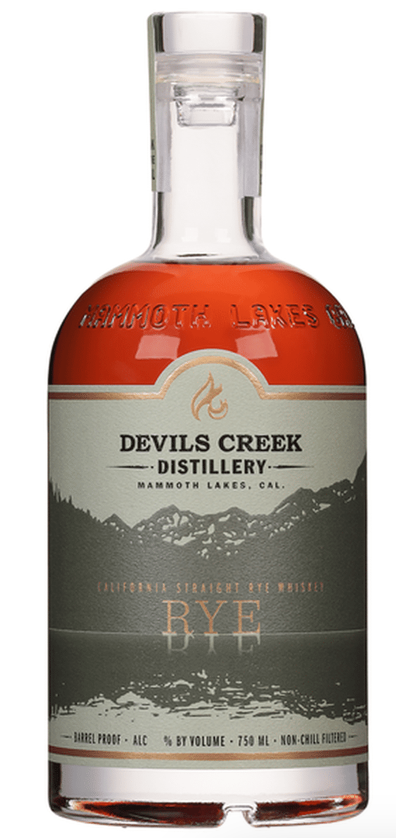
While Devils Creek produces multiple spirit types, Mendel’s public-facing work and recognition have centered increasingly on whiskey and bourbon. The distillery is consistently described as producing bourbon and rye, and Mendel himself is identified as the person shaping those spirits “from selecting the finest grains to sourcing the best barrels.” A 2025 episode of the podcast Distilling the West featuring Mendel provides a clear snapshot of where his attention has been focused: Small Batch Bourbon, “Snow Job” Single Barrel Bourbon, Small Batch Rye, and Barrel Proof Rye. Taken together, these releases place Mendel squarely within classic American whiskey tradition—balancing approachability and intensity, and working deliberately across proof and mashbill rather than chasing novelty.
Recognition followed quietly but meaningfully. In a DISCUS spotlight discussing the distillery’s trajectory, Devils Creek’s California Straight Bourbon Whiskey was noted for earning a Platinum medal at the 2023 Fred Minnick’s ASCOT Awards. For a mountain distillery operating outside traditional whiskey hubs, that acknowledgment signaled that Mendel’s work could stand up to national scrutiny, judged not by story or setting, but by what emerged from barrel and bottle.
In that sense, Clayton Mendel fits a familiar but increasingly rare American pattern. He is not a distiller who arrived through inherited fame or industrial scale, nor one who built a persona first and a product second. Instead, his path reflects a quieter lineage: learn a place thoroughly, master practical systems, work alongside family, and commit to a craft that only reveals its success over time. In whiskey, especially, there are no shortcuts. The grain remembers every decision, and the barrel keeps score.
As his bourbons and ryes continue to age in the thin air of the Eastern Sierra, Mendel’s story remains less about expansion or spectacle than about continuity—of place, of patience, and of work done carefully enough that it does not need much explanation. In a landscape shaped by weather and endurance, Clayton Mendel has chosen a craft that rewards the same virtues, allowing his whiskey to speak with the slow confidence of someone who knows exactly where he stands.
Sources:
The Sheet (Mammoth Lakes) — “Page 2: Karch buys the farm” (mentions Mammoth Biathlon turned over to Clayton Mendel, https://thesheetnews.com/2014/09/04/page-2-karch-buys-the-farm/
The Sheet (Mammoth Lakes, CA), “Embattled community”, Katie Vane, August 14, 2015
Amazon (podcast), “Episode 33: Distilling the West”, music.amazon.com
Contributed by Tracy McLemore, Fairview, Tennessee