Rick Molitor


Richard R. “Rick” Molitor was born in August of 1966. He grew up in the small town of Ephrata, Washington. He later attended the University of Montana-Western, earning a degree in education. For fifteen or so years during and after college, Molitor worked at various blue-collar jobs, including as a commercial fisherman and later, as a plant foreman in Alaska. However, beginning in 1991 he capitalized on his own education and, established a formal career in teaching. He subsequently served successively as a teacher, principal and then as assistant school superintendent in several Washington state school districts.
In 2008, Molitor and his wife Kristina, who was also an educator, moved from Washington to Central Oregon. At that time, Molitor stepped into one of the most visible public positions in Jefferson County, Oregon, becoming superintendent of the Jefferson County School District. His tenure included work with the Confederated (Native American) Tribes of Warm Springs and the development of the Warm Springs K-8 Academy, as well as district programs involving literacy, career and technical education and improvements to school facilities. The partnership that resulted in the Warm Springs Academy later stood out to Molitor as a highlight of his career in education.
One cold evening in 2012, Molitor and four of his closest friends were sitting around a campfire drinking whiskey when their conversation turned into an idea: they should start their own distillery. The group began to bring together people with strong connections to the agricultural economy around Madras, including farmers and a rancher. One short year later, New Basin Distilling Company went into business. The partners each then began learning the practical business of distilling, eventually to build a company whose identity became closely connected to Central Oregon grain and water.
New Basin bottled its first vodka and gin in 2015, but whiskey developed into a particularly important part of the operation. The company was positioned to take advantage of something many craft distilleries had to purchase from outside suppliers—grain grown by people directly connected to the business. That grain was then milled, mashed, fermented and distilled on-site, while water from nearby Opal Springs was used in production and proofing. The result was a whiskey program tied directly to the agricultural country surrounding Madras rather than simply to an Oregon address on a bottle.
Molitor’s Resignation Rye became especially personal. His grandfather had been a rye whiskey drinker, giving Molitor an existing affection for the style. Further, the grain was ground on site. Early Resignation Rye was made from a 100-percent rye mash and bottled at 100 proof. The whiskey was initially matured for only several months in small, heavily charred new American oak barrels, reflecting the practical reality confronting a young distillery that could not wait years for its first estate whiskey to reach consumers. The whiskey’s name acquired additional meaning in 2017. Molitor had announced in November 2016 that he would leave the Jefferson County school system at the end of the 2016-17 academic year. His resignation became effective June 30, 2017, ending nearly nine years of leadership in Jefferson County and a much longer career in education. Resignation Rye was released in July 2017, its name directly reflecting Molitor’s decision to devote himself to his business enterprise. What had begun as a side venture among friends was now his full-time career.
Over time, New Basin continued expanding its whiskey range. Wild Will Wheat Whiskey used 100-percent Oregon white winter wheat grown on the partners’ farms. The whiskey was bottled at 100 proof and, in one documented version, underwent additional contact with heavily charred Oregon oak after its initial barrel maturation. Together, Wild Will and Resignation Rye demonstrated the part of New Basin’s whiskey program most closely connected to its farm-to-bottle philosophy: grain grown by the people behind the distillery and transformed into whiskey in Madras.
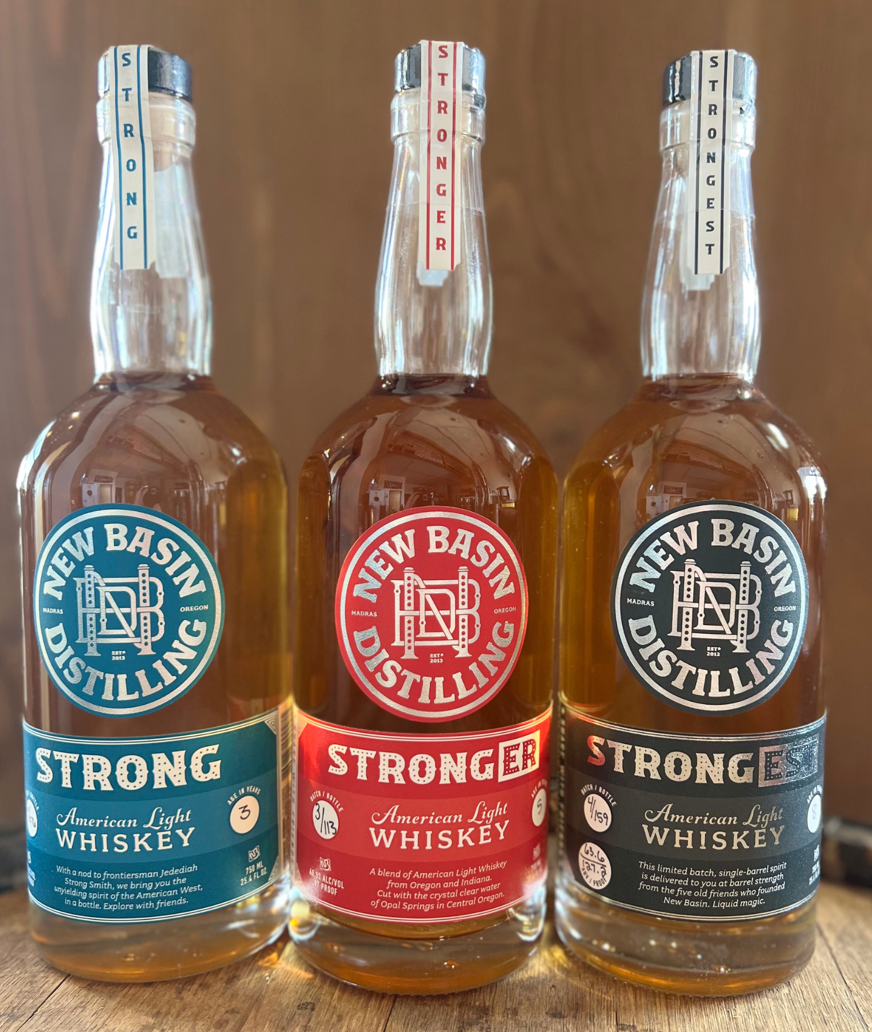
Molitor also pursued a markedly different category of American whiskey. New Basin’s Strong and Strongest American Light Whiskeys drew attention to a federally recognized but comparatively obscure whiskey classification. American light whiskey is distilled at a higher proof than bourbon and is aged in used or uncharred new oak containers. Strong was released at 80 proof, while Strongest appeared as a much older barrel-proof expression; a documented Strongest single barrel was 13 years old and bottled at 133.4 proof. Some of the mature light whiskey used for these expressions was sourced rather than distilled from New Basin’s estate grain, distinguishing it from the company’s rye and wheat whiskeys.
Oregon Bourbon also became an important part of the broader operation through Stafford’s Reserve, a small-batch bourbon associated with New Basin and bottled in both 92-proof and barrel-strength versions. Stafford’s Reserve earned a Platinum award at the 2024 SIP Awards, placing the bourbon among the better-recognized products connected with the Madras operation. New Basin’s current whiskey offerings extend well beyond the two estate-grain whiskeys with which Molitor helped establish the distillery’s reputation, encompassing rye, wheat, American light whiskey and bourbon expressions.
Rick and Kristina expanded the Madras business again in 2022 when they opened Whiskey Pie, a wood-fired pizza operation at New Basin. His family has also participated in the distillery’s development in another way: by 2019, Molitor’s son was studying food science and fermentation at Oregon State University and had helped New Basin improve the efficiency and effectiveness of its distilling procedures.
At present, Rick Molitor’s second career has already lasted over a decade, but the direction of his distillery suggests that the story is still being written. He left the familiar world of education to build something of his own, and in the years since, he has established himself as a respected Oregon distiller with a reputation for creating distinctive whiskeys rooted firmly in the place where they are made. By relying on local ingredients, Molitor has made Oregon more than simply the address of his distillery; he has made it part of the identity of the whiskey itself. As his son poises himself to perhaps take over the distillery, Molitor may have to yet again recognize the fact the “Resignation” is more than just the name of an award-winning whiskey. Hopefully, however, that will not happen anytime soon.
Sources:
KTVZ-TV NBC21, Bend, Oregon,, “Jefferson County Schools Supt. Molitor Resigning”, November 18, 2016, ktvz.com
The Whiskey Wash, “Whiskey Review: New Basin Distilling Company Resignation Rye Whiskey”, Sarah Coppola, June 26, 2018, thewhiskeywash.com
Portland Razor Co., “PR Collaborators: Rick Molitor of New Basin Distilling”, Hunter, July 17, 2019, portlandrazorco.com
BourbonBlog, “American Light Whiskey with New Basin Distilling”, BourbonBlog News, January 17, 2021, bourbonblog.com
The Whiskey Wash, “Whiskey Reviews: New Basin Distilling Company”, Kenji Mizumori, June 29, 2021, thewhiskeywash.com
New Basin Distilling Company official website, newbasin.com
Oregon Distillers Guild, “Oregon Distillers Map—New Basin Distilling”, accessed August 2026, oregondistillersguild.org
Oregon Whiskey Festival, “Distilleries of Oregon Whiskey Festival—New Basin Distilling Company”, oregonwhiskeyfestival.com
Contributed by Tracy McLemore, Fairview, Tennessee