Timo Marshall



Timothy C. “Timo” Marshall was born in September of 1971 in the small coastal community of Devon in southwest England. His relationship to spirits started early—his family had made sloe gin for generations, and Marshall learned that tradition from his grandmother. Each autumn, the family gathered the tart, dark blue fruit from blackthorn hedgerows and steeped it in gin, creating the drink that eventually supplied the first idea for Spirit Works Distillery.
Some years later in America, Marshall built both a marriage and a business partnership with Ashby Marshall, a West Coast native who had lived in Arizona, Oregon, Colorado, and California. Whiskey had been familiar to Ashby since childhood because her father drank rye, although it was her later exposure to early American craft producers that demonstrated how strongly individual grains, recipes and techniques could shape a whiskey. Timo and Ashby spent more than a decade working for environmental nonprofit organizations, including assignments that kept them at sea, and that background carried into their commitment to organic ingredients, local sourcing, sustainability, process control, and transparent production.
The couple initially hoped to reproduce the Marshall family’s traditional sloe gin in the United States by working with an existing distillery. Their research revealed that relatively few small producers made the underlying spirit themselves from raw grain; many instead purchased neutral alcohol. Timo and Ashby wanted a direct recreation, and more control over the product from its agricultural beginning. They surmised that the best way to do that was to change course and establish their own distillery. The couple spent several years visiting microdistilleries, taking courses and workshops, and gaining hands-on experience before committing themselves to the venture.
The Marshalls founded Spirit Works Distillery in 2011 and secured space at The Barlow, the redevelopment of a former apple-processing complex in Sebastopol, California. The couple conducted roughly six months of recipe development in the facility before opening the distillery to the public in June 2013. Timo became the enterprise’s operations manager, while Ashby took the role of head distiller, for in those earliest years, the couple handled nearly every part of the business themselves.
Sloe gin supplied the inspiration, but whiskey gave the Marshalls’ grain-to-glass philosophy its fullest expression. Spirit Works brought whole grain into the building and performed the milling, mashing, fermentation, distillation, aging, and bottling on site. Its equipment included a German-made hybrid pot still and a 21-plate rectification column, while the full production sequence allowed the distillers to monitor such variables as mash consistency, fermentation pH, and distillation cuts. The operation first depended heavily on organic California hard red winter wheat, the grain that also formed the base of its vodka and gins well as their first whiskey.
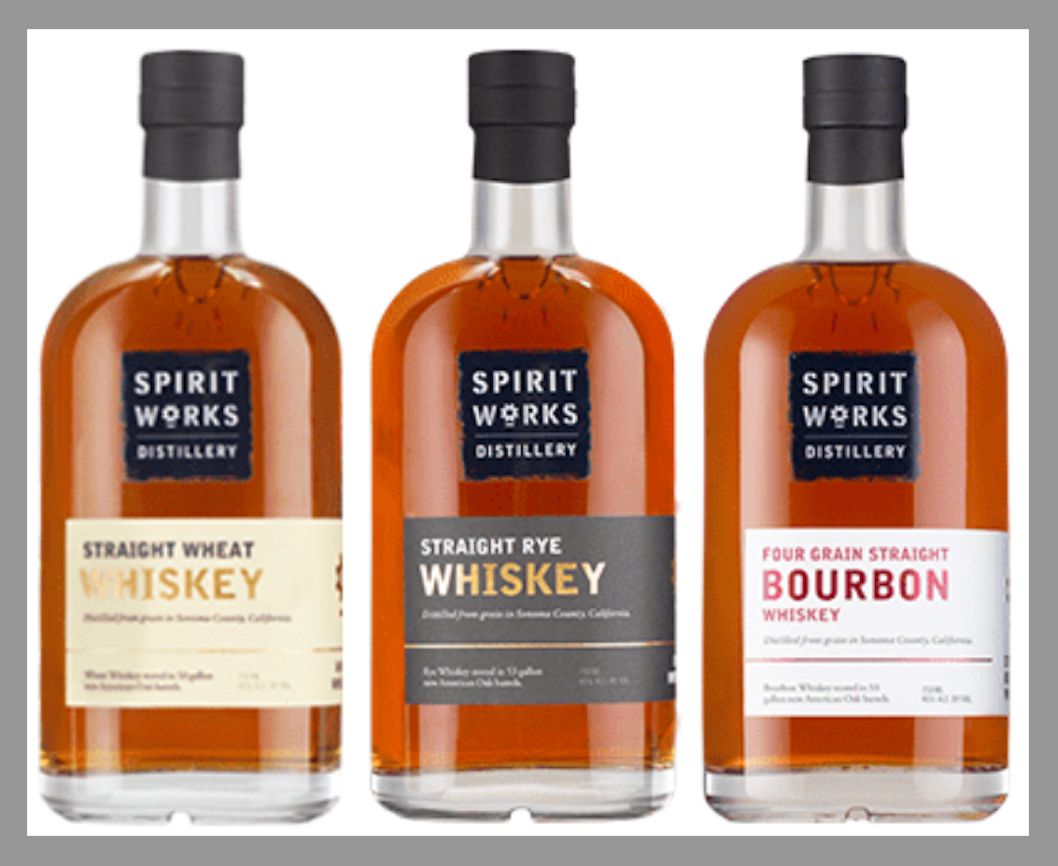
That spirit required unwelcome patience for a young company that needed products to sell. But by early 2015, Spirit Works had straight wheat whiskey and straight rye whiskey aging in full-sized, 53-gallon, newly charred American oak barrels. The wheat whiskey used 100 percent organic California red winter wheat, while the rye combined a majority of rye with malted barley. Ashby and assistant distiller Lauren Patz held responsibility for determining when the barrels were ready, and the company refused to release either whiskey merely because it had reached the two-year legal threshold for the “straight” designation.
Finally, Spirit Works’ Straight Wheat Whiskey was ready in December 2015. Bottled at 90 proof without chill filtration, it carried the same grain from the company’s clear spirits into a barrel-aged form and demonstrated the Marshalls’ belief that whiskey could foreground grain rather than allow oak to dominate it. Soon, the whiskey program expanded beyond wheat. Spirit Works Straight Rye settled on a high-rye formula that was aged in full-sized new American oak. The distillery also produced bottled-in-bond whiskey and experimented with finishes, including rye rested in barrels that had held its sloe gin. In April 2020, Spirit Works released its Four Grain Straight Bourbon Whiskey, the culmination of a longer aging program. The 90-proof bourbon was a proprietary blend of two bourbon recipes, with a combined grain composition led by 60 percent corn and supplemented by wheat, rye, and malted barley. Its grains were organic, its corn and wheat were California-grown, and the whiskey was mashed, fermented, distilled, and aged at Spirit Works for at least four years in 53-gallon new charred American oak barrels. That same year, the American Distilling Institute named Spirit Works its national Distillery of the Year, judging not only the spirits but also the company’s operating philosophy and practices. Timo’s operational work had supported that system, and he became a particularly visible advocate for disclosing recipes, sources, and methods in an industry he believed needed greater transparency.
California’s regulatory environment changed during the period of time that Spirit Works whiskey was maturing. Direct sales then gave the company a practical way to test small releases and receive immediate customer reaction. The tasting room’s large window into production reinforced the Marshalls’ original promise: visitors could see the machinery and the work behind the bottle rather than encounter an invented story detached from its source. By Spirit Works’ tenth anniversary in 2022, the company had grown from a two-person undertaking into a staffed distillery with a predominantly female production team. Ashby marked the anniversary by selecting two barrels for a limited eight-year-old rye, then the oldest Spirit Works release; one barrel showed strong fruit character, while the other presented a spicier profile. The distillery had also begun using Gazelle rye grown locally in Sebastopol, drawing its whiskey program still closer to the surrounding agricultural community. Its four-grain bourbon had become its best-selling whiskey, while straight wheat and straight rye preserved the grain-focused approach that distinguished the company from its beginning.
Timo Marshall supplied Spirit Works with an inherited English tradition, an operational discipline, and an outspoken commitment to showing how spirits are actually made. Meanwhile, his partner and wife turned their shared plan into a rigorous production program, directing the fermentations, distillation, barrel evaluation, blending, and staff development behind the whiskey. Together, they moved from environmental nonprofit work to a Sonoma County distillery whose central claim could be tested at every stage: the grain entered whole, the whiskey never left the premises during production, and the finished bottle carried the results of their own work.
Sources:
Cool Hunting, “Spirit Works Distillery,” Evan Orensten, March 14, 2014, coolhunting.com
Tales of the Cocktail Foundation, “At Spirit Works Distillery, Grain-to-Glass Is the Only Way,” September 2, 2015, talesofthecocktail.org
Food & Wine, “The Most Innovative Women in Food and Drink,” September 2016, foodandwine.com
Craft Spirits Magazine, “Spirit Works Distillery to Release Four Grain Straight Bourbon Whiskey,” Staff, April 7, 2020, craftspiritsmag.com
Healdsburg Tribune, “Spirit Works Wins Top Honors,” Rollie Atkinson, July 23, 2020, healdsburgtribune.com
Sonoma Magazine, “Passion Keeps Flowing for Sebastopol’s Spirit Works Distillery,” Sarah Doyle, October 10, 2022, sonomamag.com
Spirit Works Distilling official website, spiritworksdistilling.com
Contributed by Tracy McLemore, Fairview, Tennessee