T. J. Miller


Timothy Joseph Miller entered Texas whiskey at a time when the state’s modern distilling industry was still taking shape. Miller graduated from Nashville’s Vanderbilt University with a BS degree in political science followed by a Master of Business Administration (MBA) with a concentration in marketing and entrepreneurship. After college, he, Dennis Rylander, and Mark McDavid met while working for the same corporate employer. Away from their regular jobs, the three shared an enthusiasm for food, craft beer, and whiskey, experimented with home brewing, and began discussing the possibility of building a beverage company of their own. By 2007, those conversations had developed into plans for a business that would place a brewery and a whiskey distillery under one roof.
Miller supplied much of the distilling ambition behind the proposed enterprise, yet the three partners divided their responsibilities according to their strengths. Miller concentrated on whiskey production, McDavid directed marketing and sales, and Rylander handled financial matters. Their combined operation eventually became Ranger Creek Brewing & Distilling, a name taken from two Texas waterways, Ranger Creek and Leon Creek. The founders called the hybrid business a “brewstillery,” a concise description of a facility that could make both beer and distilled spirits from grain.
Ranger Creek opened in 2010, occupying a roughly 7,500-square-foot facility in San Antonio. It became Texas’ first combined brewery and distillery and the first legal distillery within San Antonio’s city limits since Prohibition. Miller served as co-founder and head distiller, while the brewing and distilling sides shared raw materials, equipment, technical knowledge, and production space. Beer could be sold relatively quickly, helping the young company operate while its whiskey matured in oak—a practical advantage for a new distillery facing the unavoidable delay between filling a barrel and selling aged whiskey.
Miller developed Ranger Creek’s whiskey program around a grain-to-glass philosophy. Texas corn was milled, mashed, fermented, distilled, barreled, matured, and bottled at the San Antonio facility rather than purchased as finished whiskey from an outside producer. The distillery’s connection to brewing was important because whiskey begins with many of the same processes used to make beer: grain is crushed, mixed with water, converted into fermentable sugars, and fermented before distillation. Ranger Creek’s combined operation allowed Miller to approach whiskey as both a brewer and a distiller, following the grain from its raw state through fermentation and finally into the barrel.
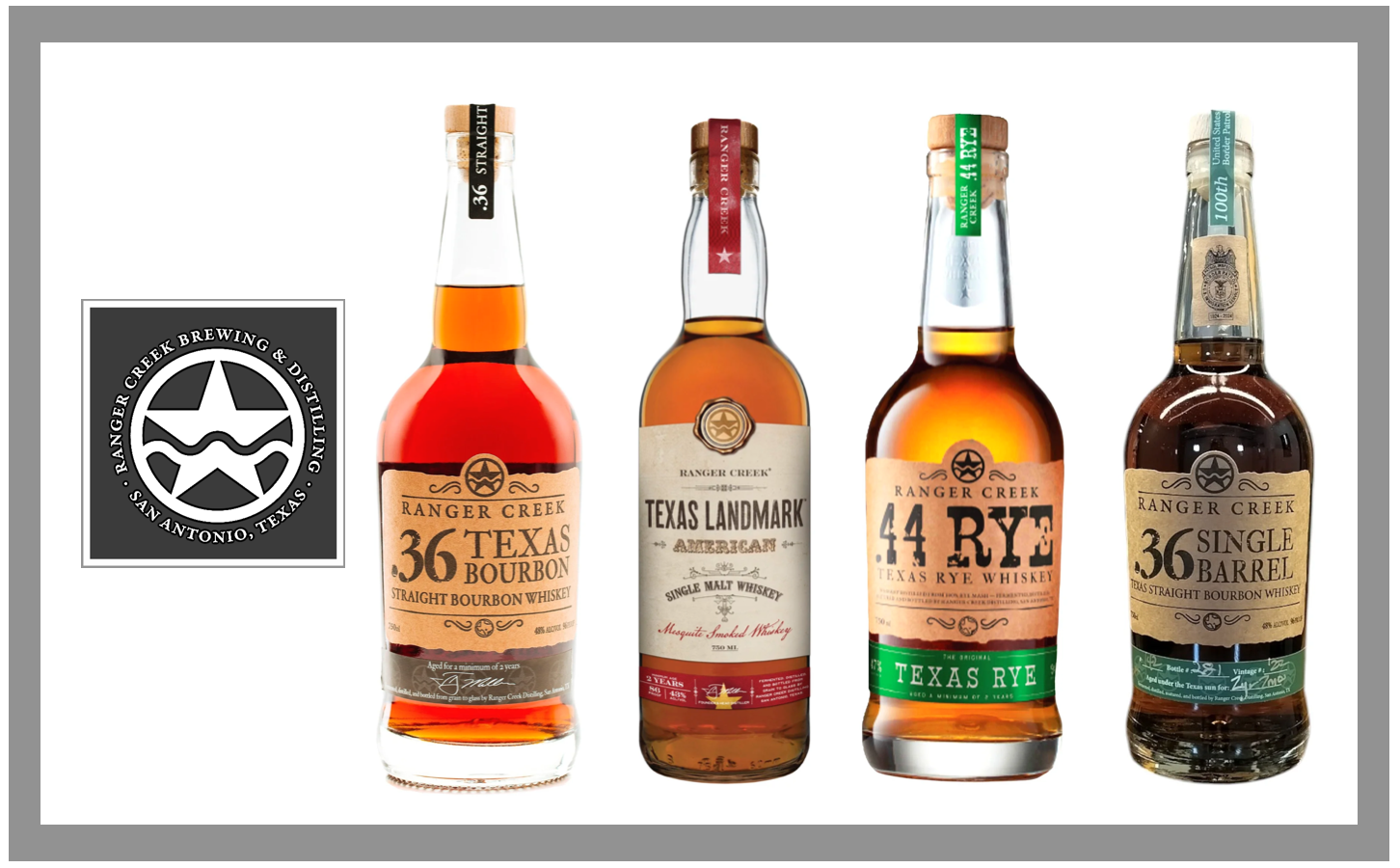
The flagship expression became Ranger Creek .36 Texas Bourbon, named for the .36-caliber revolver associated with the Texas Rangers. It was made with Texas corn, double distilled, and initially matured in small new charred-oak barrels, commonly holding five or ten gallons. Those smaller barrels exposed a greater proportion of whiskey to wood than conventional 53-gallon bourbon barrels, accelerating extraction during maturation. San Antonio’s heat also drove whiskey into and out of the oak as temperatures changed, giving Miller a distinctly Texas set of aging conditions rather than an imitation of a Kentucky warehouse environment.
The early .36 releases appeared in 375-milliliter bottles, a size chosen to correspond with the small barrels used during maturation. Each bottle carried production information such as its batch number, bottle number, season, and maturation period, reinforcing the small-batch character of Miller’s work. The whiskey was bottled at 96 proof and quickly developed a reputation beyond San Antonio. It received a double-gold medal from The Fifty Best, a gold medal from the Beverage Testing Institute, a bronze medal from the American Distilling Institute, and a score of 93 in the 2014 edition of Jim Murray’s Whisky Bible.
Miller did not restrict Ranger Creek to bourbon. The distillery produced .44 Texas Rye, an unusual whiskey made from 100 percent malted rye and matured in barrels that had previously held .36 bourbon. At the 2015 American Craft Spirits Association competition, .36 Texas Bourbon earned a gold medal and .44 Texas Rye received silver. The results placed both sides of Miller’s whiskey program—corn-based bourbon and rye whiskey—among recognized American craft spirits.
Rimfire expanded his work into American single malt. Miller created the whiskey from malted barley smoked with Texas mesquite, replacing the peat smoke associated with some Scotch whiskies with a material closely tied to Texas cooking and barbecue. Each batch required approximately 150 pounds of mesquite-smoked malt, and the resulting whiskey was bottled at 86 proof. Rimfire preserved the structural idea of smoked malt whisky while expressing it through Texas grain, wood smoke, climate, and production.
T.J. Miller’s central achievement in whiskey was to assemble the sum total of location, friendship, capital, brewing, and distilling, and production program into one successful enterprise. From a vague idea to an award-winning rye to a Texas bourbon, Ranger Creek Distilling has become a functioning continuation of a San Antonio story—one expressed through local grain, copper-pot distillation, oak barrels, and expertly-aged Texas whiskey.
Sources:
San Antonio Express-News, “Ranger Creek Brewing & Distilling Is Up and Running,” Jennifer McInnis, September 22, 2010, mysanantonio.com
Texas Cooking, “Ranger Creek: Texas’ First Brewstillery,” June 2011, texascooking.com
San Antonio Express-News, “Ranger Creek Brewing & Distilling,” Edmund Tijerina, February 23, 2015, expressnews.com
San Antonio Current, “More Awards for Ranger Creek Brewing & Distilling,” Jessica Elizarraras, February 24, 2015, sacurrent.com
The Whiskey Reviewer, “Ranger Creek Texas Whiskey Comes to Nashville,” February 3, 2014, whiskeyreviewer.com
The Whiskey Reviewer, “Brewstilling: Making Beer and Whiskey Under One Roof,” June 20, 2016, whiskeyreviewer.com
Ranger Creek Brewing & Distilling official website, drinkrangercreek.com
Texas Whiskey Trail, “Greetings from the Texas Whiskey Trail: October 2025,” October 2025, texaswhiskey.org
Contributed by Tracy McLemore, Fairview, Tennessee