Ty Phelps


Ty Adam Phelps entered whiskey through the brewhouse, carrying more than a decade of professional brewing experience into one of Texas’s most distinctive single-malt distilleries. Phelps was born June 24, 1977, and while not much is known of his personal life prior to college, he is a member of Southwestern University’s class of 1999. He then progressed his career in Austin, Texas, where he developed the practical command of grain, fermentation, flavor, and production that ultimately shaped Andalusia Whiskey Company. But first, in January 2002, Phelps joined North by Northwest (NxNW) Restaurant & Brewery in Austin. North by Northwest combined a working brewery with a restaurant, giving him responsibilities that extended into the broader demands of hospitality and commercial production. By 2007, he was the brewpub’s brewmaster, and his beers included an Okanogan Black Ale made with roasted malts. His later creations included an Irish stout and a Kriek-style beer aged in wine barrels and blended with cherries.
Phelps left NxNW in November 2010 after 9 years there and moved to Real Ale Brewing Company in Blanco, Texas. At Real Ale he was a brewer and cellar operator and also gained distilling experience as that company began to develop its spirits program. Also, at Real Ale he met Tommy Erwin, the brewery’s microbiologist and laboratory manager. Their skills were complementary: Phelps brought extensive brewing and restaurant experience, while Erwin contributed formal work in microbiology, chemistry, and quality control. After several years together at Real Ale, Phelps and Erwin decided to establish their own Texas distillery centered on whiskey.
The plans the duo conceived eventually formed Andalusia Whiskey Company, and it finally opened in 2016 along U.S. Highway 281 outside Blanco. The name came from old documents identifying the property as part of Andalusia Ranches. The surrounding hills also recalled Andalucía in southern Spain, giving the company a name tied both to the land’s recorded history and its appearance. Although the Spanish reference supplied the identity, the production philosophy came from Phelps and Erwin’s years in Texas brewing: make whiskey from grain on site, apply careful fermentation, and use the character of malted barley as the foundation rather than imitate the corn-heavy bourbon model that dominated American whiskey.
From the beginning, the distillery was designed as a grain-to-glass operation. Andalusia mashes, ferments, distills, matures, and bottles its whiskey in Texas, using a handmade 250-gallon copper pot still. Its production incorporates American and Texas malted barley, while rainwater collected at the property is used in the process. A 56,000-gallon rainwater tank reduces the operation’s demand on local water resources, and spent grain is fed to livestock living around the distillery, including cattle, sheep, chickens, and a llama. These practical choices connected the distillery’s agricultural surroundings to the everyday work of whiskey production. Phelps’ wife, Ericka, was also deeply involved in the operations at Andalusia Whiskey Co., handling tasks such as sealing, capping, and hand-labeling bottles.
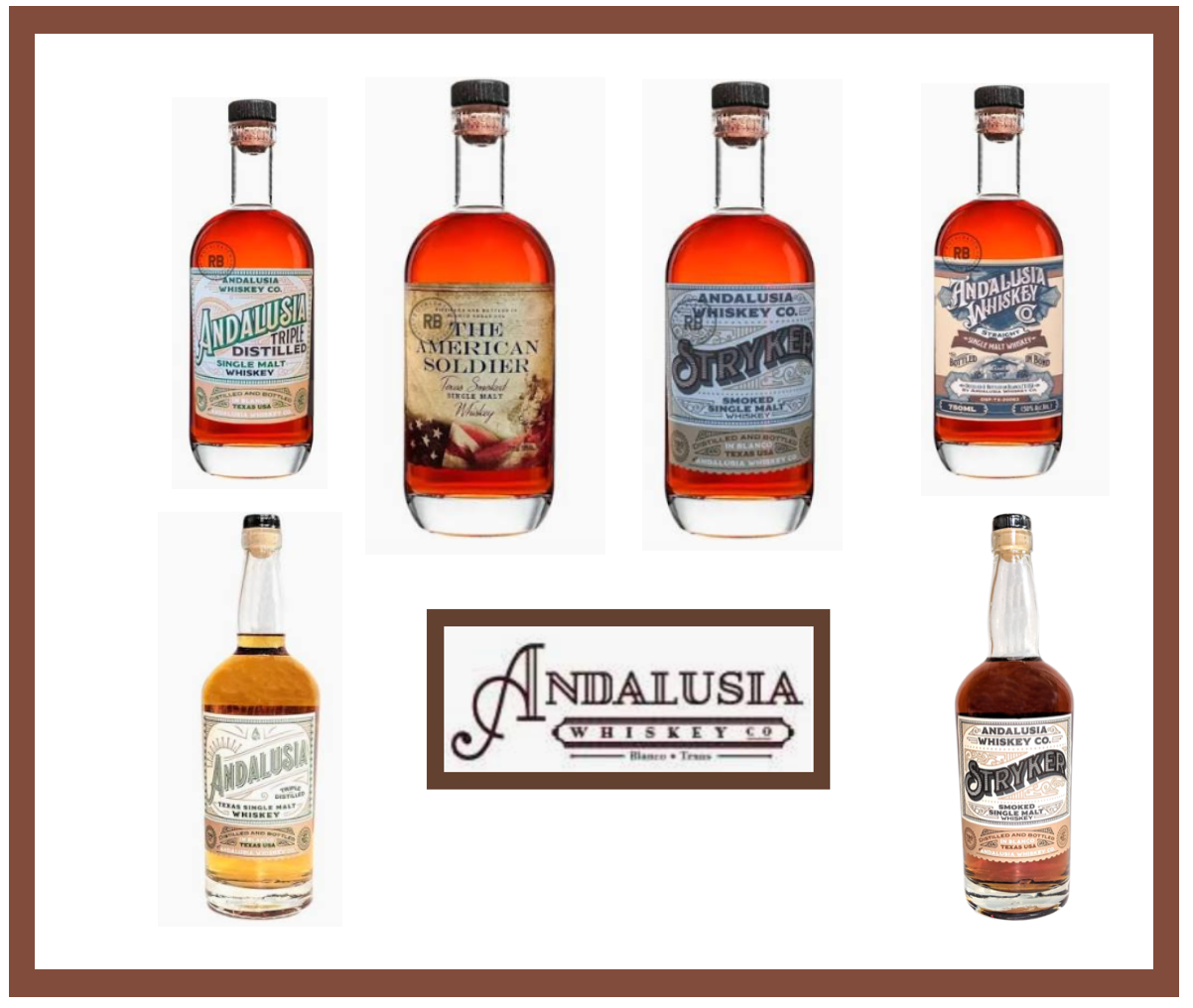
Phelps built Andalusia’s core range around three interpretations of malt whiskey. Triple-Distilled follows an Irish-influenced method in which the spirit passes through copper three times, producing a lighter-bodied distillate before maturation in charred American oak. Revenant Oak is made from 100 percent malted barley that is peat smoked and maturing in used bourbon barrels, allowing smoke, malt, and previously seasoned oak to work together. Stryker is made from 100% malted barley that swaps traditional Scottish peat for a Texas BBQ-inspired kiln process, where the grains are hand-smoked in-house over oak, mesquite, and apple woods before undergoing double distillation in copper pot stills. All three principal expressions are bottled at 100 proof, maintaining a consistent strength across distinctly different treatments of barley. Yet Stryker became Phelps’s most recognizably Texan whiskey. Scottish distillers traditionally dry malt over peat to introduce smoke, but Stryker replaces peat with oak, mesquite, and applewood, the three woods used in a typical Texas barbecue. Phelps and the Andalusia team constructed their own smokehouse, giving them control over the smoking duration, intensity, and combination of woods applied to the barley. The whiskey is then mashed, fermented, double-distilled in copper, and aged in oak. It is not a flavored whiskey or a conventional bourbon; the smoke enters through the malt before fermentation and remains part of the spirit from its creation.
Andalusia received national recognition in 2021 when Whisky Advocate awarded Stryker 93 points and placed it twentieth among its Top 20 Whiskies of the ear. It was the only Texas whiskey included on that international list. The honor established that Phelps’s barbecue-inspired treatment of malt could stand on its own as serious American single-malt production rather than as a regional novelty. Texas whiskey author Nico Martini likewise identified Phelps’s work at Andalusia as one of the state’s leading examples of single-malt whiskey, emphasizing the quality and originality of the spirit.
The distillery continued exploring barrel finishes and independent bottlings as its whiskey stocks matured. Andalusia reached another milestone at the 2025 World Whiskies Awards. Stryker Ex Haak Madeira Cask Finished Single Malt, bottled at 57.7 percent alcohol by volume, was named the World’s Best Small Batch Single Malt. The whiskey began with Stryker’s oak-, mesquite-, and applewood-smoked barley, matured in new charred oak, and then spent an additional six months in Madeira casks. Its victory placed a Texas-made, barbecue-smoked single malt at the head of an international category less than a decade after Andalusia opened.
Phelps’s documented career forms a clear progression from restaurant brewing to commercial brewing, distilling, and internationally-honored malt whiskey. At Andalusia, he did not abandon his brewing education when he entered whiskey; he made it the center of the enterprise. Triple distillation, peat, Texas smoking woods, new oak, used bourbon barrels, and finishing casks became different ways of revealing what malted barley could produce in the Texas Hill Country. Now, the small Blanco distillery that began with two brewery colleagues has earned recognition for its single malt whiskeys, both their technical complexity and for their unmistakable interpretation of how a Texas whiskey should impact the senses.
Sources:
Andalusia Whiskey Company official website, andalusiawhiskey.com
LinkedIn, “Profile: Ty Phelps—Founder, President of Andalusia Whiskey Co., linkedin.com
Austin Chronicle, “A Disaster Brewing,” Lee Nichols, January 25, 2008, austinchronicle.com
Texas Hill Country, “Try It on the Rocks at Andalusia Whiskey Company Near Blanco,” Honky Tonk Foodie, February 1, 2018, texashillcountry.com
Whisky Advocate, “The Bold Places and People Shaping Texas Whiskey,” no author given, January 13, 2022, whiskyadvocate.com
American Whiskey Magazine, “Texas Whiskey’s Diverse Creations,” no author given, no date given, americanwhiskeymag.com
San Antonio Current, “San Antonio-Area Andalusia Whiskey Co. Releases Special Bottled-in-Bond Texas Whiskey,” Nina Rangel, November 18, 2020, sacurrent.com
Lost Lantern Whiskey, “Introducing Andalusia Whiskey Co.,” Adam Polonski, September 18, 2023, lostlanternwhiskey.com
Contributed by Tracy McLemore, Fairview, Tennessee