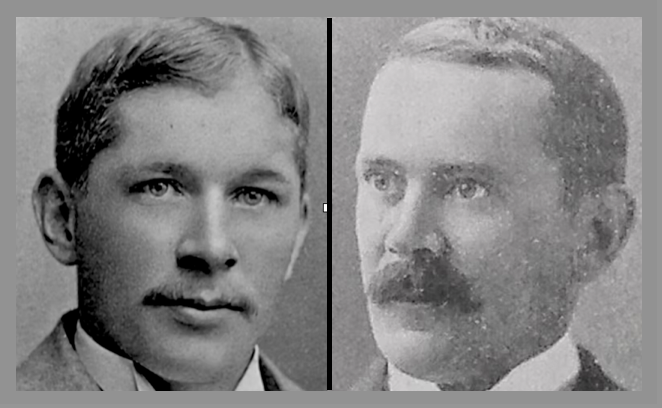
Walter GG Pattison and Robert Pattison
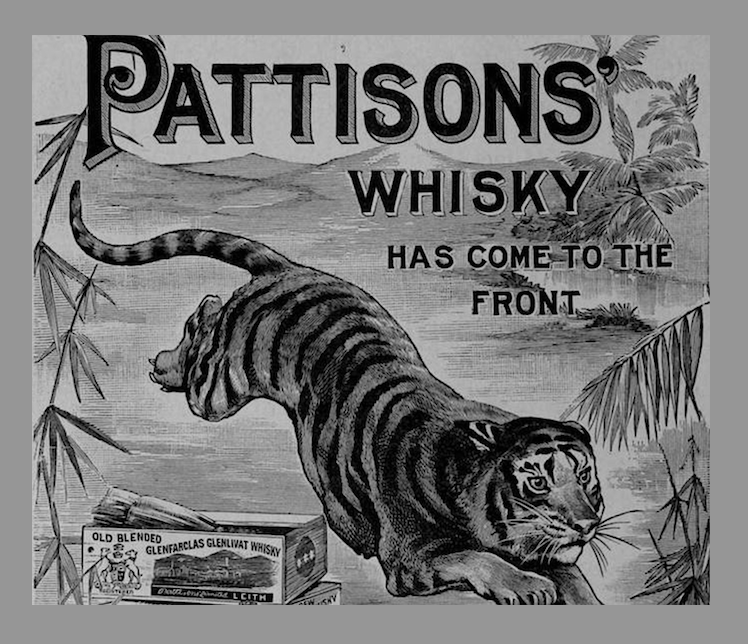

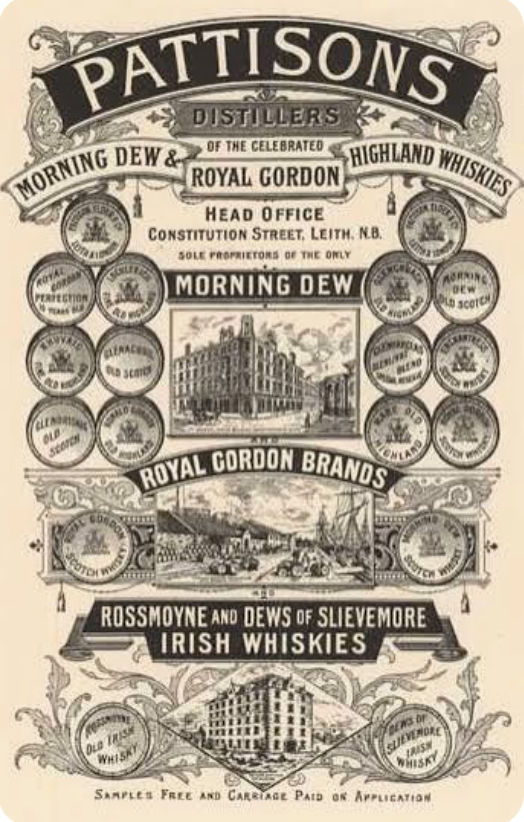
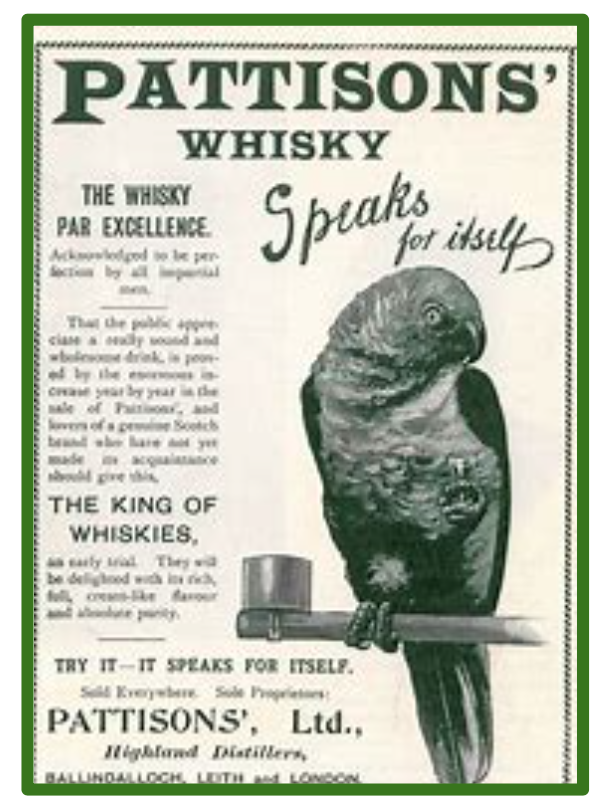
Their marketing campaigns became legendary. Pattisons spent extraordinary sums on advertising, far beyond what many competitors considered prudent. One famous promotion involved distributing approximately 500 African grey parrots to retailers. The birds were reportedly trained to repeat slogans such as “Buy Pattisons Whisky!” and “Pattisons Whisky is Best!” Such publicity stunts attracted enormous attention and reinforced the image of Pattisons as a company that knew no limits. By the late 1890s the firm employed an exceptionally large sales force and was spending tens of thousands of pounds annually on advertising alone—an astonishing figure for the era.
Walter G.G. Pattison and his elder brother Robert Pattison occupy a unique place in Scotch whisky history. During the 1890s they helped transform blended Scotch from a growing commercial product into a heavily marketed international commodity. At the height of their success they appeared to embody the optimism and wealth of Victorian Scotland. Yet within a few years their company collapsed in one of the most notorious financial failures ever to strike the whisky trade. The “Pattison Crash” of 1898 devastated investors, damaged dozens of whisky businesses, and ushered in a prolonged industry downturn. More than a century later, the Pattison brothers remain remembered not for a great whisky, but for a spectacular rise and an even more spectacular fall.
The brothers were born into a respectable Edinburgh business family. Their father, Walter Pattison, was a dairy wholesaler and insurance agent who built a successful commercial enterprise in the city. Contemporary accounts show that Robert and Walter grew up in an environment shaped by commerce rather than distilling. The family business was originally concerned with dairy products, and neither brother began his career in the whisky trade.
The brothers entered business through the family firm and demonstrated considerable commercial ambition from an early age. In 1882 they formed Pattison, Elder & Co. with Alexander Elder. By the mid-1880s they had recognized a remarkable opportunity developing within the Scotch whisky industry. The phylloxera epidemic had devastated French vineyards and sharply reduced supplies of brandy, which had long been the preferred spirit of many affluent consumers. Scotch whisky producers rushed to fill the gap, and demand expanded dramatically throughout Britain and overseas. The Pattisons saw the trend and moved aggressively into whisky blending and marketing.
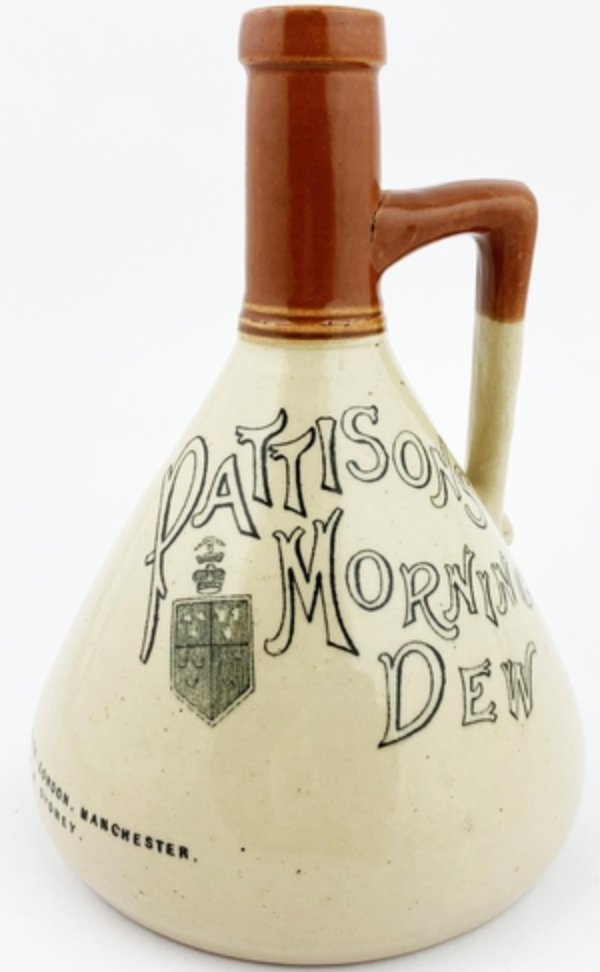
Beginning in 1887, the brothers blended and sold their own whiskies. Their principal brands included Morning Dew and Royal Gordon, among others. Their subsequent growth, culminating in the floatation of the company on the London Stock Exchange, can only be described as meteoric. Receiving around £150,000 from the IPO in 1896, the brothers, now operating as Pattisons Ltd, began spending on business as well as pleasure. At a time when many whisky merchants still relied on traditional methods of promotion, the Pattisons embraced modern advertising with unprecedented enthusiasm. They understood that branding could be as important as the whisky itself.
As profits appeared to soar, the brothers cultivated reputations for extravagant living. Contemporary observers frequently described them as symbols of the excesses of the whisky boom. They entertained lavishly, maintained expensive lifestyles, and projected an image of almost limitless wealth. The company itself behaved in a similarly expansive manner. Pattisons acquired interests in several distilleries, including shares in Aultmore and Oban, a half share in Glenfarclas, and interests in the Ardgowan grain distillery. They also purchased other businesses outside whisky, including a brewery. To investors and competitors alike, the brothers appeared unstoppable. Walter acquired several Edinburgh townhouses, while Robert purchased a grand country home at Clovenfords in the Scottish Borders. The brothers often commuted from their ostentatious abodes to the city by private train. Always aware of their position in the press, they typically made sure that newspaper folk were on hand to document their journey.
Yet beneath the surface, the foundations of their success were becoming dangerously unstable. The whisky industry as a whole had entered a speculative boom. Distilleries expanded production rapidly in anticipation of ever-growing demand. Whisky stocks accumulated at unprecedented levels. What had once been a shortage market gradually became a market burdened by excess inventory. While the industry was becoming increasingly vulnerable, Pattisons pursued growth with exceptional aggressiveness and relied heavily on credit.
The company’s accounting practices eventually proved even more troubling. Investigations later revealed that profits had been overstated, assets overvalued, and dividends paid from capital rather than genuine earnings. The brothers also engaged in transactions that created a misleading impression of prosperity. According to evidence presented after the collapse, stock was bought and sold in ways that inflated apparent performance. Creditors and investors were led to believe the company was stronger than it truly was.
The crisis erupted in December 1898. Pattisons had accumulated significant debts, including a large unpaid balance owed to the powerful Distillers Company Limited (DCL). When confidence began to falter, the financial structure underpinning the company quickly unraveled. Shares collapsed, creditors demanded payment, and the true condition of the business became impossible to conceal. What followed became known as the Pattison Crash.
The consequences extended far beyond a single company. Pattisons owed creditors hundreds of thousands of pounds, an immense sum at the time. Numerous businesses that had supplied or financed the company found themselves exposed to severe losses. Distilleries that had expanded during the boom suddenly faced a much harsher commercial environment. Whisky prices fell, investment dried up, and a prolonged industry contraction followed. Some historians have described the Pattison Crash as the greatest disaster to strike Scotch whisky before American Prohibition.
The collapse also triggered criminal investigations. Authorities discovered evidence of fraudulent practices, including the sale of inferior whisky mixed with small quantities of higher-quality spirit and marketed under premium descriptions such as “Fine Old Glenlivet.” Prosecutors charged the brothers with fraud and embezzlement. Their trial attracted widespread public attention because the defendants had become famous figures during the whisky boom years.
In 1901 the brothers were convicted. Robert Pattison received an eighteen-month prison sentence, while Walter received a shorter sentence of approximately nine months. The verdict confirmed what many investors had come to suspect: much of the spectacular prosperity associated with Pattisons had been built upon deception and financial manipulation rather than genuine profitability. The convictions effectively ended the brothers’ business careers and permanently damaged their reputations. Both Walter and Robert had married and had children, but their prolonged notoriety effected their families to refuse any attempt to recount inheritance to the Pattison line
Meanwhile, some competitors actually emerged stronger from the disaster. Distillers Company Limited weathered the crisis and was able to acquire assets at greatly reduced prices. Many weaker firms disappeared, while stronger organizations consolidated their positions within the industry. The Scotch whisky trade eventually recovered, but the speculative excesses of the 1890s were not forgotten. For decades afterward, the Pattison name served as a cautionary example of what could happen when ambition outran financial discipline.
Today, Walter G.G. Pattison and Robert Pattison remain among the most consequential figures in Scotch whisky history. They helped pioneer modern whisky marketing, demonstrated the power of branding, and accelerated the expansion of blended Scotch during a crucial period of growth. Yet their greatest legacy is the warning embodied by the Pattison Crash itself. Their story illustrates how rapidly commercial triumph can turn into catastrophe when speculation, excessive borrowing, and misleading accounting replace sound business practices. In the history of Scotch whisky, few rises were more dramatic, and few falls were more complete.
Sources:
Scotch whisky.com, “The Pattison Brothers”, Gavin D. Smith, 30 November 2015, scotchwhisky.com
Difford’s Guide, “The Pattison Crisis”, diffordsguide.com
The Scotsman, “The Pattison Bros: The Men Who Nearly Brought Down the Scotch Whisky Industry,” Sean Murphy, 21 September 2023, foodanddrink.scotsman.com
Whisky Magazine Issue 52, Ian Buxton, “Bring on the Bulls?”, Ian Buxton, November 2005, whiskymag.com
Scottish Delight, “The Pattison Crash”, scottishdelight.com
Contributed by Tracy McLemore, Fairview, Tennessee USA