Chris Seals



Christopher C. Seals is a Kansas City native born in August of 1974. Early in his life, Seals developed an appreciation for agriculture during childhood visits to his great-grandfather’s Missouri farm. He later made a life in Sulphur Springs, Texas before attended the University of Texas at Austin, graduating in 1996. He then earned a Master of Business Administration degree from the University of Houston. Seals then spent approximately 15 years as an economist and consultant working in sustainable development, environmental policy, risk management, and regional planning. His assignments took him to all 50 states and more than 40 countries, where he helped governments, communities, and businesses consider economic growth alongside energy use, environmental impact, and long-term sustainability.
The idea that redirected his career came from his father, Cleveland Seals. In 2012, Cleveland retired and proposed starting a craft whiskey distillery in Austin. Chris understood the financial hazards: distilleries require expensive equipment and years of operation before their maturing whiskey can generate substantial revenue. He nevertheless agreed to conduct a feasibility study, partly because the project would allow father and son to travel together, visit distilleries, study whiskey, and spend time together. Chris initially expected the numbers to persuade them not to proceed, but changes in Texas law made operating a craft distillery more practical, and the study gradually became a business plan.
Chris and Cleveland joined two other couples—Andrew and Lisa Braunberg and Sal and Joanna Salinas—to establish Still Austin Whiskey Co. Each brought a useful professional discipline to the venture. Chris contributed economic analysis and business leadership; Andrew Braunberg oversaw production; Lisa Braunberg handled marketing; and attorney Joanna Salinas managed legal and regulatory matters. The partners were united by a determination to make an authentic Austin whiskey instead of purchasing finished spirit from another producer and bottling it under a local label. They wanted control over the entire process, beginning with Texas grain and ending with whiskey distilled, matured, and bottled in Austin.
That goal proved difficult before a drop of whiskey reached a barrel. Austin had not contained a whiskey distillery since Prohibition, and municipal approval of the proposed operation required 37 months. The founders worked through fire, engineering, zoning, and safety requirements while developing relationships with farmers and other suppliers. When the nearest conventional grain elevator proved to be approximately 300 miles away, the company began dealing more directly with Texas growers. Still Austin finally opened its doors at The Yard in Austin’s St. Elmo district on September 23, 2017.
The distillery’s early releases reflected the unavoidable timetable of whiskey maturation. Still Austin sold New Make Whiskey produced from its bourbon mash and introduced infused versions called Mother Pepper and Daydreamer while its barrels aged. Mother Pepper incorporated chile pequin, smoked serrano, and aji amarillo peppers, while Daydreamer used Valencia orange, tangelo, and bergamot. These products helped introduce the distillery’s grain spirit to consumers, but properly matured bourbon remained the central objective.
Seals built the company around a genuine grain-to-glass system. Still Austin mills, mashes, ferments, distills, matures, blends, and bottles its whiskey, using grain grown by Texas farmers. Its flagship bourbon mash bill consists of 70 percent white corn, 25 percent rye, and 5 percent malted barley. White corn supplies the bourbon’s foundation, while the unusually substantial rye component gives it a pronounced sweet-spice character. The company’s commitment to local agriculture also supports Seals’s earlier work in sustainability: Still Austin obtains grain from family-owned farms, operates with renewable energy, incorporates water- and energy-conservation measures, and returns spent grain to farmers for livestock feed.
At that time, production expertise came from a team. Veteran distiller Mike Delevante helped develop the production system, John Schrepel became head distiller, and sensory specialist Nancy Fraley shaped maturation and blending as master blender. Fraley introduced a gradual proof-reduction method derived from the French petites eaux, or “little waters,” tradition. Instead of adding the full quantity of water immediately before bottling, the process reduces whiskey gradually during maturation, allowing water, alcohol, and flavor compounds time to integrate. Seals’s principal role has remained that of co-founder and chief executive officer: defining the company’s direction, assembling expertise, building its agricultural and community relationships, and connecting the whiskey to Austin’s identity.
Still Austin reached its defining commercial milestone in July 2020 with the release of its first high-rye straight bourbon, later identified with the label character “The Musician.” Made entirely with Texas-grown grain, the bourbon was aged for at least two years in new charred American oak barrels and bottled at 98.4 proof. Its 70-percent-white-corn, 25-percent-rye, and 5-percent-malted-barley formula balanced corn sweetness with rye spice. The Musician also established Still Austin’s visual practice of presenting its principal whiskeys through characters created in collaboration with local artists, connecting the bottles to the city’s music and arts culture. The portfolio expanded with a cask-strength version of the bourbon and a straight rye called “The Artist.” The rye uses 100 percent Texas-grown rye, is aged for at least two years, and is bottled at 99.6 proof in its standard form. Limited distillery releases broadened the range further, including whiskeys made with malted blue corn, oated bourbon, sherry-cask-finished rye, double-barreled bourbon, and individually selected cask-strength barrels. These expressions demonstrated how different Texas grains, barrel treatments, and proofing methods could work within the distillery’s locally-rooted production system.
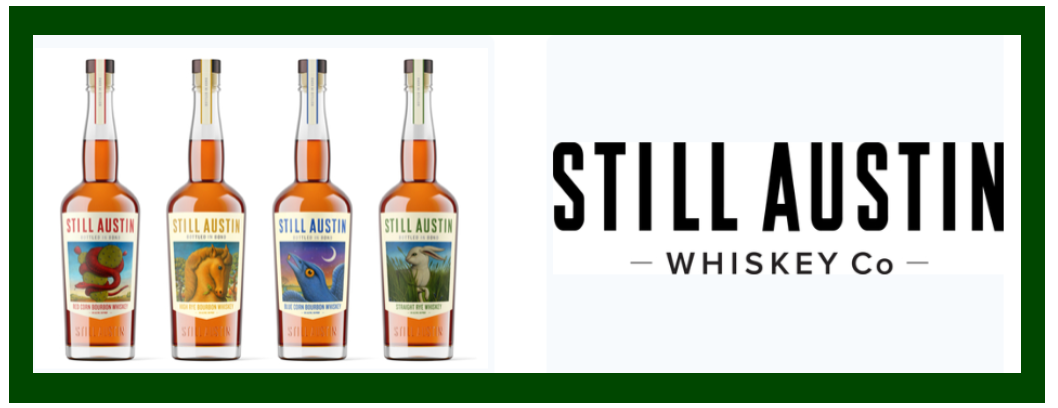
In 2023, Still Austin began a seasonal bottled-in-bond series, a major step for a young grain-to-glass distillery. The sequence included Red Corn Bourbon for summer, high-rye Straight Bourbon for fall, Blue Corn Bourbon for winter, and a 100-percent Texas rye for spring. The original Blue Corn Bourbon combined 26 percent blue corn, 25 percent white corn, 44 percent rye, and 5 percent malted barley, while the Red Corn Bourbon brought together red corn, white corn, rye, and barley. By 2026, selected bonded releases had reached six or seven years of age, providing a mature extension of the work begun when the first barrels were filled in 2017.
Still Austin subsequently developed Tanager, a cigar-blend bourbon assembled from white-corn, red-corn, and blue-corn bourbon stocks, further demonstrating Fraley’s blending role and the production team’s continuing experiments with grain. The company also grew beyond Texas, establishing national distribution while retaining its South Austin distillery and tasting room. By 2024, it was identified as the fastest-growing whiskey brand in Texas, competing in a state where hundreds of whiskey labels were sold through retail chains.
Seals’s next major undertaking extended the company’s whiskey-centered identity into hospitality. Still Austin announced a 15,000-square-foot destination called the Still Austin Quarter, scheduled to open in September 2026 near the existing distillery. Inspired by The Musician on the flagship bourbon label, the project includes a cocktail destination, a vinyl lounge, a live-performance room, and private-event space. It represents the larger idea that has guided Seals since the original feasibility study: whiskey can carry the character of its grain, its makers, and the community in which it is produced.
Seals is married with two daughters and a son. His oldest daughter, Tressa, recently married, giving him his first son-in-law. Yet Seals is best known as the business architect behind one of Texas’s most notable grain-to-glass whiskey producers. Still Austin is a company that moved from an uncertain father-and-son experiment to mature bonded bourbon without abandoning its commitment to Texas grain and Austin production.
Sources:
Still Austin Whiskey Company official website, stillaustin.com
Austin Young Men’s Business League, “Speaker Series—Still Austin Whiskey Co./Chris Seals”, March 2, 2022, austinymbl.org
FoundingAUSTIN, “Distilling the Spirit of Austin”, April 16, 2017, foundingaustin.com
Voyage Austin, “Meet Chris Seals of Still Austin Whiskey Co.”, March 9, 2021, voyageaustin.com
Craft Spirits Magazine, “Still Austin Whiskey Releases Its 1st High-Rye Straight Bourbon with 100% Texas Grains”, July 22, 2020, craftspiritsmag.com
American Whiskey Magazine, “Still Austin: Texas Forever”, americanwhiskeymag.com
Forbes, “How Still Austin Crafts Its Exceptional Texas Whiskeys,” Joseph V. Micallef, January 8, 2025, forbes.com
Contributed by Tracy McLemore, Fairview, Tennessee