Christian Stromberg


Christian J. Stromberg was born on September 21, 1971. He grew up in a blue-collar manufacturing town in Connecticut where work was an expected part of childhood. At an early age, he was given a paper route, and he also spent time in the metal-parts factory established by his Lithuanian grandfather. Manufacturing consequently became familiar territory long before Stromberg made spirits. After attending Kingswood Oxford School, where he graduated in 1989, he studied engineering at Rensselaer Polytechnic Institute. There he completed a cooperative work assignment at aircraft manufacturer Pratt & Whitney working in the world of jet engines.
In that way, engineering became Stromberg’s first career. For approximately 15 years Stromberg worked in fields that included steel, aircraft, automotive manufacturing, electronics, and fiber optics. Yet he wanted to own a business rather than remain an engineer working for someone else. After moving to Vermont, he took an engineering position with a smaller company, hoping to improve its manufacturing processes, but that job did not last. He subsequently traveled around the world and when he returned, he was more determined than ever to establish a business of his own.
The deeper roots of his eventual distilling career stretched back another generation. Stromberg’s ancestors fled Russian-controlled Lithuania in the early twentieth century, carrying with them traditions that included homemade flavored liquors. His great-grandfather settled in Pennsylvania and died young while working as a coal miner, leaving Stromberg’s great-grandmother with nine children to support. During the Depression, she made and sold moonshine, an unlikely but necessary and genuine part of the family history. Stromberg himself experimented with distillation while in college, although at that point spirits remained nothing more than a casual interest.
Vermont supplied the ingredient that ultimately gave his business its identity. Stromberg became familiar with maple production by visiting friends’ sugarhouses during the spring and developed considerable respect for the labor involved in turning maple sap into high-quality syrup. At the same time, he had inherited a family tradition of making Krupnikas, the Lithuanian honey-based cordial. He began considering what would happen if Vermont maple syrup took the place of honey in a spirit inspired by that old family tradition.
In 2006, Stromberg founded Saxtons River Distillery along the Saxtons River in Cambridgeport, Vermont. Its original production facility was a lightly heated barn he had built himself, and in the beginning Stromberg performed virtually every job. He was making and bottling the product, while also trying to sell it throughout the Northeast. His first commercial creation was Sapling Maple Liqueur, made by combining corn-based spirit with locally produced Vermont maple syrup and allowing oak aging to bring additional character to the maple flavors. By November 2007, Sapling was already being distributed through Vermont liquor stores. The business soon required Stromberg to learn something engineering had not taught him: salesmanship. Creating and manufacturing a spirit was only part of building a distillery, and he soon realized that even an excellent liquor could disappear if its maker failed to market it properly. In-store tastings forced the engineer who had previously worked in the background to meet customers, tell his story, and sell his product directly.
Stromberg had married his wife, Sandra (née Dougall), in 2002. Their daughter, Gretchen Eva, was born in 2006. Two years later, they couple also had a son. In Sandra’s small amount of spare time away from the children, she became part of the Saxtons River effort, helping at festivals and in the tasting room. Even Christian’s mother assisted by obtaining a liquor-server permit so that she could occasionally cover the store. It was truly a Stromberg family effort, and their work paid off. By 2011, the original barn operation had outgrown its beginnings. Saxtons River Distillery moved production to Brattleboro, and the Stromberg family followed. The expansion gave him room to develop a broader portfolio, but the most important direction for a whiskey-centered account of his career was the extension of the Sapling concept into bourbon and rye. Vermont’s General Assembly later specifically recognized the progression from the original maple liqueur to Sapling Maple Bourbon and Sapling Maple Rye when it congratulated the distillery on its tenth anniversary.
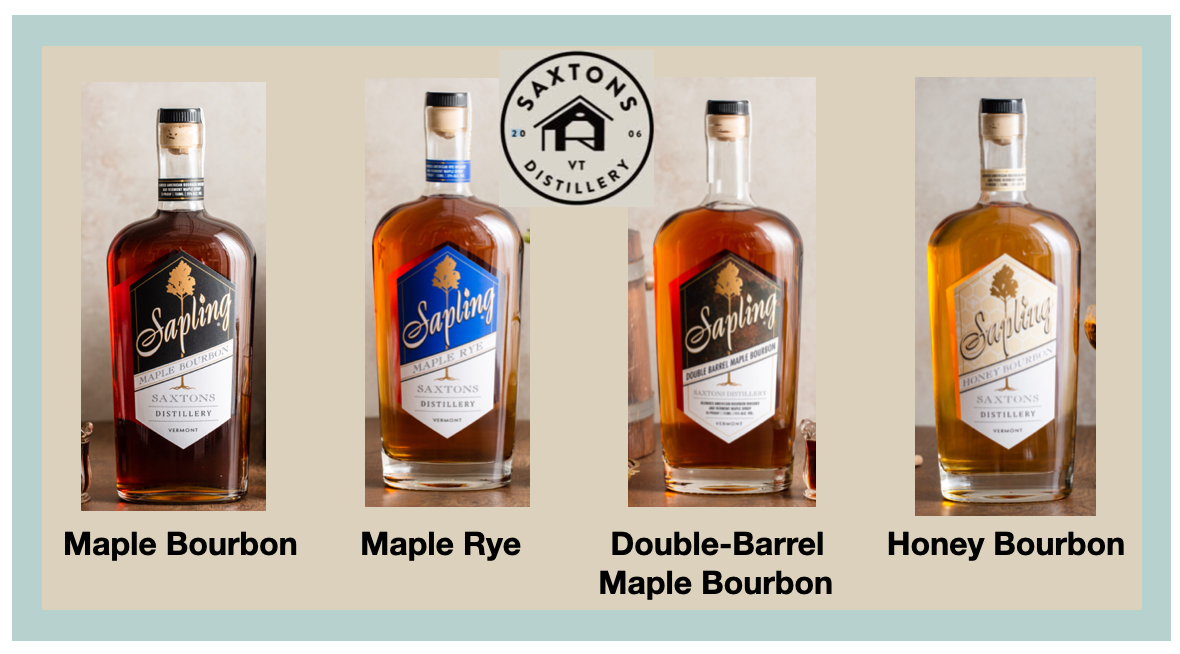
Sapling Maple Bourbon soon became the distillery’s top-selling product. Stromberg’s approach uses American bourbon and real Vermont Grade A maple syrup rather than artificial maple flavoring. The bourbon is aged in charred American oak for approximately a year and a half before it is blended with maple syrup; the combined spirit then receives another year of aging. Bottled at 70 proof and containing 12 percent maple syrup, the finished whiskey is deliberately approachable, with maple sweetness softening some of bourbon’s alcoholic heat while leaving its oak character intact.
Stromberg subsequently pushed the whiskey side of the business toward a more bourbon-forward expression with Sapling Double Barrel Maple Bourbon. That whiskey combines Sapling Maple Bourbon with three-year-old straight American bourbon, producing a 90-proof expression containing seven percent maple syrup. The lower proportion of maple and higher proof shift the balance toward bourbon while retaining the Vermont ingredient that defines the Sapling brand. Sapling Maple Rye follows a related method: two-year barrel-aged rye is blended with maple syrup and then aged for an additional year, marrying rye’s peppery character to Vermont maple sweetness. Another variation, Sapling Honey Bourbon, circles back toward Stromberg’s Lithuanian family heritage. Made with American bourbon and locally sourced raw Vermont honey, it connects the whiskey line to the honey-based liquor tradition that originally inspired all of his experiments.
Stromberg continued expanding the physical and environmental footprint of the operation. In 2022, Saxtons River installed a 177-kilowatt rooftop solar array that produces more electricity than the distillery consumes, making the operation 100 percent solar powered. That same year, Stromberg opened a seasonal tasting hut near Grafton Village Cheese in Brattleboro, extending a relationship between two Vermont producers that had begun years earlier through festivals and other events. Saxtons River products have since reached markets beyond Vermont, with distribution extending into several states across New England and elsewhere.
Nearly two decades after Stromberg started filling bottles in a lightly heated barn, Saxtons River Distillery still reflects both sides of its founder’s background. Founded by an engineer interested in processes, materials, and repeatability, the descendant of Lithuanian immigrants whose family kept an old tradition of homemade spirits alive in America. Stromberg did not attempt to reproduce Kentucky bourbon in Vermont. Instead, he took American bourbon and rye and gave them a distinctly Vermont identity through local maple syrup, additional barrel aging, and the manufacturing discipline he had spent 15 years learning before he ever made whiskey for a living.
Sources
Saxtons River Distillery official website, saxtonsdistillery.com
Authority Magazine, “Christian Stromberg Of Saxtons River Distillery: Second Chapters; How I Reinvented Myself In The Second Chapter Of My Life”, Pirie Jones Grossman, July 14, 2022, medium.com
Forbes, “Moonshiner Descendent Creates Award-Winning Distillery,” Jeanette Hurt, July 25, 2022, updated August 3, 2022, forbes.com
Vermont General Assembly, “House Concurrent Resolution H.C.R. 223: Congratulating Saxtons River Distillery on Its 10th Anniversary”, 2016, legislature.vermont.gov
Marist College Archives and Special Collections, “Alumni News”, marriage announcement for Sandra Dougall and Christian Stromberg, Fall 2003, exhibits.archives.marist.edu
Contributed by Tracy McLemore, Fairview, Tennessee