Anthony Wills


Anthony Wills did not arrive on Islay as a long-established distilling family patriarch. Instead, his rise into whisky was something more modern and, in its own way, more precarious: a drinks-industry professional who took decades of selling, selecting, and learning, then poured nearly everything he had into a distillery that did not yet exist. When Wills speaks about the route that led to Kilchoman, he consistently traces it through the wine trade first, joining the whisky world in 1995 after having previously been involved in that industry for fifteen years. Born in December 1956, Wills came into spirits neither young nor untested. By the time he entered whisky, he already understood margins, markets, and the slow arithmetic of businesses that demand patience before they offer reward. He was not a late convert, but someone shaped by the commercial bloodstream of the trade, learning early that whisky is slow to pay you back.
His first decisive step into hard spirits came through independent bottling. Wills moved to Scotland with his family and started an independent bottling company, buying casks and releasing selected single malts into a growing premium market. The independent bottler’s vantage point is a peculiar education. You learn how spirit behaves over time; you learn what casks can do, and what they cannot; you learn how reputations are built on selection and consistency. But you also learn a harsher lesson: you are dependent on supply. Wills later connected his decision to build a distillery directly to the growing difficulty of sourcing good single casks. As demand for quality whisky expanded, access to great casks tightened. By the turn of the millennium, he recognized a structural problem in his own business. In 2001, the idea hardened into action. That year, he embarked on a plan to build a farm distillery on Islay.
The choice of Islay, in his own telling, was deliberate. He pointed to the island’s iconic status and the reality that every distillery already there was owned by a large company. That left an opening, not for another corporate plant, but for a different kind of story and a different kind of ownership. The distance between deciding and building is where Kilchoman’s origin becomes less like a founding slogan and more like an endurance test. Wills has recalled risking essentially everything—“all my money”—to bring the project to life. Banks were uninterested. Raising funds took years and depended on small private investors willing to accept long odds. These are not the details usually preserved in celebratory origin stories, but they explain Kilchoman more clearly than any branding language. From the beginning, it was a distillery created through persuasion, persistence, and personal exposure, with utterly no margin for easy failure.
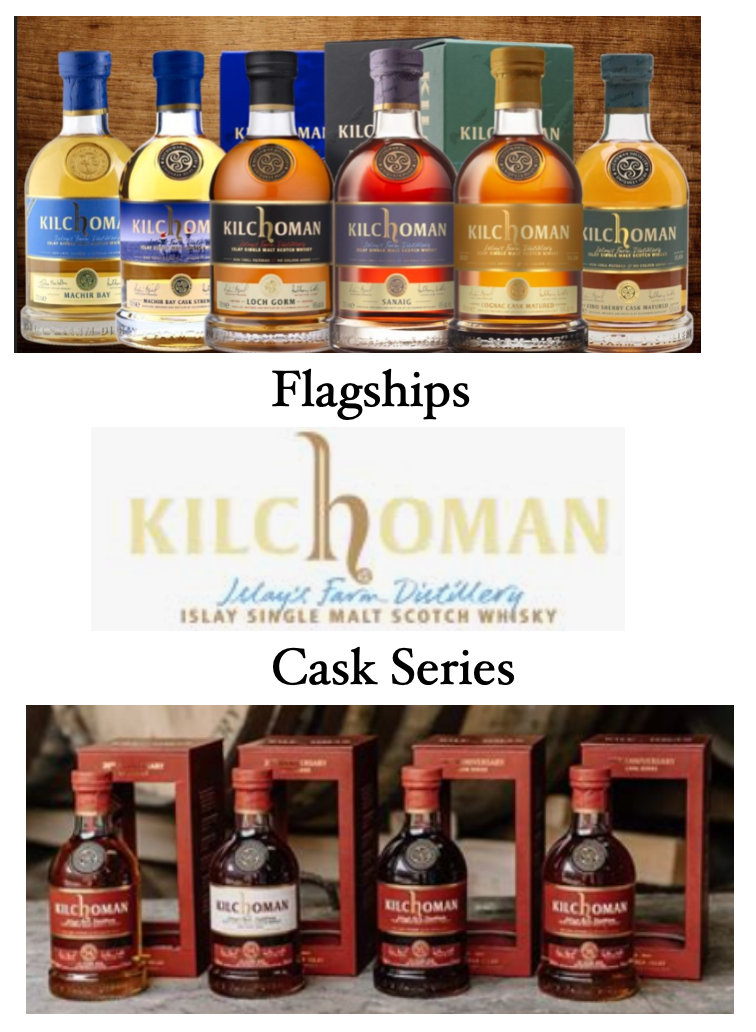
In 2005, the project finally became physical reality. Anthony Wills and his wife Kathy converted a collection of derelict farm buildings into Kilchoman, establishing the first new distillery built on Islay in more than a century. The “farm distillery” identity, including barley, place, and process kept under one roof, was not added later as a marketing flourish. It was the organizing principle from the start. Kilchoman was conceived as a working farm distillery, reviving an older model of Scotch production while executing it with modern discipline. That same year, the stills ran for the first time. Four years later, in September 2009, Kilchoman released its first single malt. Those dates mark the central truth of new distilling economics: years of labor before a single bottle can carry a name.
As the whisky matured, so did the enterprise. Kilchoman grew from a risky experiment into a functioning international distillery, exporting to more than sixty markets and producing more than 600,000 liters of alcohol each year. Yet even as production scaled, the original structure remained intact. The business became visibly a family enterprise. Anthony and Kathy were joined by their three sons—James, George, and Peter—once they came of age. The sons now manage sales and marketing; Kathy runs the visitor centre; Anthony remains managing director and master distiller. What had begun as a personal gamble became a multi-generational operation without surrendering control or identity.
When Wills speaks about Kilchoman decades after its founding, he rarely frames success in terms of volume or trophies. Instead, he returns to improbability: that a distillery built by an outsider, funded against reluctance, and launched in one of the most competitive whisky landscapes in the world, not only survived its risk years, but earned a permanent place on shelves, in bars, and in conversations.
Now in his seventies, with more than forty-six years in the spirits trade behind him, Wills stands as something rare in modern Scotch: a founder who arrived without inheritance, built without corporate shelter, and left behind not merely a brand, but a living distillery rooted in family, land, and patience. In an industry shaped by legacy, his own legacy is simpler and harder: he proved that, even in the twenty-first century, a distillery could still be built the old way; by committing everything, waiting long enough, and letting the whisky speak when it was finally ready.
Sources:
UK Companies House, find-and-update.company-information.service.gov.uk
Kilchoman Distillery Official website, kilchomandistillery.com
Scotch Whisky,“Five minutes with… Anthony Wills, Kilchoman”, scotchwhisky.com
WhiskyCorner, “Anthony Wills”, whiskycorner.co.uk
Drampath, Chapter 14/#10, “Q&A with Anthony Wills”, drampath.com
Scottish Distillers’ Conference (transcript), “Anthony Wills”, KD Media scottishdistillers.co.uk
Contributed by Tracy McLemore, Fairview, Tennessee