Graeme Wallace


Graeme Wallace was born in Scotland on January 5, 1963. And while little has been shared publicly regarding his early personal life, as a young adult in the early 1980s, his professional life centered on publishing and photography, with photography providing a substantial portion of his income. That proved particularly valuable when he entered whisky publishing because it allowed him to document distilleries through both words and pictures. Instead of treating a bottle as an isolated product, Wallace presented whisky within the physical and historical setting in which it was made.
Around 2000, Wallace attended Whisky Live in London, then an uncommon type of public event devoted to exploring and comparing whiskies. He had begun regularly publishing books by that time and saw room for a guide that would provide more information about distilleries by utilizing photographs of their buildings and bottles. The result was The Malt Whisky Guide, produced with whisky writer and independent bottler David Stirk and published in 2002. Preparing the book required Wallace to visit and photograph every operating distillery in Scotland, an undertaking that gave him a practical education in the diversity of Scottish whisky production.
Wallace subsequently revisited many of those distilleries for other projects, but Ardbeg became his sentimental favorite. The Islay distillery had experienced long periods of inactivity before Glenmorangie purchased it in 1997 and slowly began restoring the distillery to full production. Wallace gained access during this revival and undertook a detailed examination of Ardbeg’s past, working through surviving documents and interviewing former managers and employees. He spent nearly a decade researching the subject, repeatedly traveling from his home in England to Scotland and staying on Islay while the distillery returned to life. That work ultimately resulted in Ardbeg: A Peaty Provenance, written with Gavin D. Smith, photographed by Wallace, and published by Wallace’s GW Publishing in 2008. A revised history, Heavenly Peated, followed in 2017. The years spent documenting Ardbeg placed Wallace close to one of Scotland’s best-known heavily peated single malts and gave him an extensive understanding of its production, history, workforce, and revival. His whisky education was therefore grounded not only in tasting, but also in prolonged observation of distilleries and their operating traditions.
By that time, Wallace decided that he wanted to live in the United States. His original American business plan was to become an independent bottler specializing of craft whiskey, particularly whiskey made in Colorado. While researching the idea, he visited approximately 30 US distilleries. Lenny Eckstein of Deerhammer Distillery spent considerable time explaining his operation, and the example of a small Colorado producer helped convince Wallace that he could build a distillery despite having limited capital. Unfortunately, the independent-bottling proposal did not quite satisfy the requirements of the United States immigration process, forcing Wallace to reconsider his plans. He replaced it with the more ambitious idea of making his own whisky, financing the undertaking largely with proceeds from the sale of his publishing business. Finally, in 2016, Wallace left Scotland for Colorado, and in 2017 he began the distilling venture; the first Hogback whisky barrels were filled the following year.
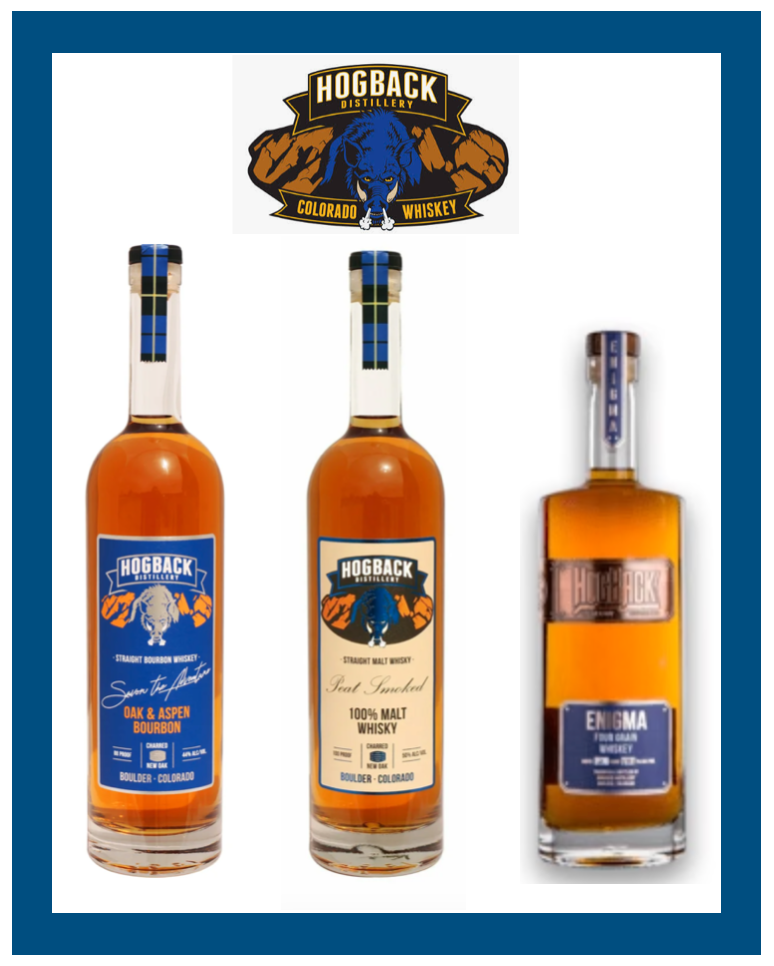
Wallace named his venture for the Dakota Hogback Ridge, the long geological formation running along the eastern side of the Rocky Mountains. He constructed a production location in the Boulder area and later operated a tasting room in Estes Park. Hogback was then a small, hands-on operation run by Wallace and his partner, Katherine. Rather than build a broad portfolio of unrelated spirits, Wallace concentrated Hogback entirely on whiskey. Peated American single malt became the distillery’s central purpose. Hogback’s Rich Roast American Single Malt uses lightly kilned malted barley from Rahr Malting in Minnesota, developing roasted coffee, chocolate, and dark-fruit characteristics during production and maturation. Colorado’s high altitude and semi-arid climate govern the whiskey’s aging environment. Together, Peat Smoked and Rich Roast demonstrate the two sides of Wallace’s approach: the first directly evokes Scotland’s peated malt tradition, while the second explores the character of American malt and new American oak. Yet Wallace did not confine his work to single malt. Hogback developed high-wheat and high-rye bourbons, rye whiskey, and Enigma, a cask-strength four-grain whiskey made from barrels containing rye, barley, corn, and wheat. Oak & Aspen Bourbon begins as a high-rye bourbon aged for at least four years in new oak before it is finished with Colorado aspen wood. That use of aspen brought a distinct regional element into a whiskey governed initially by traditional American bourbon requirements.
The Wallace Collection became Hogback’s most personal and experimental series. Its first release came from the first single-malt barrel filled at the distillery, using Minnesota two-row malted barley, four years of maturation in new American oak, and a finishing treatment with Colorado aspen. The 63.2-percent-alcohol whisky won the 2022 World Whiskies Award for Best American Single Cask Single Malt. The next Wallace Collection release used fully peated Scottish malt, matured in an ex-rye barrel and finished in a Cabernet Sauvignon cask from Continuum Estate in Napa Valley; it won the same American category in 2023. A Wallace Collection Peated Malt was again named a category winner at the 2024 World Whiskies Awards. Graeme and Katherine continue to operate Hogback on a deliberately small scale, with some Wallace Collection whiskies spending five or six years in used barrels and longer-aged releases planned as inventory matures.
Graeme Wallace had entered the industry as a photographer, publisher, and historian who helped readers understand the places and people behind Scotch whisky. At Hogback, he converted that accumulated knowledge into production, making bourbon, rye, and especially American single malt within Colorado’s climate. His work now joins two whisky traditions: the Scottish tradition he spent decades recording and the American tradition in which he finally became a distiller.
Sources:
Hogback Distillery official website, hogbackdistillery.com
The Whiskey Wash, “Graeme Wallace—The Scotch Whisky Icon Making Single Malt in Colorado”, Samuel Wright, January 27, 2025, thewhiskeywash.com
World Whiskies Awards, “Hogback Distillery/Wallace Collection Peated Malt”, 2024, worldwhiskiesawards.com
Mile High Bourbon and Rye, “Hogback Distillery Oak & Aspen Bourbon”, January 26, 2023, milehighbourbon.com
Contributed by Tracy McLemore, Fairview, Tennessee