Paul Werni


Paul Anton Werni was born in September of 1965 in Milwaukee, Wisconsin, but he grew up in Merrill, a small town in the north-central part of the state. As a teenager traveling between Merrill and Wausau, he regularly passed a highway sign identifying the 45th parallel—the line of latitude approximately halfway between the equator and the North Pole—and thought it would make a good name for a business someday. The name stayed with him, although the nature of that future business would take years to emerge.
Werni graduated from Merrill High, then followed his oldest sister to Minneapolis to attend the University of Minnesota, where he studied history. Minneapolis also became important to his personal life, for it was there that Paul met Tina, the woman who would become his wife. As soon as their university studies had concluded, the couple married and settled in Northeast Minneapolis to start a family; eventually a daughter, Josie, was born, then later, a son, Anton.
At that time, Werni was building his own company, a landscape/construction business with a friend and business partner. After about a decade in landscaping, Werni sold his half of the business, intending to spend more time with his children, travel, help Tina pursue her career, and consider what he would like to do next. He wanted his next venture to involve manufacturing something tangible and creative, preferably a product capable of competing on a broader stage. Within several months, distilling emerged as the answer. The idea was ambitious, because in the early 00s, craft distilling was still a tiny American industry, and the Midwest offered few operating distilleries from which an aspiring producer could learn. So Werni read extensively about distillation, attended workshops in New Hampshire, and traveled to Germany and Austria to study small distilleries. Charles McGonegal of AeppelTreow Winery & Distillery in Wisconsin helped him understand the regulatory side of the business, while Michigan State University chemical engineer and food scientist Kris Berglund provided guidance on fermentation, ethanol production from different grains, and in scaling a distilling operation. Werni also learned as much as he could from the representatives of German still manufacturer Carl.
Wisconsin ultimately provided the practical home for the venture. Minnesota’s distilling permit fees were prohibitively expensive at the time, while Wisconsin offered a substantially less costly path into the industry. Werni contacted communities in St. Croix County and found New Richmond receptive to his proposal. Ground was broken in 2006, and 45th Parallel Distillery officially opened in 2007, when it was among only about 50 craft distilleries operating in the United States and one of only a small handful of commercial distilleries in Wisconsin. The name finally gave Werni a use for the geographic marker he had remembered since his youth. Much of his life had been spent near the 45th parallel, and the farm that eventually supplied the distillery’s grain was also located near that latitude. The name therefore connected his Wisconsin upbringing with the agricultural foundation of the business.
Once distilling was underway, Werni initially concentrated on vodka in order to forestall the unavoidable and common financial problem of time caused by whiskey maturing for years before producing revenue. The original 45th Parallel Vodka was made from Wisconsin-grown corn, giving Werni experience converting local grain into finished spirits. As soon as was feasible, however, whiskey entered the picture, and soon 45th Parallel was approached about producing it under contract. The project became the catalyst for Werni’s own whiskey program. He began making bourbon and subsequently expanded into rye and wheat whiskey, accepting the long wait necessary for properly-matured spirits.
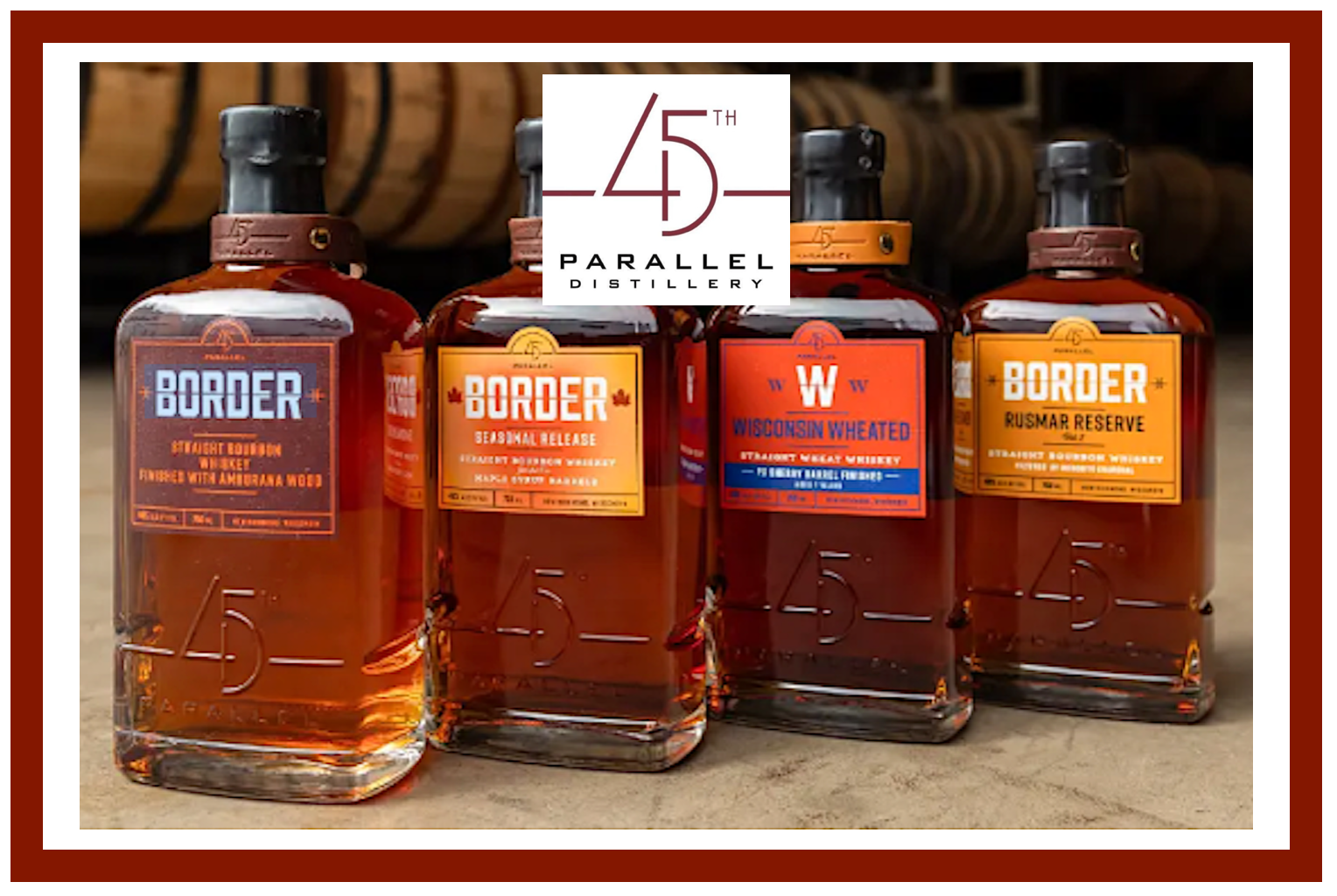
Border Bourbon became 45th Parallel’s first released aged spirit. The whiskey has a mashbill of 62 percent corn, 12.5 percent wheat, 12.5 percent rye, and 13 percent malted barley, creating a four-grain bourbon. The whiskey is aged at least five years, with individual small batches assembled from five barrels produced during the same distillation run. All of the barrels that Werni uses are made from Ozark white oak by McGinnis Wood Products in Cuba, Missouri.
Werni followed Border Bourbon with New Richmond Rye in 2013. The first release had been aged approximately two and a half years and was bottled at 92 proof, with Werni planning progressively older releases as the inventory matured. The modern Richmond Rye is built around a 67-percent-rye mash, accompanied by corn and malted barley, while the distillery has also developed R100, a 100-percent rye whiskey. A wheat-dominant whiskey followed the rye, broadening 45th Parallel into a distillery capable of showing how different grains could define the character of American whiskey. Border Bourbon eventually earned significant national recognition, receiving 93 points from Wine Enthusiast in 2018 and appearing among the publication’s Top 100 Spirits of that year.
As the whiskey stocks matured further, Werni’s patience began to reshape the company. By the middle of the 2010s, brown spirits were assuming a larger role in a business that had originally depended heavily upon vodka. 45th Parallel expanded its production capacity, added fermenters and stills, and developed contract distilling into an important part of its operation. Werni also became involved in Wisconsin’s developing craft-distilling industry, serving as vice president of the Wisconsin Distillers Guild and sharing his experience through consulting and distilling workshops. Meanwhile, the New Richmond campus has continued growing. It now includes expansions to the original distillery, a separate rickhouse capable of holding thousands of barrels, and an entertainment facility containing a restaurant, bar, retail space, and event center. The company remains family-owned after nearly two decades in business.
The development of 45th Parallel ultimately followed the logic Werni established at the beginning: use Midwestern grain, make the spirit rather than merely market it, and allow whiskey the time it requires. What began in 2007 with corn vodka gave Paul Werni the operating foundation to wait for bourbon and rye to mature. Border Bourbon, New Richmond Rye, wheat whiskey, and 100-percent rye now demonstrate how thoroughly whiskey has moved from a long-term gamble at 45th Parallel to one of the central reasons for the distillery’s existence.
Sources:
Wisconsin Academy of Sciences, Arts & Letters, “A Craft Movement at the 45th Parallel,” Brenda K. Bredahl, Winter 2019, wisconsinacademy.org
Taste the Dram, “Paul Werni Speaks to Tastethedram About the 45th Parallel Distillery in New Richmond, WI”, January 11, 2017, tastethedram.com
45th Parallel Distillery, official website, 45thparalleldistillery.com
Bourbon Guy, “45th Parallel to Release New Richmond Rye,” Eric Burke, January 22, 2013, bourbonguy.com
Cocktails & Cologne, “45th Parallel Distilling: ‘We’re Going to be Known for Whiskey,’” January 20, 2016, cocktailsandcologne.wordpress.com
St. Croix Valley Magazine, “From Grain to Glass at 45th Parallel Distillery,” stcroixvalleymag.com
Contributed by Tracy McLemore, Fairview, Tennessee