James Buchanan
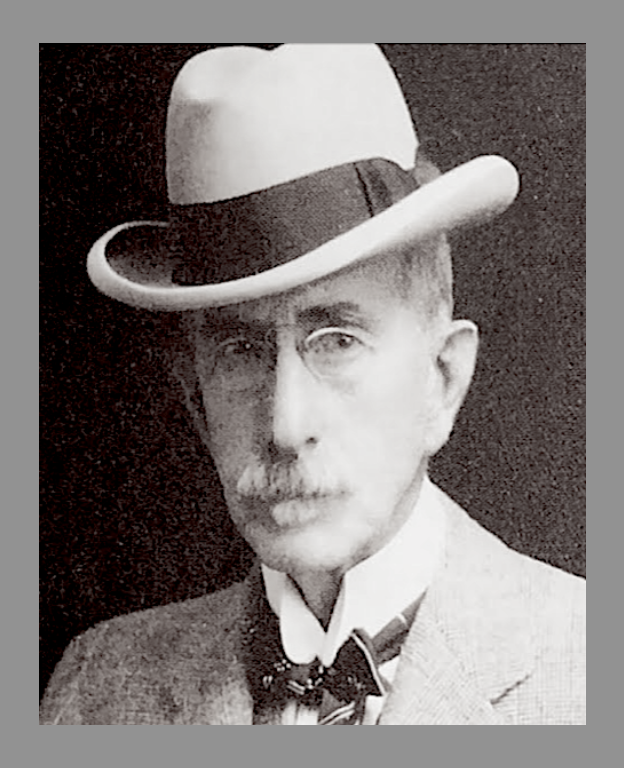

James Buchanan was born 16 August 1849 in Brockville, Ontario, Canada. He was the third and youngest son of Alexander Buchanan and Catherine McLean, Scottish immigrants who returned to the United Kingdom soon after his birth. Buchanan was raised in Larne (County Antrim, Ireland), where his father worked as a quarry manager. His childhood health was reportedly fragile, and thus his early schooling was private rather than through a standard public-school track, a detail that might explain how quickly he was pushed into work and practical learning rather than extended formal education.
As a teenager of fourteen or fifteen, Buchanan entered the commercial world as an office boy with William Sloan & Co., a Glasgow shipping firm, later advancing to a clerkship. That early job placed him in the rhythm of invoices, cargo movements, credit, and correspondence, exactly the kind of training that later suited a blender and marketer operating between Scotland’s production centers and London’s demand. In 1868, he joined his brother William in the grain business in Glasgow. Grain was the raw material of whisky, but just as importantly it was an education in commodity pricing, supply reliability, and the practical realities of moving bulk goods, kills that would become crucial when Buchanan began assembling consistent blends at scale.
The decisive shift came in November 1879, when Buchanan moved to London as an agent for the Leith whisky blenders Charles Mackinlay & Co. London, in the late Victorian period was where Scotch was becoming fashionable across clubs, hotels, restaurants, and the growing world of bottled goods. Buchanan perceived a market gap: Scotch could be sold not merely as a spirit shipped in casks, but as a reliable bottled blend designed to suit English taste; lighter, smoother, and consistent from bottle to bottle.
In 1884, he struck out on his own, founding James Buchanan & Co. in London. His earliest flagship blend was marketed under names that reflected where it was being consumed and how it was being positioned socially. The whisky that ultimately became Black & White began life as ‘Buchanan’s Blend’ and was also known as ‘House of Commons,’ a name tied to one of the most valuable endorsements a Scotch could receive in that era: it actually became the Scotch served at the House of Commons bar from 1885.
Buchanan did not initially distill the spirit himself. Instead, he relied on the blending and production capacity of established Glasgow firms, most notably W. P. Lowrie & Co., and then built a sales network that turned his London base into an international platform. His skill was not only in the liquid, but in building trust around the liquid. He knew early on that a bottle had to communicate consistency, respectability, and easy recognition in a crowded marketplace.
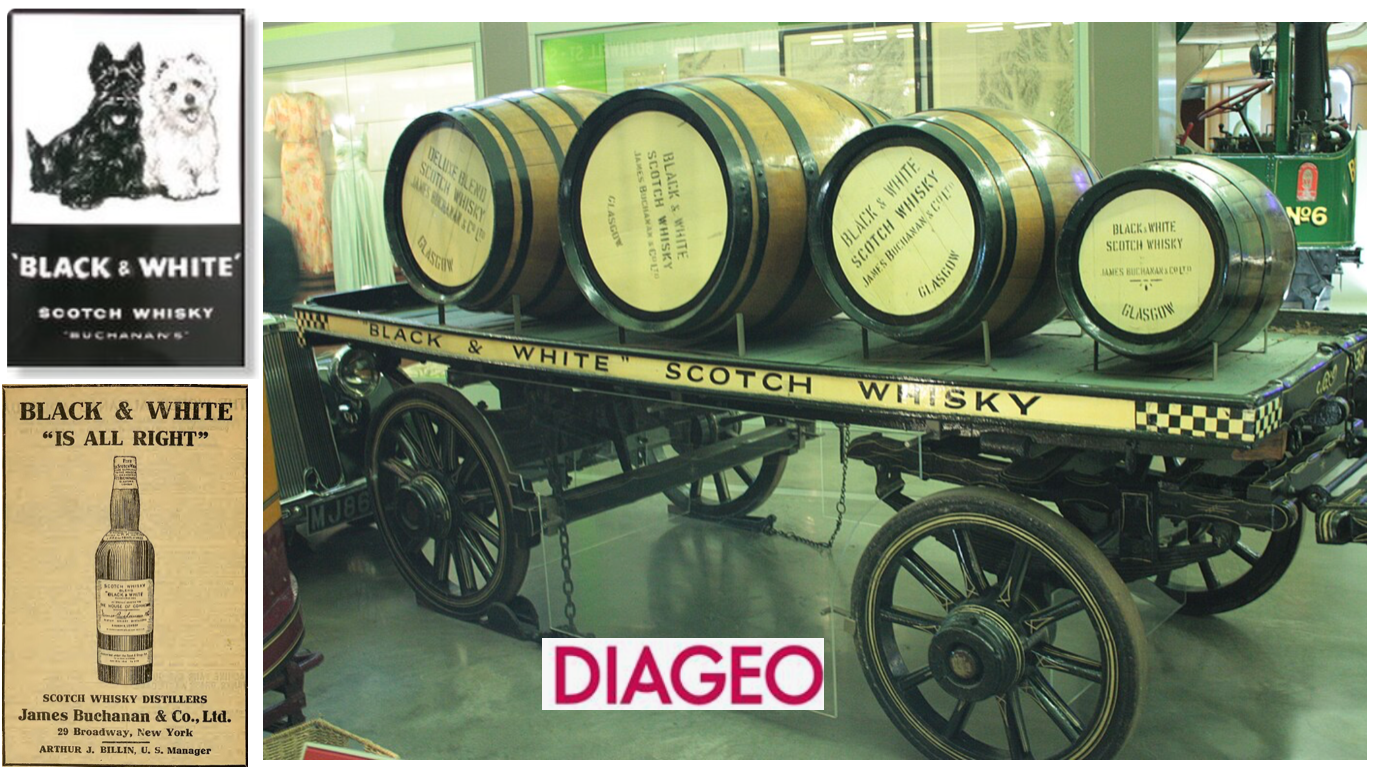
That emphasis on recognizability helps explain how “Black & White” emerged. Buchanan’s House of Commons whisky was marketed in black bottles with plain white labels. The look was so distinctive that customers began asking for “that black and white whisky,” and the nickname eventually became the brand. In the 1890s, Buchanan conceived the now-famous label motif: a black Scottish Terrier and a white West Highland White Terrier. The dogs were not a random flourish; they were visual shorthand for the name and a memory aid in export markets where brand recognition could matter as much as pronunciation. By 1902, as the business expanded abroad, “Black & White” was first used as the official name on the label.
The 1890s and early 1900s were also when Buchanan tied his brand to high-status signals that moved product. In 1898, he received Royal Warrants to supply Queen Victoria, the Prince of Wales, and the Duke of York, reinforcing the notion that his blends belonged in the upper tier of respectable Scotch. That same year he opened the Glentauchers distillery on Speyside, a step toward securing supply and quality control in at least part of his portfolio. By the early 1900s, the company’s footprint included overseas offices in Paris and New York, and by 1909 Buchanan’s was described as the best-selling Scotch in England.
Buchanan’s business methods were modern for the time: mechanization, vertical integration where it made sense, and attention to packaging and distribution. In 1906, he bought W. P. Lowrie & Co., the blender linked to his early production, and moved quickly to modernize facilities. He also invested in businesses that supported bottling and logistics, including an interest in the North British Bottle Manufacturing Company, and he acquired the Acme Tea Chest Company, both connected to the practicalities of getting product safely and efficiently to market.
As for Buchanan’s personal life, on 5 December 1891, Buchanan married Annie Eliza Bardolph (née Pounder), a widow thirteen years his junior. Annie came into the marriage with a son and a daughter from her earlier life, and then she and Buchanan had a daughter, Catherine, plus a son who unfortunately, died in infancy. Later, during the First World War, Annie worked as a nurse in London hospitals, and her death in October 1918 ended a partnership that had spanned the years when Buchanan built his empire and public stature.
From the mid-1910s into the 1920s, Buchanan’s story became part of consolidation in the Scotch industry. In 1915, Buchanan’s and John Dewar & Sons formed a joint holding company later known as Buchanan Dewar. In 1925, the so-called “big three” firms of Buchanan’s, Dewar’s, and Walker’s ultimately merged into the Distillers Company, bringing Buchanan’s brands into one of the major structures that shaped twentieth-century Scotch. Buchanan remained a director but, late in life, was less active in management.
Public honors followed. He was created a baronet in 1920, and raised to the peerage in 1922 as Baron Woolavington, titles associated with his public services and philanthropy. He also held civic roles such as High Sheriff of Sussex in 1910.
By this stage, Buchanan had become more than a whisky merchant; he was a wealthy Edwardian figure with broad interests, including thoroughbred horse racing and breeding. He also became known for major gifts to institutions—among them substantial hospital support, including a large donation connected with the Middlesex Hospital in 1928 in memory of his late wife. When he died on 9 August 1935 at Lavington Park in Sussex, his peerage and baronetcy became extinct due to the lack of a surviving male heir.
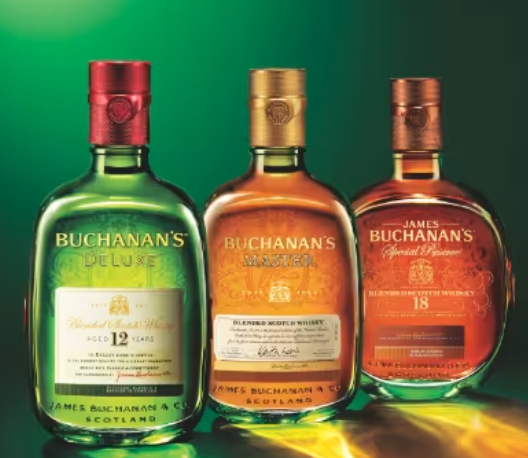
The brand legacy, however, outlived him. Black & White, born from the practical need to make a palatable bottled Scotch for English drinkers and then made famous by its stark packaging and canine iconography, remained a recognizable international blend, eventually passing through industry mergers to become part of the portfolio now owned by Diageo. In Buchanan’s own lifetime, he helped push Scotch toward a modern era in which branding, bottling, distribution, and consistent blending were not peripheral concerns, but the center of the business.
Sources:
Whiskypedia, “Black & White”, scotchwhisky.com
Whiskypedia, “Buchanan’s”, scotchwhisky.com
ScotchWhisky.com, “James Buchanan” (Whisky Heroes profile).
National Library of Medicine, NCBI Bookshelf (NIH), “Making Scotch Respectable: Buchanan and Walker”, ncbi.nim.nih.gov
Diving for Pearls (blog), “Black & White blended whisky, a history”, 04 September 2019
Diageo Bar Academy, “Buchanan’s”
Oxford Dictionary of National Biography, “Buchanan, James, Baron Woolavington (1849–1935)”
Contributed by Tracy McLemore, Fairview, Tennessee USA