

A.J. Cameron

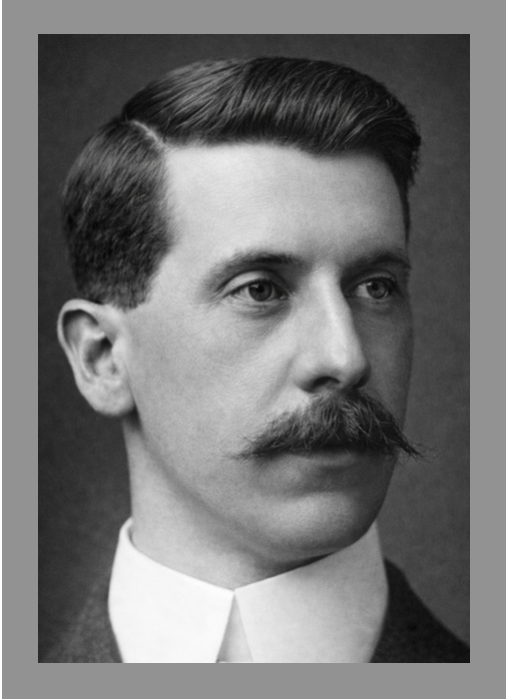
AJ Cameron steps into the historical record not as a flamboyant founder or a romantic Highland myth, but as a hardworking, talented professional whose decisions helped define what millions of people still recognize plainly as “Dewar’s”. By the time he appears clearly in company history, Dewar’s had already grown beyond a local Perth wine-and-spirits business into a whisky house with international ambition, but it needed someone whose innovation could keep pace with that initiative. Cameron became that person. He was Dewar’s first official blender appointed outside the founding family, and the creator of the blend that would become the brand’s most enduring signature, Dewar’s White Label.
The story of Cameron begins in the late nineteenth century, at a moment when blending was becoming the engine that drove Scotch whisky’s global expansion. Dewar’s founder, John Dewar, had started the firm in Perth in 1846, and the business eventually passed to his sons, who divided responsibilities between production and promotion as the brand grew. As demand increased, Dewar’s made one of the most consequential moves a blending house could make: it built its own malt whisky distillery, Aberfeldy, specifically to supply spirit for the blends that were increasingly being shipped far beyond Scotland. In that growth phase, when consistency, house style, and scale mattered more than ever, John Dewar brought in AJ Cameron and, in 1897, gave him the title that signaled authority: ‘Master Blender’.
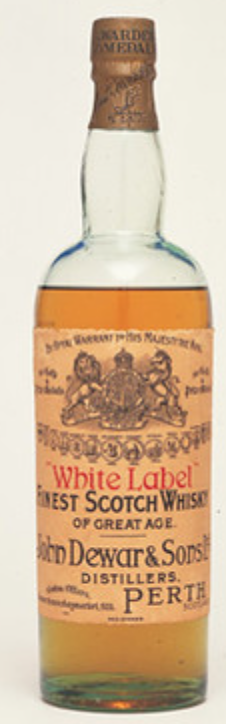
Early Dewar’s ‘White Label’ bottle, c. 1900
What is striking is not merely that he was hired, but that he was hired from “outside the family,” a decision that even the company later described as “bold”. In the world of whisky that has most often traded on ancestral lineage, Dewar’s effectively said that the future of its whisky would be secured instead by demonstrated skill rather than blood. Cameron’s task was as practical as it was artistic: to assemble a blended whisky that tasted the same to a customer in one city as it did to a customer thousands of miles away, bottle after bottle, shipment after shipment, and year after year.
Just 24 months after his appointment came the work for which Cameron is most widely credited. In 1899, he created Dewar’s White Label, the blend that became the defining expression of the Dewar’s house style and, over time, one of the world’s best-known blended Scottish whiskies. White Label’s identity has long been connected to the idea that it brings together a wide set of malt and grain whiskies into something coherent and approachable; contemporary product descriptions commonly describe it as drawing on many component whiskies and placing Aberfeldy at its heart.
Cameron’s importance, however, is not only that he “made a blend.” It’s that he helped define how Dewar’s would build that blend; more precisely, how it would be structured, integrated, and readied for the bottle. Whisky writers have described Cameron as a pioneer of “marrying,” a practice in which whiskies are returned to casks after blending to allow flavors to integrate before bottling. In profiles of Dewar’s blending tradition, this idea of integration, or assembling whiskies thoughtfully, then letting them settle and harmonize, appears again and again as part of what made Dewar’s stand out.
Over time, this method became closely associated with what Dewar’s calls “double aging”. Modern accounts explicitly connect that approach to Cameron and treat it as a signature technique that helped make Dewar’s whisky notably smooth. Then, by 1901, Cameron had pushed the method further by adding additional steps intended to create an even smoother whisky, an approach that later inspired Dewar’s “four-stage” aging concept in contemporary releases.
This is the clearest through-line from Cameron’s era into the present. When modern Dewar’s releases reference “four-stage aging” or the “Double-Double” concept, they frequently frame it as a revival or extension of a historical process associated with AJ Cameron, specifically linking the 1901 development to what today’s blenders build upon. In other words, Cameron’s innovations were not treated as a one-time trick; they became a foundation that later generations could revisit, refine, and market because the underlying technique genuinely shaped the whisky.
What, then, of the man himself: his childhood, his schooling, his life outside the blending room? Here the historical trail becomes thin. In even the most accessible modern sources, Cameron is only presented through his work: appointed in 1897, creator of White Label in 1899, associated with developing and advancing the blending-and-marrying approach that Dewar’s uses to describe its signature smoothness, and credited with the kind of patient method-making that still frames the brand’s identity. These sources do not, in the portions available, provide his birth date, nor do they offer confirmed details about his education, early jobs, marriage, or children. That absence is revealing in its own way. Whisky history often preserves the voices of owners and public-facing figures more readily than the private life of the technical specialist. Yet Cameron’s professional footprint is unusually durable: the blend he created is still a flagship name; In Scotch whisky, “legacy” is often a slogan. In Cameron’s case, it is measurable: in a recipe that endured, and in a process that outlived him so thoroughly that it could be revived, named, and celebrated more than a century later.
As for the modern Dewar’s company: it was purchased in 1998 in a deal that included Bombay gin by spirits behemoth Bacardi, Ltd., for nearly £1.5b. In 2024, Dewar’s was the fourth best-selling Scotch worldwide, with 3.3 million cases sold. It has long been considered one of Scotch whisky’s “big four” in terms of sales.
One of the most interesting facts regarding Dewar’s, is that, in 1987, several unopened cases of still-perfect Dewar’s were discovered 24 meters underwater in the hull of the SS Regina, which had sunk with no survivors in the frigid waters of Lake Huron, USA, 74 years earlier.
Sources:
Dewar’s official website, “Discover Dewar’s”, www.dewars.com
Whisky Magazine/issue 100, “100 greatest…”, Gavin Smith, 02 December 2011
Whisky Advocate, “Discover the Malts Behind the Most Iconic Scotch Blends”, Ted Simmons, 13 September 2021
Forbes, “Dewar's Double Double Series: Is This The Ultimate In Smoothness”, Joseph V Micallef, 23 April 2019
ScotchWhisky.com, “Dewar’s Double Double Launches in Duty Free”, Becky Paskin, 18 March 2019
Scottish Field, “Dewar’s Reveals New 36-Year-Old…”, Kenny Smith, 14 December 2021, scottishfield.co.uk
Contributed by Tracy McLemore, Fairview, Tennessee USA
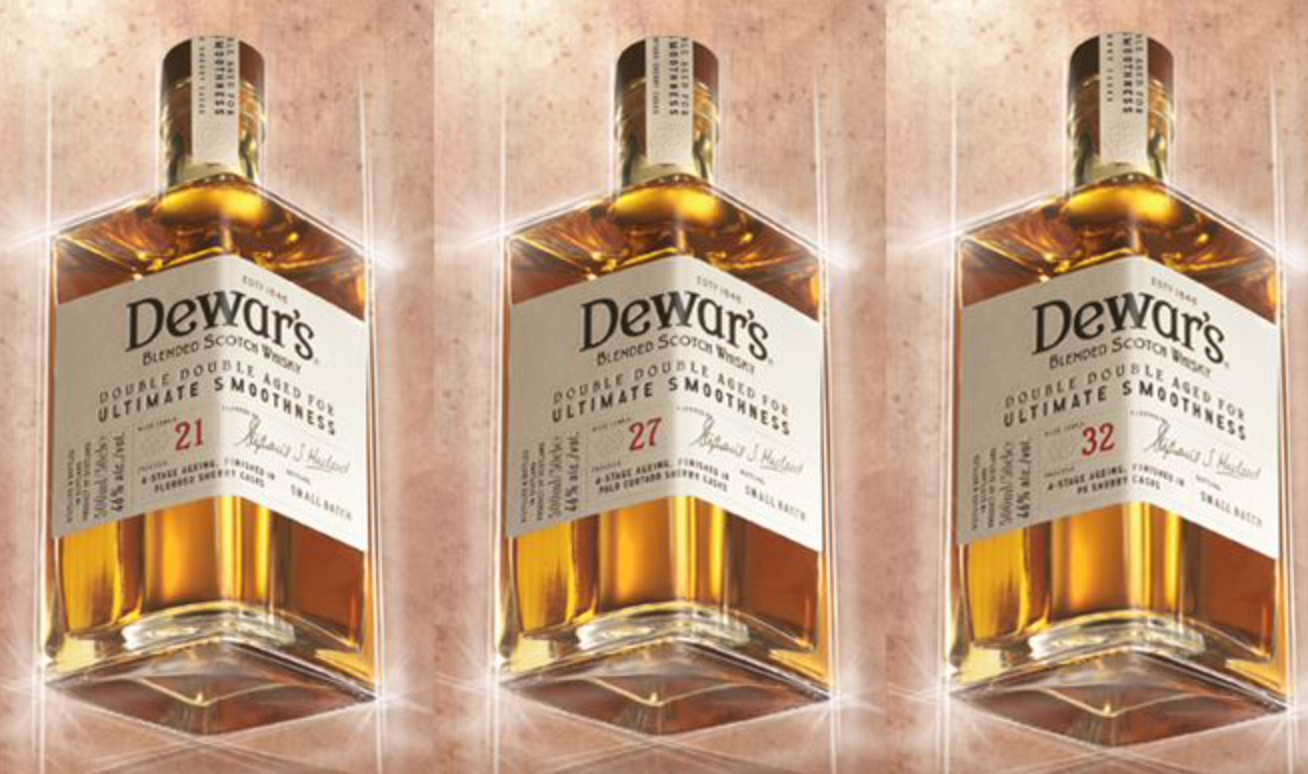
Part of Dewar’s “Double-Double” portfolio: 21-year-old; 27-year-old;, and 32-year-old