

Alistair Cunningham

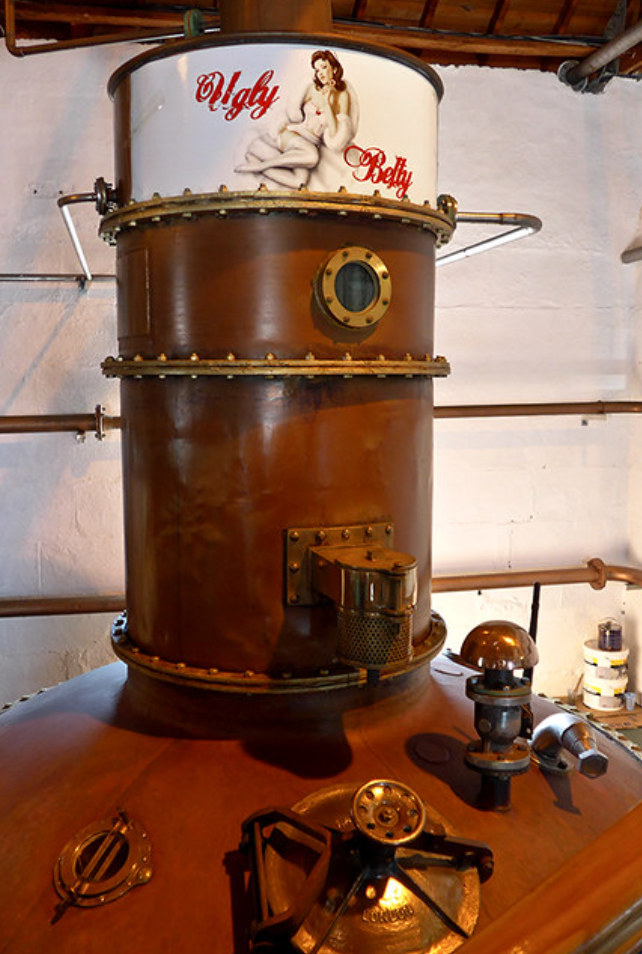
Even though the Dumbarton/Interleven works were dismantled and soon disappeared from a map, Cunningham’s technical legacy proved harder to demolish. His Lomond still, built in 1955, outlived both its inventor as well as the distillery that had given it a home. It was installed at Bruichladdich on Islay for the production of gin, where it became famous under the affectionate nickname “Ugly Betty” with a brand new purpose. She still operates faithfully as of this writing.
Alistair Cunningham was born 3 February 1926, in Bonhill, Dunbartonshire, the son of John Cunningham, a local machine printer, and Margaret Cowan Cunningham. He went to Dumbarton Academy, and when he left school at 15, he did not go searching for a trade so much as step into the dominant industry in his own shadow. On the day before his 16th birthday in 1942, he started work at Ballantine’s distillery in Dumbarton as a general apprentice, at a site that would become the setting for his entire working life. Dumbarton, with its rock and castle, its shipyard, and, by the time Cunningham was a young adult, one of the most modern spirits complexes in Scotland.
Hiram Walker had recently purchased notable blender Ballantine’s and opened the new Dumbarton distillery in 1938, establishing the huge grain operation and, within the same grounds, the malt distillery known as Inverleven. It was a practical arrangement designed to secure the style and volume needed for a major blend. By the time Dumbarton began distilling in 1938, it was immediately the largest continuous distillery in Scotland producing grain whisky.
Alistair Cunningham’s early years there were a time of learning in more than one way. He did not simply remain a shop-floor man. Through a company training scheme Cunningham earned a degree in chemical engineering, a qualification that placed him at the junction where whisky’s old copper traditions met the modern urge to control, measure, and repeat. Toward the end of the Second World War he served for a time with the Fleet Air Arm of the Royal Navy, then returned home to the same Dumbarton orbit. The pattern of his entire career was unusually consistent: he stayed rooted in Ballantine’s distilling, warehousing, blending, and bottling infrastructure, despite several changes in ownership and corporate names.
By the early 1950s, Cunningham was deep inside the technical parts of the business, carefully watching how small adjustments could change a spirit’s character, and how the industry’s needs were changing. The old still types, with their fixed shapes and fixed outputs were under pressure from new markets and the need for flexibility. It was in that environment that Cunningham’s most famous contribution took shape. In 1955, he and draftsman Arthur Warren came up with an idea for a new type of still. They designed and devised what became known as the “Lomond still.” The still was not created to be pretty. The traditional pot stills with their elegant swan necks, had been shaped by centuries of practice, but they were not capable of rapid adjustability. The Lomond still kept the familiar bulb-shaped base, yet it introduced a neck and rectification arrangement intended to give far more control over reflux. In other words, it offered a way to make different outcomes from the same basic equipment, a feature that mattered to blenders seeking a consistent “house style” while also needing options.
After that, Cunningham’s reputation grew as Dumbarton grew. At the distillery, he was involved across the operation: distilling, warehouse oversight, and the international work of maintaining a brand that had become a major export. Within the company he became known as “Mr. Ballantine’s,” regarded as the custodian of the blend he helped create through years of changes and corporate restructuring.
Cunningham eventually became managing director of Hiram Walker in Scotland. This was not a ceremonial title, it was respective of the fact that the decades after the Lomond still’s invention were years of expansion, modernization, and logistics on a massive scale. Under his leadership, Hiram Walker developed new facilities at Kilmalid near Dumbarton: a blending plant, which opened in 1977, and a bottling plant opening in 1982. The latter, as described in later accounts, could handle volumes measured in the tens of millions of bottles a year.
In 1988 Hiram Walker was sold to Allied Lyons, and at that time, ironically, Dumbarton fell for the first time under actual British ownership. Nevertheless, three years later, Allied mothballed the Inverleven distillery, and in 2002, Dumbarton itself followed suit. The entire complex has since been demolished to make way for a housing development.
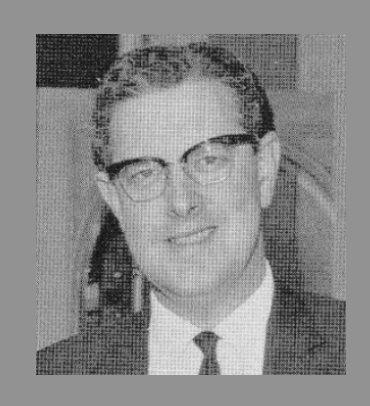
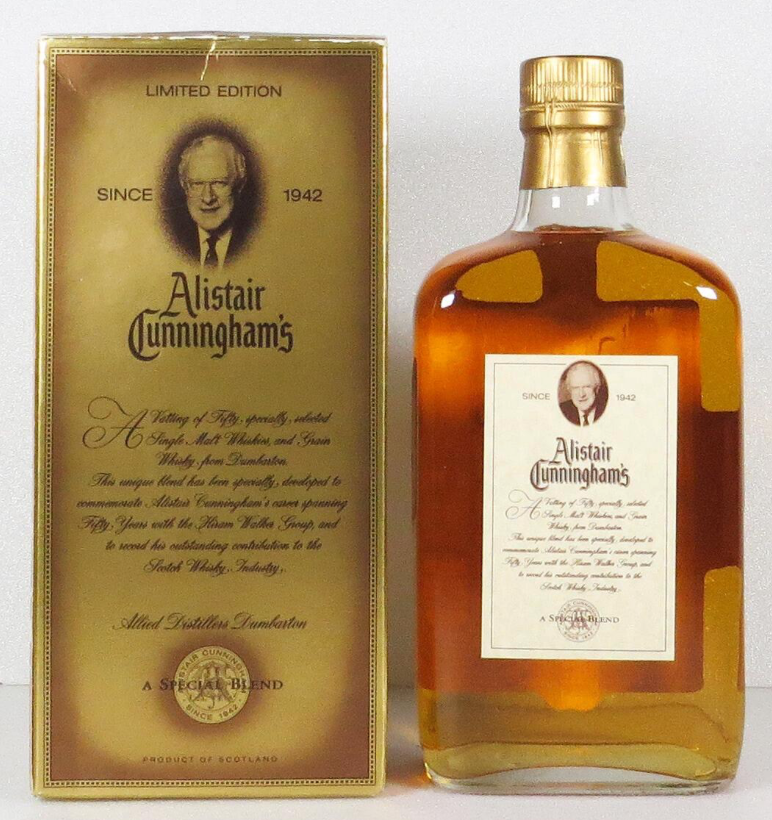
Cunningham himself finished in the same orbit where he had started. He retired in 1992, marking 50 years tied to the Dumbarton/Interleven operation. To commemorate that milestone, a special blend, aptly named “Alistair Cunningham’s 50 Years Scotch Whisky,” was produced by Allied Distillers to celebrate his half-century with the Hiram Walker group.
Cunningham’s personal life was never a chain of dramatic episodes, but a steady, stable, domestic story. He had married Ella Stenhouse Sheach, originally from the Isle of Lewis, and they had one son, Iain. After retirement, Alistair spent much of his time traveling and painting, and in later years caring for his ailing wife as her health declined. Alistair Cunningham died 14 July 2010 in Paisley, aged 84 years.
Sources:
The Scotsman (obituary text), “Alistair Cunningham, 84, Scotch whisky expert…”, Phil Davison, 17 July 2010
Whiskypedia, “Lomond”, scotchwhisky.com
Gordon & MacPhail distillery webpage, “Inverleven”
WhiskyAuctioneer, “Alistair Cunningham’s 50 Years Scotch Whisky”
Difford’s Guide, “Ugly Betty”(Bruichladdich Lomand gin still), diffordsguide.com
Contributed by Tracy McLemore, Fairview, Tennessee USA