Francis Cuthbert


Francis Cuthbert’s Daftmill story begins the way most real Scottish whisky stories used to begin, and that is, in a working farmyard, with the year divided into seasons and the day divided into jobs that cannot be postponed. Daftmill sits in the Howe of Fife, near Cupar, There, the Cuthberts have farmed cereals in rotation, beef cattle, potatoes, and other field crops in an operation that was already modern, productive, and anchored to the practical economics of agriculture many generations before it was ever associated with single malt.
What changed everything was not a sudden whisky epiphany, but a land purchase. In 1984, the Cuthberts bought the Pitlair Estate, including Daftmill, from Sir William Walker, a step that turned a family rooted in tenancy and work on the same ground, into owners of the estate itself. In the shorthand of local history, it made them only the third family to hold the Pitlair land in roughly a thousand years. That kind of acquisition does not simply expand acreage; it alters how a family thinks about the long term.
On the ground, the farm’s barley was not a hobby crop. Malting barley was grown at scale, with the bulk entering the wider whisky supply chain. Edrington is a major customer, with the farm also supplying malt for Highland Park and The Macallan, an important clue to how Daftmill developed: it grew up inside the existing system first, and only later tried to pull a small portion of that system inward, back toward a farm-bottled identity.
The idea of a distillery did not arrive as a dramatic break from farming. It came slowly; “kicked about for a long time.” Something like a running joke until it became a plan with drawings, deadlines, and regulation. The motive was simple and stubborn: add value to what the farm already produced by turning barley into something more valuable than grain. Daftmill would not be a rural theme park, and it would not be an industrial plant. It would be an extension of the farm’s logic. In June 2003, brothers Francis Cuthbert and Ian Cuthbert applied to the planning commission for permission to convert old mill buildings into a distillery, just two farmers taking part of a working agricultural site and asking the government to let them turn it into a bonded, regulated (and tax-paying) production space. From there, Daftmill’s founding becomes a story of building, slowly, locally, and with a preference for the nearby and the known. The distillery records emphasize how much of the conversion work came from local craftsmen around Cupar, while key whisky-specific pieces, including the copper stills and mash tun, were sourced from Forsyths in Rothes. The project was meant to be “an entirely local affair,” with work done, where possible, within a five-mile radius of the farm.
The legal moment arrived on St Andrew’s Day 2005. Her Majesty’s Revenue & Customs granted the license to distill and the first whisky was produced on 16 December 2005. Those dates are the hinge between dream and compliance. Once the license arrived, Daftmill ceased to be an idea and became an accountable distillery, with records, duties, and the slow mathematics of time in cask. But a license does not teach you how to run a still. Francis had to learn the craft—quickly, and well enough that the farm would not be jeopardized by mistakes. The Daftmill identity that later fascinated whisky drinkers—small, controlled, and minimal, began here, not as a marketing posture, but as a practical choice. A one-man operation has no margin for chaos. Francis would become mashman, stillman, manager, and the public voice of the distillery, in a facility that prized simplicity over gadgetry. In a widely read profile, he framed his role in a line that captures Daftmill’s core truth: “I’m a farmer who moonlights as a distiller.” That sentence has become Daftmill’s operating principle. Daftmill is required to fit around agriculture rather than the other way around. The official distillery description lays it out with unusual clarity: winter is for whisky-making, but spring demands sowing barley, planting potatoes, and putting cattle out to grass, so the distillery falls silent. Distilling returns in June and July during a lull, then stops again for harvest. The farm’s calendar sets the boundaries, and whisky is permitted only in the quiet spaces between essential tasks. The same mindset extends into inputs and reuse. Daftmill’s barley is grown on the farm, and the water comes from an artesian well on the property. Spent grains feed cattle; the residues of distillation are stored and used as fertilizer; warm cooling water is reused or sent to a pond. This is not presented as a new sustainability program, but as the inherited thrift of farming: waste is simply another word for something you failed to use.
Seasonal distillation also explains why Daftmill became famous long before it became widely obtainable. If you only distill in specific windows, and you do it with a small set-up, you can’t flood the market later without breaking the rules that made the whisky what it is. The first spirit ran in 2005, but Daftmill did not rush bottles onto shelves. Scotch whisky must legally mature for at least three years, yet Daftmill signaled something stricter: patience measured in a decade, not in marketing cycles.
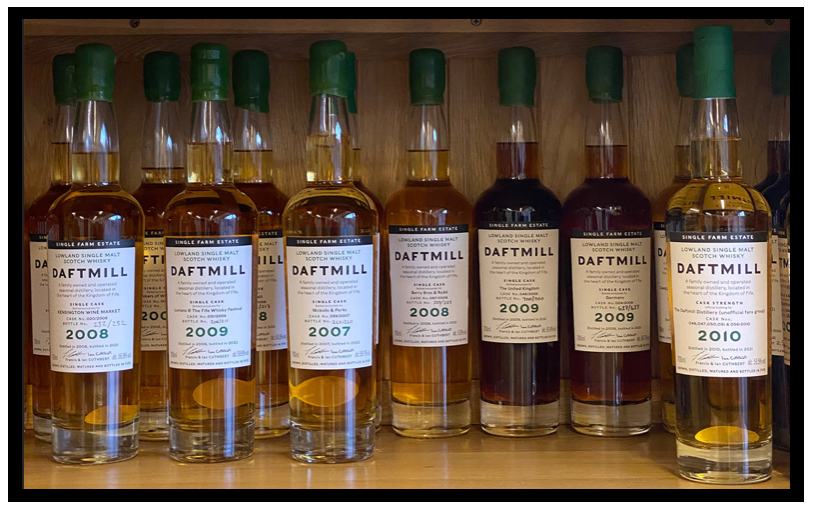
When Daftmill’s first single malt finally arrived, it arrived with a signature realism. The inaugural release was a 12-year-old whisky distilled in 2005 and bottled in 2018, drawn from first-fill bourbon casks and released in tightly limited numbers. Even the official release page underscores the operating constraints: the distillery runs only in the farm’s quiet periods and can produce as few as about 100 casks per year.
In April 2018, the world got a public demonstration of what “tiny and patient” looks like in practice. Berry Bros. & Rudd, Daftmill’s distributor, handled the first release via a ballot, allocating bottles at random to keep the sale fair. The coverage at the time spelled out the mechanics and the scarcity: registration, a closing date, and a limited number of bottles offered through that route, with additional bottles later reaching specialist retailers. It was the opposite of mass marketing. It was controlled access to something that could not, by design, be made in large quantity.
By then, a certain “cult status” was inevitable, not because Daftmill tried to manufacture mystique, but because its production model forces rarity. When you distill around cattle and crops, and when one person insists on keeping control rather than scaling up staffing and output, scarcity is not a campaign; it is arithmetic. In the same period, Francis publicly stressed “unhurried” methods and the reality of producing around 100 casks a year. That is then amount enough to be meaningful for a farm distillery, but never enough to satisfy global demand.
This is also where Ian Cuthbert’s role becomes clearest. Daftmill’s founding was not a solo myth; it was a shared risk—brothers who filed the planning application together, rebuilt together, and waited together through the long years when there was spirit in cask but nothing on shelves. Yet the distillery’s day-to-day identity still resolves around Francis: the voice, the operator, the man whose temperament fits a place that values routine, livestock discipline, and the calm efficiency of doing things the same way because the same way works.
Daftmill’s founding, then, is not a story of escape from farming. It is farming that refused to let whisky become fantasy. The distillery was built inside the farm’s calendar, inside its crops, inside its self-reliance. It runs when the land allows it, and it falls silent when the land demands something else. If a clean moral is demanded from that, Daftmill provides one without pretending: the romance is real, but it is earned by restraint.
And the final irony—fitting for a farm distillery that waited twelve years to release its first single malt—is that Daftmill’s greatest asset may be the thing modern whisky culture struggles against most: the ability to do nothing, on purpose, for long stretches of time. In Fife, the barley still gets sown, the cattle still get fed, the harvest still arrives on schedule. Whisky happens only when those facts leave room for it. That is Francis Cuthbert’s kind of ambition: not loud, not rushed, and quietly uncompromising—like the farm itself.
Sources:
Daftmill Distillery, “Our Distillery” / “…Inaugural Release”, www.daftmill.com
ScotchWhisky.com, “Five minutes with… Francis Cuthbert, Daftmill”, Gavin D Smith, 30 May 2018
ScotchWhisky.com, “Daftmill Inaugural Release to be balloted”, Matt Evans April 30, 2018
Whiskypedia, “Daftmill”, scotchwhisky.com/whiskypedia/1834/daftmill/
Daftmill Distillery Official Website, “History”; “About”, www.daftmill.com/history
ScotchWhisky.com, “Daftmill: From Farm to Distillery”, www.scotchwhisky.com
Forbes, “Daftmill: Scotland’s Rarest Distillery”, 28 November 2018, www.forbes.com
Whisky Advocate, “Daftmill Distillery Profile”, www.whiskyadvocate.com/distillery/daftmill
Contributed by Tracy McLemore, Fairview, Tennessee USA