
Tommy Dewar
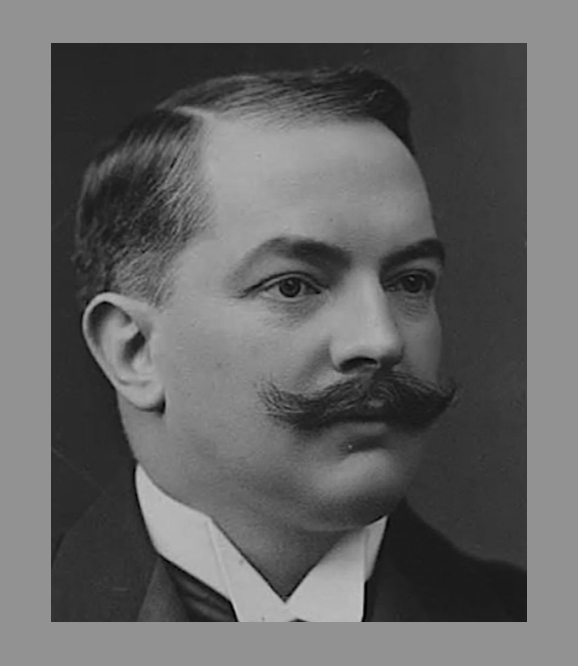

Thomas Robert “Tommy” Dewar was born in Perth, Scotland, on January 6, 1864. He entered a household where whisky was already a serious business. His father, John Dewar, had built a Perth wine-and-spirits enterprise that evolved into John Dewar & Sons, and Tommy grew up watching a local merchant’s trade stretch toward national ambition.
The Dewar family produced three sons who became public figures in very different arenas. John Alexander Dewar, Tommy’s older brother, took the steadier, managerial role inside the firm; Tommy became its most visible, as salesman and public face; and their brother Arthur Dewar pursued law and became a Scottish judge. The division of temperaments certainly influenced Dewar’s rise from a respected Scotch blender to a global name. Inside the firm, John Jr.’s operational discipline kept quality consistent, and Tommy’s social daring was used to persuade the wider world that a blended Scotch from Perth belonged on the best tables in London, New York, and beyond.
Tommy’s education came first, and, like many heirs to Victorian-era drinks businesses, his preparation for the trade included practical industry training rather than a purely academic path. He attended Sharp’s Institution in Perth and then took on a form of technical education through apprenticeships with other drinks merchants, building a working knowledge of the business before stepping fully into the family firm. This was the kind of hands-on commercial schooling that taught young merchants how supply chains worked, how credit and cashflow kept businesses alive, and how relationships with publicans, hoteliers, and agents could determine whether a brand grew or stalled.
An unfortunate yet defining rupture came early when patriarch John Dewar died in 1880, leaving the company to sons who were still young and inexperienced. In that succession, Tommy’s role became increasingly clear: he could sell; boldly, incessantly, and with a showman’s instincts. By the early 1890s, he was ready to do something few whisky men of his era attempted at scale, and that was treat the world itself as his ownsalesterritory. So in August 1892, Tommy set out on a remarkable marketing journey that became part business expedition and part public spectacle. Over roughly two years, he visited 26 countries, pushing Dewar’s into new markets and building the kind of international distribution that could turn a strong brand into an institution. He kept travel journals, and in 1894, he published them as A Ramble Round the Globe, issued by Chatto & Windus. The book preserved the voice that made him useful to the business: observant, quick with a line, and unafraid to put himself at the center of the story.
That same appetite for visibility helped root Dewar’s in elite London life. By the 1890s, Dewar’s whisky was embedded in fashionable venues, and Tommy’s own address became famous in its way. He maintained a serviced apartment at the Savoy Hotel from 1904 all the way up until his death in 1930, a run that has been widely credited as the Savoy’s longest continuous guest stay. This was not merely a quirky personal preference. The Savoy placed him at the crossroads of politics, theatre, finance, sport, and press, exactly the social ecosystem where a premium brand could become a default order.
Public life followed. In 1897, Tommy became Sheriff of London, a civic role that fit his flair for public ceremony and his ease in high society. He also stepped into national politics. In October 1900, he won election as Conservative Member of Parliament for St George, Tower Hamlets, and he served until 1906. His later career confirmed that he was never content to be only a merchant prince; he wanted the authority and social standing that came with office, title, and public recognition.
Honors arrived in sequence. He was knighted at Buckingham Palace on December 18, 1902. In 1917, he was created a baronet, tied to Homestall Manor in East Grinstead, Sussex. Two years later, in 1919, he entered the peerage as Baron Dewar of Homestall and was formally introduced in the House of Lords. The arc was unmistakable: salesman to national figure, brand-builder to titled aristocrat. For all the social visibility, Tommy’s domestic life was notably spare by the standards of his class and era. He never married, and he left no children. That fact shaped the afterlife of his honors, for when he died, his titles became extinct, a rare kind of punctuation mark on a life that had been built around public presence rather than family continuity.
Tommy also poured real money and attention into sport, especially thoroughbred racing, where status and competitionintertwined. He bred notable horses, including Cameronian, later a classic winner, and Challenger, a stallion that went on to major influence as a sire. This was an extension of the same instinct that made him valuable to Dewar’s: he liked arenas where reputation could be built in public, where success could be measured, and where a name, whether on a bottle label or a racecard, might become famous.
Tommy Dewar died on April 11, 1930, at age 66. His death closed one of Scotch whisky’s most theatrical chapters: a man who helped turn blending into an export language the world could understand, who treated travel as sales strategy, who lived for decades in the Savoy as if it were a headquarters, and who accumulated the civic roles and aristocratic titles that Victorian and Edwardian Britain reserved for men who both madefortunes and performed power convincingly. Dewar’s survived him because the business had become larger than any onepersonality, but its rise into global popular culture still carries the imprint of “Tommy,” the salesman who insisted that Scotch could be marketed with the same confidence as any great luxury product.
Sources:
The Peerage, “Thomas Robert Dewar, 1st Baron Dewar”, www.thepeerage.com/p23337.htm
Enterprise & Society, Cambridge University Press, “Local Patriots: Dewar’s Scotch Whisky, Prosociality, Politics, and Place, 1846–1930”, Niall G. MacKenzie, 10 December 2024
ScotchWhisky.com, “Whisky Heroes: Tommy Dewar”, Gavin D. Smith, 16 November 2016
History of Parliament Online, “Sir Thomas Robert Dewar”
Hansard (UK Parliament) | Volume 34, “Lord Dewar,” House of Lords debate/entry, 28 May 1919
Contributed by Tracy McLemore, Fairview, Tennessee USA