Rich Eggers



Rich Eggers has spent much of his public life standing in a uniquely Iowan intersection: the long shadow of Prohibition-era rye, the stubborn practicality of small-town craftsmanship, and the modern world’s insistence that even the most local traditions must be explained, documented, and made legal. He is sometimes introduced by his nickname, “Whiskey Rich,” and the work that built his reputation is just as straightforward: turning a regional, family-proximate rye tradition into a functioning, licensed distillery business centered in Carroll, Iowa.
Born October 11, 1960, Eggers grew up in the small, western Iowa town of Crawford, in a part of the state where stories of “Templeton Rye” didn’t live in museums, they lived in memory, family lore, and in the way people still write stories about what had happened in the 1930s. But Eggers didn’t come to distilling by reading about it first; he came to it through people. While he was refining his methods, Eggers worked days in the service department of a Ford dealership, and he learned the basics from a neighbor who practiced moonshining. Eggers’ entry into a “real” historical whiskey rye recipe, though, is tied more tightly to his family, through one of the original Iowa bootleggers, Lorine Sextro, who shared her methods with Rich’s brother, Chuck. Chuck became friends with Lorine later in her life, and she learned of Chick’s interest in distilling. Lorine then worked with him to help him reproduce her rye technique. Chuck soon followed his older brother down that career path and found that it became his own lasting passion. Iowa’s rye identity, then, is inseparable from the Prohibition-era story of moonshining. That history is what Eggers and his partners lean on in a specific household narrative of farm hardship, an illicit economy, and an octogenarian recipe.
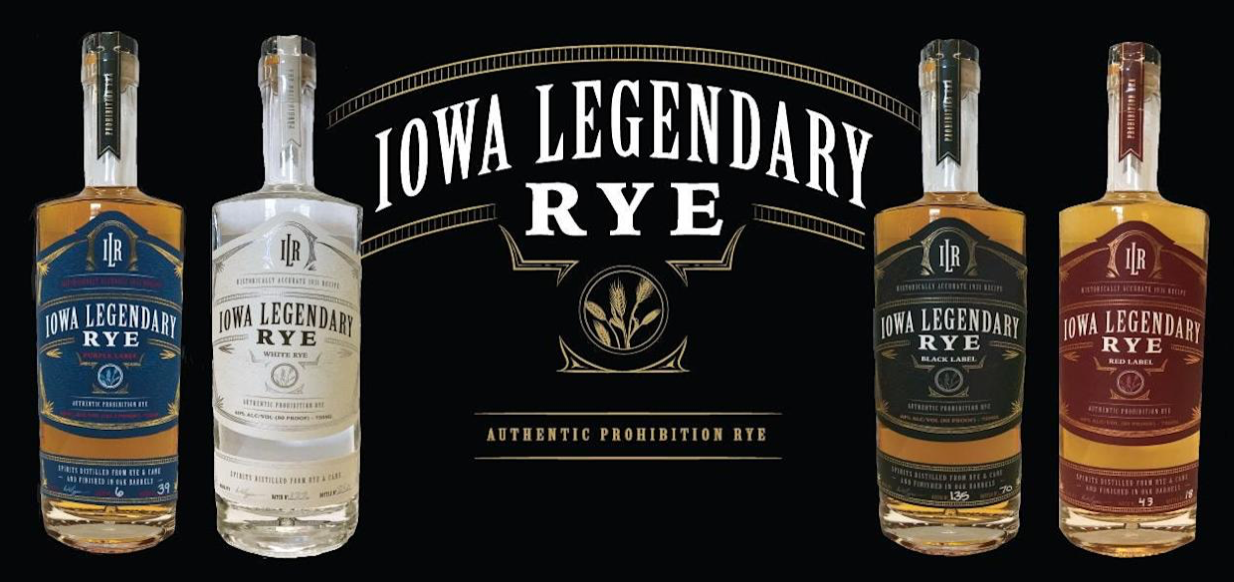
In the original telling of that story, Frank and Lorine Sextro let a down-on-his-luck bootlegger move into their attic in 1932, and he shared his booze-making technique with the couple. Open to giving it a try, Lorine soon proved she had a real knack for distilling, and before long, she was making her own palatable small-batch rye; the operation expanded quickly, though always under cover from the authorities. Much later, the Sextro family believed that a still (and possibly barrels) were buried to avoid federal seizure. In any case, Whiskey Rich became the keeper of that legend when he came into possession of Sextro’s 80-year-old original recipe. So in 2015, he co-founded Iowa Legendary Rye using Lorine’s handwritten instructions and original distilling process.
The transition from “recipe” to “company” did not happen with a single clean date. Eggers and his wife Lisa Chase opened their then-small distillery operation in 2014 in the back of a former apothecary near the Carroll town square, and in 2015 and put to use the 1932 recipe and small-format equipment that still echoed the old methods. Once paperwork was filed and Eggers’ project moved into the legal realm, his public identity sharpened into something closer to “craftsman” than “entrepreneur.” In those first years, the distillery’s co-founder, Heath Schneider, handled much of the marketing/finance/promotion side while Eggers was presented as the “master craftsman” behind the operation.
The process itself was deliberately designed to look backward. Iowa Legendary Rye is frequently described as making spirits in small batches using equipment sized to match the older clandestine scale: 26-gallon stills appear, alongside small barrels, as a way to stay faithful to how rye was actually produced when secrecy mattered. Additionally, Eggers partners with a nearby farm to utilize certified organic Iowa rye. Fermentation time is long at two to three weeks as part of an “old” process they believed produces a different result than fast, modern schedules. Whether one agrees with every claim attached to those choices, Eggers and his team ties process decisions to identity: “If you couldn’t do it in a barn in 1932, we don’t do it now.”
Eggers continues to operate on a scale that mirrors his philosophy. Production remains limited, methods remain manual, and processes stay closely aligned with those used generations earlier. The distillery’s equipment, techniques, and workflow reflect a deliberate choice to preserve practices that predate modern automation, even as the operation itself functions within today’s legal and regulatory framework. Within his small Iowa community, “Whiskey Rich” Eggers is known less for expansion than for consistency. His distillery stands as a working example of how historical methods can be preserved in a modern context, not as a novelty, but as a practical and intentional way of making whiskey.
Sources:
Clawhammer Supply, “Making Rye Whiskey…", Emmet Leahy, July 06, 2016, clawhammersupply.com
The Whiskey Wash, “Iowa Legendary Rye Whiskey—Review”, Jim Bonomo, September 15, 2017, thewhiskeywash.com
Agrisecure, “Organic Rye Key to Distillery’s…Spirits”, December 29, 2020, agrisecure.com
Rackhouse Whiskey Club, “Hunting for Buried Treasure…”, February 2, 2023, rackhousewhiskeyclub
Travel Iowa, “Iowa Legendary Rye”, traveliowa.com
Sextro Rye Official Website, “Home”, sextros.com
Contributed by Tracy McLemore, Fairview, Tennessee