Garrett Janko


Garrett Janko was born on September 12, 1984. Public records and interviews reveal little about his childhood, but what can be documented with clarity is the shape of his adult working life: a slow, grind-heavy climb into distilling that mirrors the way many durable craft operations are actually built; through parallel jobs, incremental learning, and a deliberate resistance to growing faster than cash flow will allow.
In the early 2010s, Janko was running a small store in his hometown of Norman, Oklahoma. At the same time, he worked a second job. He maintained that two-job schedule for roughly five years, when he began to investigate distilling ethanol. But his initial research into distillation didnot center on beverage alcohol. Instead, he first explored ethanol production as an industrial product. After all, ethanol sits at a strange intersection. It is both a fuel and the base alcohol used in beverage spirits. On paper, it looked like a possible business; in practice, the numbers did not hold. Janko concluded that small producers cannot compete economically in industrial ethanol, where scale determines survival. That realization forced a pivot. Beverage spirits offered a market where small-batch production, differentiation, and local identity could matter.
That pivot also aligned with something older than profit margin spreadsheets. Janko has spoken about a family lineage connected to distilling, tracing back to a great-grandfather who emigrated from the Czech Republic. The family connection did not come packaged as a functioning distillery or inherited brand, but it carried symbolic weight. Distilling, in that sense, did not feel like an invented identity, it felt like a return.
Once the decision was made, Janko and his younger brother moved quickly from discussion to paperwork. They assembled federal and state permit applications and began laying the regulatory groundwork required to operate legally. Equipment followed. Their father built a 200-gallon plated still, a hands-on contribution that underscored how homegrown the operation was in its earliest form. With permits in hand and a still in place, Janko began producing rye-based distillate.
His first named commercial venture was Twister Distillery in Moore, Oklahoma. The operation was small, and the product vision was broad from the outset: a flavored “sweet-tea” vodka, whiskey, and rum, all leaning heavily on rye as the base grain. Even in this early phase, Janko talked about buying local grain when possible and emphasized that rye-based spirits delivered a specific character he personally preferred. The approach reflected a practical Oklahoma sensibility: work with what is nearby, make products people will actually drink, and do not overcomplicate the process.
Janko operated Twister Distillery for about 18 months. He has described that period as brief but formative, later calling it “educational,” and framing it as a necessary apprenticeship in the realities of running a distillery. But the partnership behind Twister ultimately disappointed him, so rather than attempt to force a working relationship that no longer functioned, Janko sold his shares, stepped away, and chose to start again on his own terms. Unfortunately, in 2014, roughly six months after Janko sold his interest in Twister, the distillery was involved in a serious incident. A still overheated, causing an ethanol flash fire that resulted in a worker suffering severe burns. A news crew was onsite filming an interview at the time and captured images of the explosion. The episode underscored the risks inherent in potentially poorly controlled or improvised distilling setups, lessons Janko had already absorbed and would carry forward.
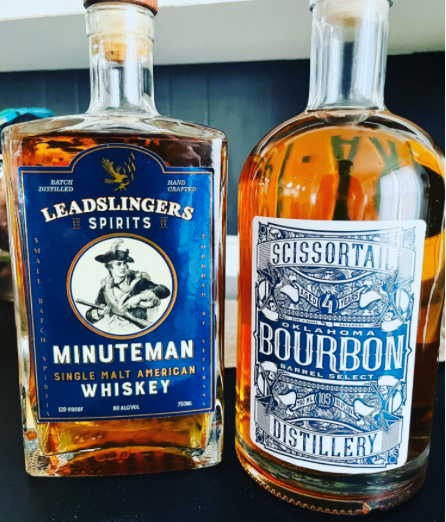
The second chapter began quickly. In 2013, Janko founded Scissortail Distillery, also in Moore. He has described Scissortail as a “starting anew” phase: a self-funded distillery built without outside control, where decisions could be made based on what the business could realistically support rather than what looked impressive on paper. It was, in effect, a distillery designed to survive before it was designed to shine. By 2014, Janko had Scissortail producing bourbon, rye, rum, and gin in small batches. Whiskey anchored the lineup, but Janko made it clear that he did not want the distillery boxed into a single category. The breadth of production reflected both creative interest and operational logic. A small distillery with one product and limited volume is fragile. A distillery capable of producing multiple spirits can adapt to shifts in demand.
The day-to-day reality of Scissortail in those early years was labor intensive. Accounts from the period note that Janko “seldom gets a day off.” He was not operating as a distant owner or brand ambassador. He was filing permits, running equipment, troubleshooting production problems, and handling the unglamorous details that keep a small plant functioning. By 2017, Janko explained that Scissortail handled contract distilling and private labeling in addition to producing its own branded spirits. That work required translating someone else’s idea into a finished product; sometimes through in-house production, sometimes by sourcing to meet a specific request. Janko framed this as both craft discipline and survival strategy. A distillery runs best when it operates near full capacity. Idle equipment does not age well, and unused fermenters do not pay rent. Contract work kept the stills hot, the lights on, and the business solvent.
Across these chapters, a consistent profile emerges. Janko is not a celebrity founder whose reputation is built primarily by marketing. He is a working distiller who learned by doing, paid for his education with years of extra labor, and accepted slow growth as the price of independence. Scissortail Distillery stands as the physical expression of that philosophy: a self-funded operation in Moore, Oklahoma, with a wide spirits portfolio, a willingness to take on contract work, and an insistence that making a distillery “work” is an operational discipline measured in inches rather than headlines.
Sources:
The Alchemist Cabinet (WordPress), “Interview with Garrett Janko of Scissortail distillery.” June 12, 2017
The Journal Record, “Vodka production starts in state”, Brian Brus, October 29, 2012
Oklahoma Gazette, “We’ve done the homework and the legwork…”, Devon Green, November 19, 2014
Scissortail Distillery Facebook page, facebook.com/Scissortaildistillery/mentions/
Dun & Bradstreet, “Scissortail Distillery, LLC, Company Profile”,dnb.com/business-directory/company
Contributed by Tracy McLemore, Fairview, Tennessee