Amy Levesque


Amy Levesque’s route into Canadian whisky runs through the unglamorous disciplines that keep a big distillery honest: steam, power, process control, and the everyday arithmetic of yield. Before her name became associated with Hiram Walker & Sons in Windsor, Ontario, she built a foundation in industrial production: training that treats heat, pressure, and flow as real forces with real consequences. That foundation began at Lambton College, where Levesque earned a technical education in chemical production and power engineering. She paired that schooling with an Operating Engineer credential through Ontario’s Technical Standards and Safety Authority (TSSA), a combination that sits squarely in the world of boilers, utilities, and plant systems, the infrastructure that also allows a distillery to run at scale without sacrificing repeatability.
In 2014, Levesque joined Hiram Walker & Sons Ltd. and stepped directly into operations as a Process Operator. One must be assured that Hiram Walker is not a boutique stillhouse built for small runs; it is one of the largest spirits production sites in the world, producing several major bestselling Canadian whisky brands, and operating with the kind of continuous throughput where small decisions can easily compound into big outcomes. At Hiram Walker, Levesque moved quickly into leadership. From 2016 to 2019 she served as Distillery Supervisor, then advanced to Distillery Manager from 2019 to 2024, and in 2024 she took on the title Director, Distillation. That quick progression maps a career that reflects a professional identity rooted in making the equipment behave, the spirit cut correctly, and the production targets land without compromising the profile that blenders and consumers expect.
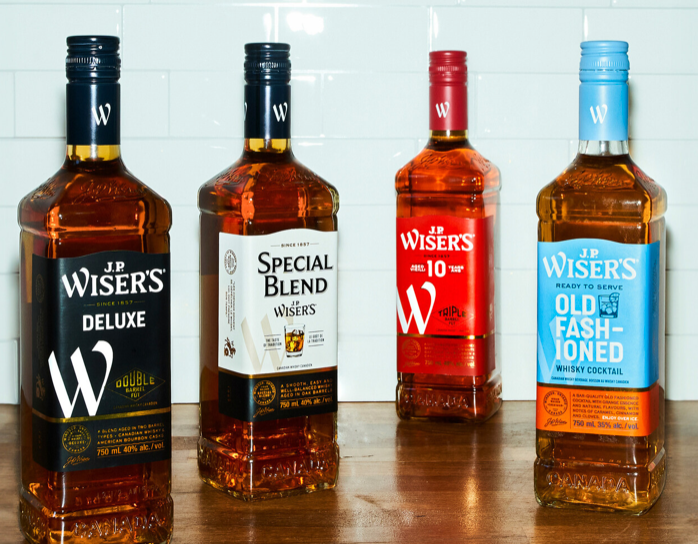
Hiram Walker’s modern whisky identity is often described through its brands: J.P. Wiser’s, Lot No. 40, Pike Creek, Gooderham & Worts, and through the blending reputation of Dr. Don Livermore. But the production side that feeds those blends is its own craft: fermentation management across large tanks, column and pot distillation choices that shape congeners, and the discipline required to keep a distillery’s “house style” stable over time. In practice, Levesque’s work sits at the interface between the physical plant and the intended flavor. Her background helps explain why her responsibilities extend beyond the stills themselves. A large distillery is a network of energy systems: steam generation, evaporation, and process controls that are not support functions, they are part of spirit quality, because they determine stability and precision. Levesque’s contributions have been described in concrete, plant-level projects, like installing a micro-fermenter in production to enable larger-scale product trials; helping bring rum distilling back to the facility, starting with trials and scaling up to a stated six million liters per year; assisting with commissioning a 250,000-pound-per-hour boiler in the power plant; and commissioning a new vapor recompression evaporation system. These are the kinds of projects that rarely make front labels, yet they shape what a distillery can attempt, and how efficiently it can deliver.
Levesque’s public visibility has also grown as the industry has become more deliberate about recognizing technical excellence among women in production roles. In March 2023, Hiram Walker & Sons highlighted her inclusion in an LCBO “Women in Wine, Beer and Spirits” initiative. In that feature, Levesque addressed a familiar reality in industrial spirits: people often underestimate a woman’s expertise in whisky distillation, tasting, column operation, and equipment design, and she framed that underestimation as fuel for higher performance and achievement. Her name also appears in broader roundups of women in senior spirits roles. In parallel, industry education programming has positioned her as a guide to production-driven flavor; teaching, tasting, and explaining how distillation decisions translate into sensory outcomes.
Levesque’s is already a complete whisky story, because distilling at her level is not a single job; it is a long argument for consistency. Levesque’s career arc, from process operator to Director of Distillation in only ten years, shows a practitioner who learned the plant from the inside out, then used that knowledge to change what that plant could do: trial faster, scale responsibly, commission major equipment, and keep flavor targets intact across columns, pots, and time. In Canadian whisky, where blending is a very public art and large scale production is the hidden engine, Amy Levesque stands in the engine room, proudly building the spirit that makes the blend possible.
Sources
Toronto Whisky Society, “Hiram Walker Distillery Visit (2023)”, September 25, 2023,
torontowhiskysociety.caThe Alchemist Magazine,”Women in Spirits Day”, March 8, 2022, thealchemistmagazine.ca
Bourbon Women, “2025 SIP Workshops”, bourbonwomen.org
Hiram Walker & Sons official distillery profile, poured.ca/profiles/hiram-walker-sons
Contributed by Tracy McLemore, Fairview, Tennessee