W.P. Lowrie



The above AI-generated image of W.P. Lowrie from about 1850 is based on an accepted depiction
William Phaup “WP” Lowrie’s name is welded to Scotch whisky in a way that feels bigger than any single brand. He helped build a still-productive distillery called Glentauchers that quietly powered major blends; he ran one of Glasgow’s most significant whisky warehousing and blending businesses; and, perhaps most lastingly, he became part of the practical “wood-and-warehouse” revolution that shaped how Scotch was matured, handled, and sold.
Lowrie was born in Dalkeith in 1831. Little is known of his parents, childhood or early life. Once he became of age, however, Lowrie served an apprenticeship with the Commercial Bank of Scotland in Edinburgh, training in the habits that later defined him; namely, accounts, inventory, risk, and the unglamorous mechanics of moving valuable goods through regulated channels. From banking he shifted into the whisky-and-wine trade through a powerful Islay connection named John Ramsay of the Kildalton Estate. There, he worked in the management of Port Ellen distillery, and Ramsay’s wider agencies for wine and spirit producers. That step in his career was important because Ramsey’s interests all sat at the intersection of production, shipping, and a marketplace that was rapidly professionalizing. It was also a setting where a young broker could learn that whisky’s destiny was decided as much by casks, credit, and logistics as by malt and peat. Meanwhile, in about 1851, Lowrie married Anne Beattie. Again, history falls silent as to whether the couple ever had any children, but there is no indication that any of his later business ventures ever resulted in inheritance.
In 1869, Lowrie struck out on his own in Glasgow, establishing himself as a broker and commission agent for Scotch whiskies. Glasgow in the late 19th century was not merely a city of consumption, it was a nerve center of blending, warehousing, bottling, and export. Lowrie positioned his firm right where the business was becoming modern: in bonded stores, brand identity, and reliable supply. Within fifteen years, Lowrie was one of the largest stockholders of Scotch whisky in Scotland. Maintaining large inventories meant living with price swings, tax rules, warehouse requirements, and the constant question of whether the market would reward patience. It also meant he might soon be the kind of figure that blenders and merchants needed: a man with whisky to sell, and the infrastructure to manage it properly. That infrastructure grew into something unusually complete. Lowrie’s firm had a substantial blending and bottling operation. In 1885, Lowrie’s firm became exclusive supplier of whisky to James Buchanan & Co., whose commercial success came from blending, branding, and marketing whisky with exceptional skill at a time when the blended Scotch industry was rapidly expanding. Buchanan focused on consistent quality, strong brand identity, and elite clientele—most famously securing contracts with the British Houses of Parliament and later becoming a supplier to the Royal Household.
In 1869, Lowrie struck out on his own in Glasgow, establishing himself as a broker and commission agent for Scotch whiskies. Glasgow in the late 19th century was not merely a city of consumption, it was a nerve center of blending, warehousing, bottling, and export. Lowrie positioned his firm right where the business was becoming modern: in bonded stores, brand identity, and reliable supply. Within fifteen years, Lowrie was one of the largest stockholders of Scotch whisky in Scotland. Maintaining large inventories meant living with price swings, tax rules, warehouse requirements, and the constant question of whether the market would reward patience. It also meant he might soon be the kind of figure that blenders and merchants needed: a man with whisky to sell, and the infrastructure to manage it properly. That infrastructure grew into something unusually complete. Lowrie’s firm had a substantial blending and bottling operation. In 1885, Lowrie’s firm became exclusive supplier of whisky to James Buchanan & Co., whose commercial success came from blending, branding, and marketing whisky with exceptional skill at a time when the blended Scotch industry was rapidly expanding. Buchanan focused on consistent quality, strong brand identity, and elite clientele—most famously securing contracts with the British Houses of Parliament and later becoming a supplier to the Royal Household.
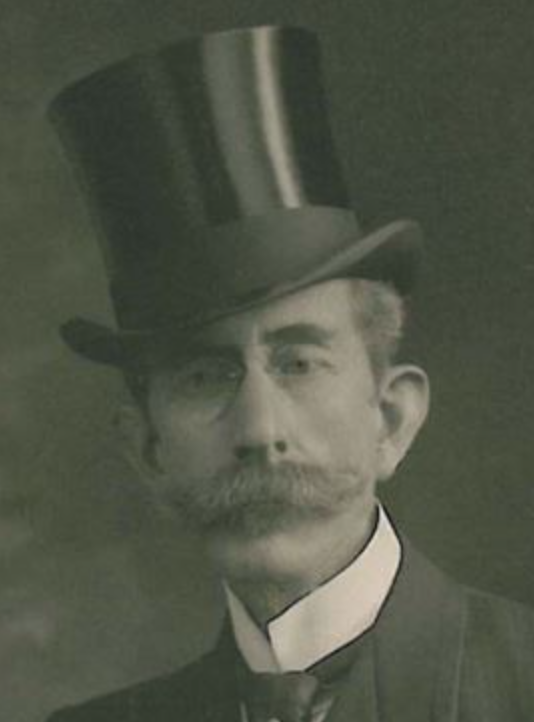
Actual photo of Lowrie’s partner James Buchanan
During the mid-to-late-19th century, Scotch producers began to face a practical problem: the supply of traditional sherry shipping casks began to tighten, even as whisky output and maturation needs expanded. One solution, though immediately controversial, was solved by Lowrie. He imported new oak from America, had the casks coopered in Glasgow, and then steamed them in an inexpensive, sherry-like wine known as paxarette under mild pressure. This resulted in stave absorption, improving a cask’s flavor profile and imparting vinous color to the cask. The paxarette treatment did not dose the whisky directly, but economically seasoned the casks by forcing flavorful liquid into the wood. The practice became highly frowned upon later in the 20th century, but historically, Lowrie belonged to the generation that treated wood management as an engineering and supply chain problem to be solved, and he did so pragmatically, and in a manner that was legal at the time.
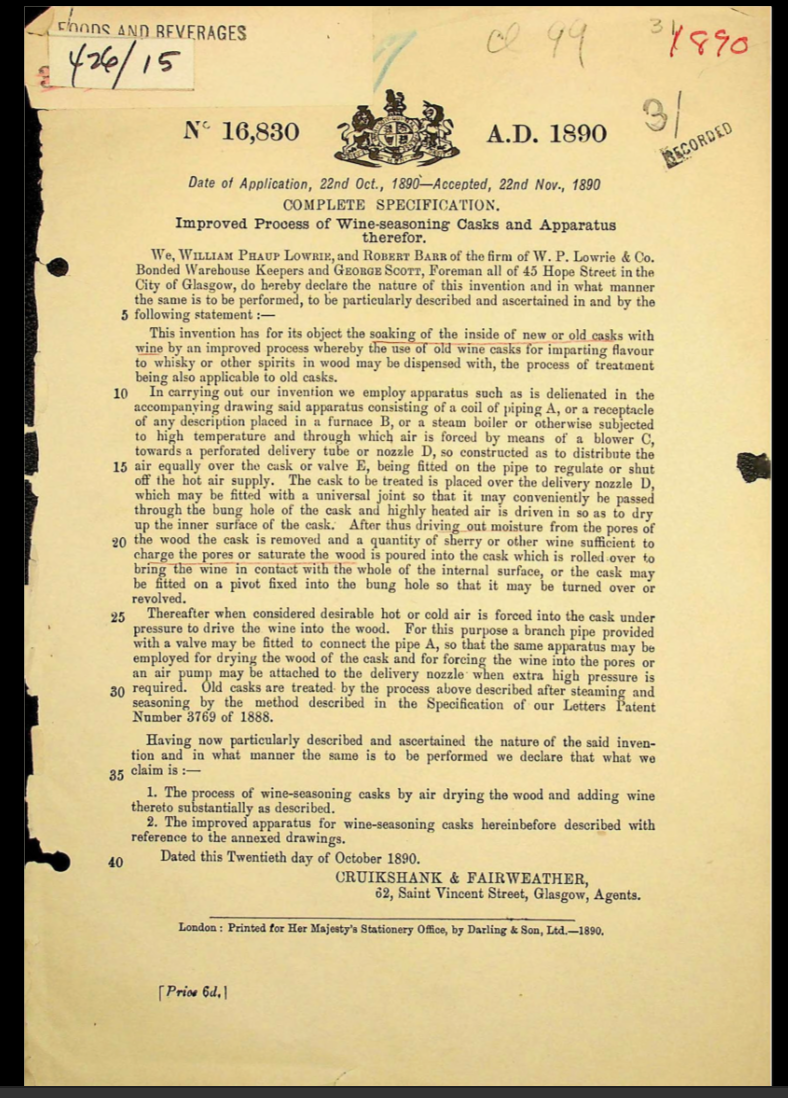
Patent application for Lowrie’s “Paxarette” process
October 1890
During the mid-to-late-19th century, Scotch producers began to face a practical problem: the supply of traditional sherry shipping casks began to tighten, even as whisky output and maturation needs expanded. One solution, though immediately controversial, was solved by Lowrie. He imported new oak from America, had the casks coopered in Glasgow, and then steamed them in an inexpensive, sherry-like wine known as paxarette under mild pressure. This resulted in stave absorption, improving a cask’s flavor profile and imparting vinous color to the cask. The paxarette treatment did not dose the whisky directly, but economically seasoned the casks by forcing flavorful liquid into the wood. The practice became highly frowned upon later in the 20th century, but historically, Lowrie belonged to the generation that treated wood management as an engineering and supply chain problem to be solved, and he did so pragmatically, and in a manner that was legal at the time.
Lowrie died in 1916, and did not live to see the full consolidation of Scotch’s corporate era, but his firm’s fate ran in that direction. Even at the moment of his death, Lowrie’s world was still rearranging itself through mergers and joint control. A few months after his passing, W P Lowrie & Co. Ltd., was one of four distiller–blender firms involved in taking over Dailuaine–Talisker Distilleries Ltd, alongside Distillers Company Ltd., John Walker & Sons, and John Dewar & Sons.
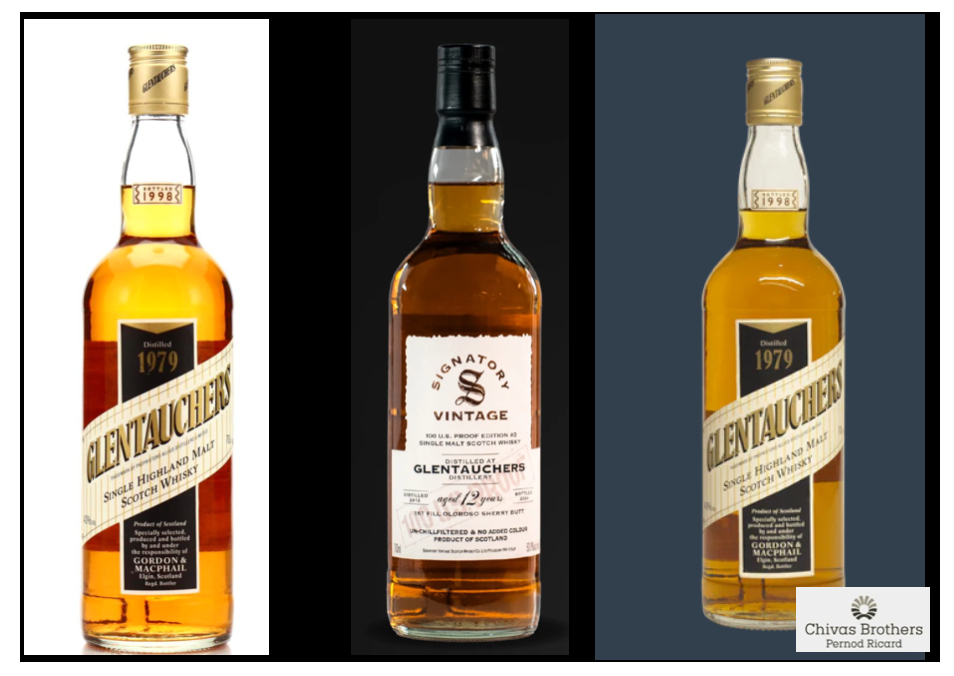
Meanwhile, Glentauchers, the distillery that Lowrie co-founded with Buchanan in the late 1890s, remained a workhorse of Speyside production, yet was much better known inside the industry than on bottle labels. In that sense, Glentauchers stands as Lowrie’s most visible monument: a distillery conceived not as a solitary artisan’s statement, but as a strategic engine for consistent blending stock; exactly the kind of modern, system-minded whisky thinking that Lowrie embodied.
For all his later mythology, especially overseas, where his bearded likeness has taken on a life of its own, Lowrie’s verified story is less legend than infrastructure. He rose from apprenticeship and management work into a Glasgow firm that handled whisky at scale; he partnered with and supplied one of the great blending entrepreneurs of the era; he helped found a Speyside distillery which fed the blend-driven century to come; and he became tightly linked to the evolution of cask sourcing and seasoning. Those are the hidden gears of Scotch whisky’s transformation from a regional spirit to a global industry that took its first breaths largely under the careful, efficient administration of William Phaup Lowrie.
Sources:
Your Scottish Archives (Scottish Council on Archives), “Records of W P Lowrie and Co…”, yourscottisharchives.com
Scotch Whisky, “How do Sherry casks…”, 19 October 2016, scotchwhisky.com
Scotch Whisky, “James Buchanan…”, Gavin D. Smith, 23 August 2016
Whiskipedia, “What is Paxarette?”, whiskipedia.com
The Whisky Shop, “Glentauchers distillery”, whiskyshop.com
Nonjatta blog, “More Bearded Tales”, 28 November 2000, nonjatta.blogspot.com
Contributed by Tracy McLemore, Fairview, Tennessee USA