Long John MacDonald

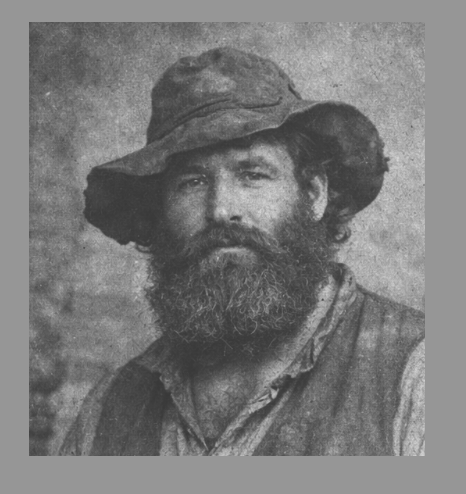
There are no known photographs of John MacDonald known to exist. Above
is an AI-generated image of him based on facts known about his life.
John MacDonald, who is remembered in Lochaber and far beyond as “Long John,” stands at the beginning of Ben Nevis distillery not simply as a name on a foundation date, but as a type of 19th-century, near-legendary whisky figure who could turn landscape, reputation, and daring publicity into a brand long before “branding” was a boardroom word. In 1825, a legal distillery took shape at Lochy Bridge, just outside Fort William, in the shadow of Britain’s highest mountain. That year was the moment Long John took out the license for Ben Nevis distillery, and by the early 1830s, the whisky leaving Lochy Bridge was increasingly tied to his name and his showman’s instincts.
MacDonald was born in 1796, and his nickname was not merely decorative. He was always described as exceptionally tall, a giant of a man, and the physical fact of him became part of the his public identity. This made him “built” for a life in distilling, particularly in an age when whisky often travelled by cask, by word of mouth, and by the reputations of merchants and innkeepers. A proprietor who was memorable on sight, then, had a commercial advantage. MacDonald made himself difficult to forget, and he pushed the Ben Nevis whisky outward with the same stubborn clarity that defined his local presence.
The young legal whisky trade did not exist in a vacuum. Lochaber had long been a landscape of illicit distilling alongside licensed enterprise, and most certainly, MacDonald was part of that older world before he went straight. Whatever his exact route into licensed production, his forward motion inside the legal business was rapid. In 1830 he was a partner in the firm; by the following year, he had bought out his associate’s interest and taken control. But that control came at a cost. The Ben Nevis story under Long John is not only a tale of bold marketing, but also of heavy borrowing, an early example of a whisky man trying to fund growth in an industry that demands patience while aging, all the while consuming large quantities of cash.
It was about that time that MacDonald married a local girl, Mary McCormick, from Lochaber. The couple settled on the western slope of Ben Nevis near Fort William, and soon had a daughter named Jane, Tragically Jane died in infancy, but a few years later, John and Mary had a son, Donald, known better as “D.P.,” who later played a big part in the family business after the death of his parents.
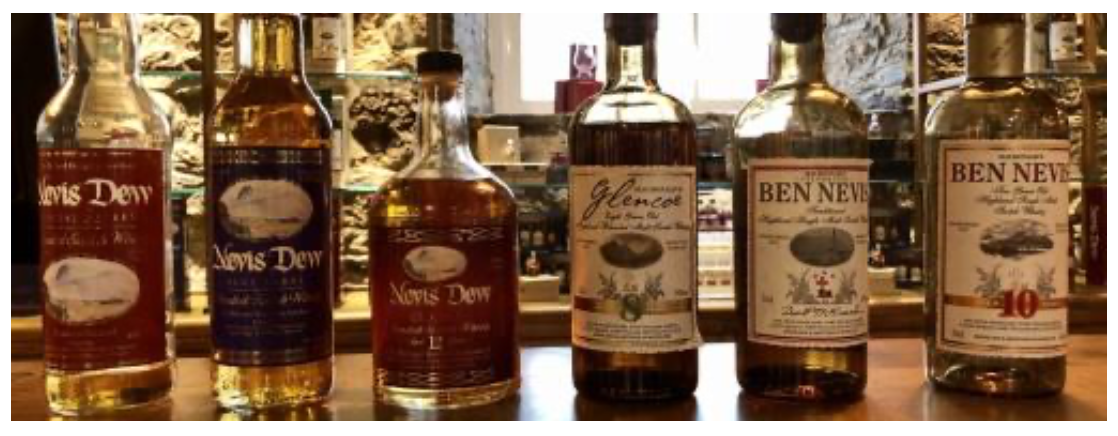
If Ben Nevis had remained merely “a distillery near Fort William,” it might have been one more Highland name among many. However, MacDonald’s lasting contribution was to attach the whisky to a narrative: mountain water, Highland stature, and an owner who behaved as though the product belonged in the cellars of the powerful. Under his stewardship, Ben Nevis became nicknamed, “Long John’s Dew of Ben Nevis,” a style of presentation that treated the malt, not as anonymous spirit, but as a branded article; as something that should be asked for by name. John pursued that attention with deliberate tactics. One oft-repeated episode places a cask of his whisky on a route far above the ordinary customer: Buckingham Palace, sent with instructions that it be held for the Prince of Wales’ 21st birthday. Whether a single cask changed sales overnight is unknowable, but the underlying method is clear and historically plausible in its mechanics that MacDonald sought the halo of elite patronage, then used the very idea of that patronage as a selling tool. In the 1840s and 1850s, the line between product and reputation was thin, and for his whisky, MacDonald did everything he could to make that line vanish.
Another time, MacDonald led a mountain rescue for the Duchess of Buccleuch. In 1838, the Duchess and her retinue got lost in the mist on Ben Nevis during a pleasure trip ascent. An outdoorsy man his entire life, Long John was easily the first rescuer to find the party, and rang a very large bell to attract the others’ attention; it worked, and the Duchess was brought down on horseback using the wily Long John’s bright plaid in lieu of a saddle. History does not record how much of the “Dew of Ben Nevis” was consumed as a result. The episode functions as an explanation for how Ben Nevis’ whisky travelled socially as well as geographically: a noble act turned into a Highland calling card.
By Victorian times, “Long John’s Dew of Ben Nevis” was being described as one of the best-known names in Highland malt. Some went far as to call it among the earliest single malt brands to achieve wide recognition, especially in France, where the whisky’s—and Long John’s—reputation was repeatedly noted, and the stories of “Légende de la montagne brumeuse” were retold with relish.
Yet the hard truth of Long John’s career is that immense popularity and solvency are not the same thing. The distillery’s growth was financed by debt, and debt has its own calendar. MacDonald’s borrowing eventually tightened into crisis, with bankruptcy finally arriving a half-dozen years before his death. The dates are not presented identically everywhere, in some place the bankruptcy is listed in 1850, others more generally in the early 1850s, but the end point is consistent: Long John MacDonald died in October of 1856, and his demise closed the founding chapter of Ben Nevis in unfortunate insolvency.
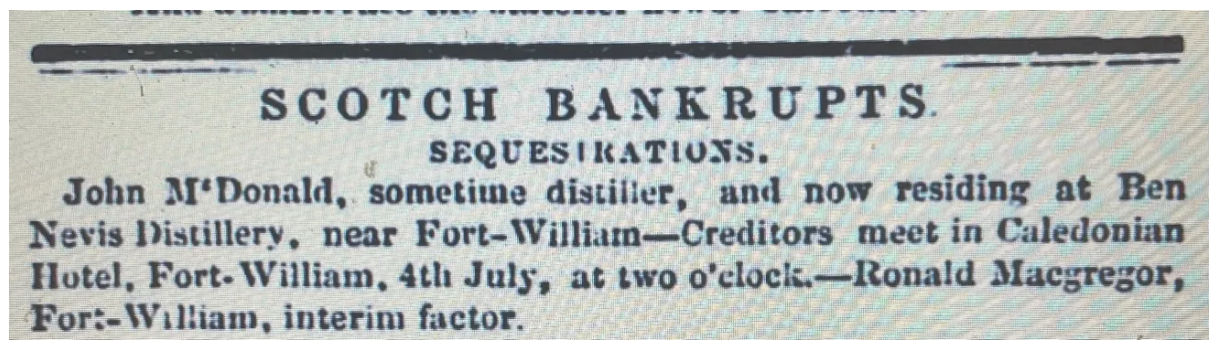
-Courier and Argus July 1, 1856
Contemporary reporting of his passing described him as well-known across the north, familiar to travellers and sportsmen in Lochaber, and “above sixty years of age.” That tone suggests a man whose public life was not confined to invoices and warehouses; someone who belonged to the social fabric of the Highlands at the exact moment that tourism, sporting estates, and the romance of place were beginning to intertwine with the whisky trade. MacDonald did not just sell spirit; he sold the idea that Ben Nevis itself, and its rock, water, weather, and all, had been turned into something you could simply pour into a glass.
After 1856, the business passed into the hands of his son, Donald P. MacDonald, and at that point, the story of Ben Nevis whisky shifts from flamboyance to scale. If Long John was the marketer, then D.P. was the steady builder—the one who expanded capacity and worked to turn the fame of “Long John’s Dew” into a more durable industrial base. By the mid-1860s, Donald pushed distillery production to a level that demanded more infrastructure than the original site could easily provide. By 1878, that logic became bricks and stills: a second distillery, Nevis, was built nearby to run alongside the original Ben Nevis operation. Its construction was described a remarkable local concentration of labor, with hundreds employed across what became, in effect, a small whisky city. The expansion is the clearest proof of what Long John had achieved in the market: his name could still help sell the whisky years after he was gone, and demand, particularly in the blend-driven late 19th century, that was strong enough to justify major capital work.
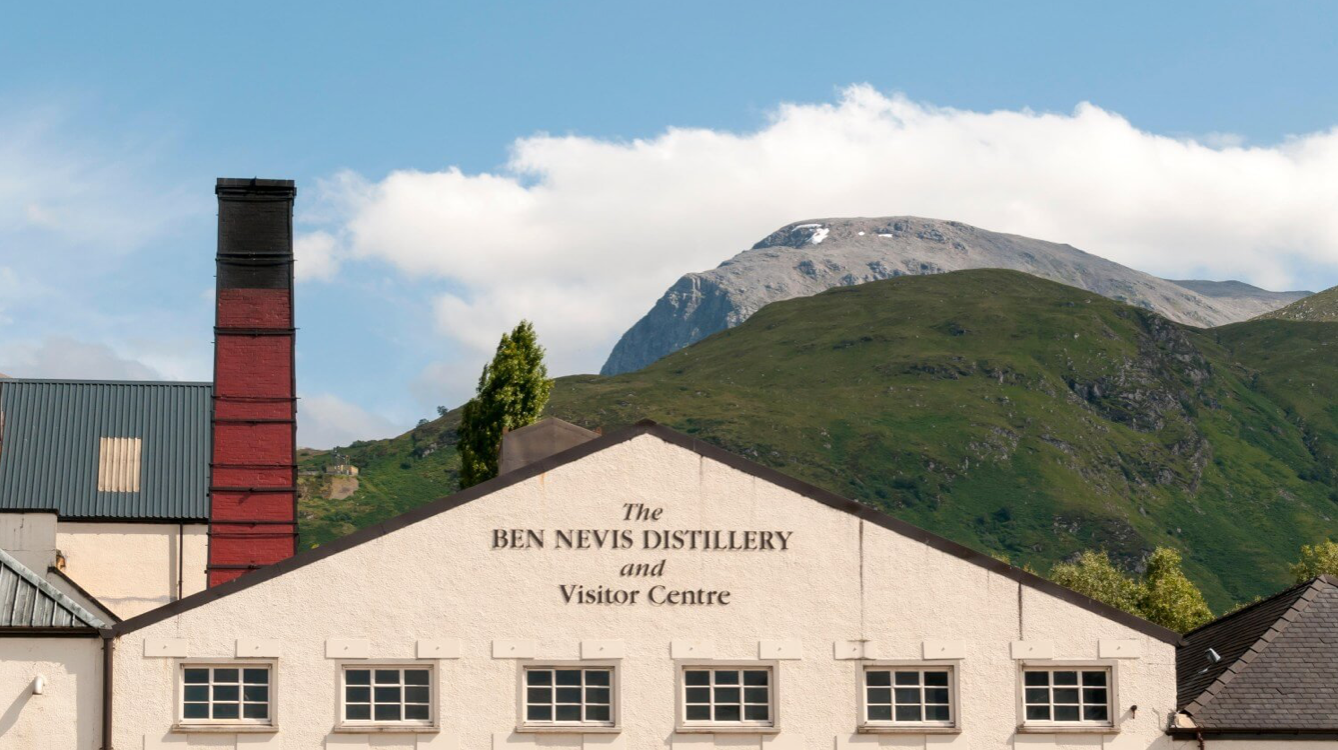
Even that golden run did not hold forever. In 1908, the Nevis distillery closed and its buildings became warehousing, and Ben Nevis itself moved into the long 20th-century rhythm familiar across Scotch: intermittent closures, ownership changes, and technical experiments. In 1941, the distillery was sold into new hands under the Canadian entrepreneur Joseph Hobbs, and in 1955 Hobbs installed a Coffey still, making Ben Nevis capable of producing both malt and grain spirit on site for a period. Later decades brought stoppages and subsequent reopenings: 1978 silence, revival in the early 1980s, another closure in the mid-1980s, until the Japanese distiller Nikka acquired Ben Nevis in 1989, reopening it and later adding a visitor center in 1991 to indicate confidence in the distillery’s permanence.
Through all of that, Long John McDonald remains the figure people reach for when they try to explain why Ben Nevis matters. He was not remembered merely as an early license-holder, or even an early distillery owner. He was remembered because he made Ben Nevis’s whisky carry a persona: his height, his audacity, his hunger for prestige, and because he proved, early, that Highland malt could be marketed as a named product with an identity strong enough to outlive even the giant man himself.
Sources:
Whiskypedia, “Ben Nevis”, scotchwhisky.com
The Whisky Exchange, “Long John Blended Scotch Whisky”, thewhiskyexchange.com
Drink Limited, “The Characterful Story of Ben Nevis”, 2 October 2022, www.drinklimited.com
Elite Wine & Whisky, “The History Behind Ben Nevis…”, elitewineandwhisky.com
Ascot on Scotch, “Ben Nevis 10 Year Old”, Neill Murphy, November 25, 2019
Bay Bottles, “Tag: Long John MacDonald”, October 12, 2022, baybottles.com/tag/long-john-macdonald
Some photos courtesy of baybottles.com
Contributed by Tracy McLemore, Fairview, Tennessee USA