William Mitchell


The above image of William Mitchell is an AI-created depiction based on facts known about his life.
William Mitchell belongs to a small circle of Campbeltown figures whose decisions still echo through the Scotch whisky world. He stood at a hinge point in a family enterprise that helped define Campbeltown’s rise, collapse, and eventual revival.
Located on the Kintyre peninsula, Campbeltown was a whisky boomtown in the early nineteenth century. With a deep-water harbor, close ties to Glasgow’s merchants, and a dense local network of maltsters, coopers, and shippers, the town became a powerhouse of whisky production long before the twentieth century reduced its once-crowded distilling map to just a handful of surviving names. Among the earliest recorded maltsters in the region was Archibald Mitchell. Archibald married Isabel Mitchell in 1798, and together they raised six children—three sons and three daughters. He is best remembered for operating an illicit still near the site that would later become Springbank distillery, though he was also involved in legal whisky making as a partner in the Riecachlan distillery. The Mitchells’ whisky connections extended beyond Archibald himself. His sister, Mary Mitchell, ran Drumore Distillery at a time when demand for malt was steadily rising, further embedding the family in Campbeltown’s expanding whisky economy.
The youngest of Archibald and Isabel’s sons was William Mitchell, born in 1819. Within the Mitchell family, whisky was never a single occupation but a widening web of relationships. Farming, distilling, blending, and brokerage overlapped as siblings, in-laws, and successive generations moved fluidly among them. For the Mitchell boys, choosing a career in whisky was less a decision than an inheritance.
That inheritance took formal shape in 1837, when Springbank passed into Mitchell hands. William and his brother John assumed ownership and became active figures in the distillery’s early licensed era. Their stewardship coincided with a period when Campbeltown malt still enjoyed reliable access to the wider Scotch trade. This mattered deeply to whisky history. The nineteenth century was not only about building distilleries; it was about securing dependable routes to market. The Mitchells would later formalize their broader commercial activities under the name J. & A. Mitchell & Company, a business concerned as much with managing whisky stocks and brands as with distilling itself. Over time, the firm handled both single malts and blends, including Campbeltown Loch and other blended Scotch and blended malt labels. Even as individual recipes and bottlings evolved, the family’s business model remained consistent: distill whisky, mature it, bottle it, and, crucially, blend it in ways that kept Campbeltown spirit present in the market, even as the region’s distillery count steadily declined.
On 10 September 1845, William Mitchell married Helen Greenlees. Like his parents before him, William went on to raise a large family; he and Helen also had six children, like his father, also evenly divided between sons and daughters. But while his domestic life flourished, his professional world eventually fractured. After thirty-five years in partnership, the alliance between William and John Mitchell came to an abrupt end in 1872. The cause of the dispute that separated the brothers is unknown, but its outcome was decisive: William left Springbank.
Within months, he embarked on a new venture. William built a distillery of his own, Glengyle distillery, situated near other Campbeltown plants in a region that still supported dozens of working sites. Glengyle became another pillar of the Mitchell whisky presence in Campbeltown—Springbank continuing under the family line that would remain associated with J. & A. Mitchell, and Glengyle representing William’s independent enterprise after the split. William lived another fifteen years after founding Glengyle, serving as its head distiller and blender until his death on 24 August 1887. He was sixty-eight years old. Helen Mitchell survived him by fifteen years, dying in 1902 at the age of seventy-nine.
The early twentieth century, however, proved unforgiving to Campbeltown. Global upheaval, including the First World War and the onset of American Prohibition, sharply constricted markets. By the 1920s, some Campbeltown distilleries began to cut workers, blenders were turned away, and closures followed in waves. Glengyle was caught in that downturn. The distillery was sold in 1919 to West Highland Malt Distilleries Ltd., and production ceased entirely in 1925. However, Glengyle’s later history is unusually well documented, largely because the buildings themselves survived. During the long closure, the site was used by local clubs and businesses, preserving the structures in better condition than many other abandoned distilleries that were left to decay or demolition.
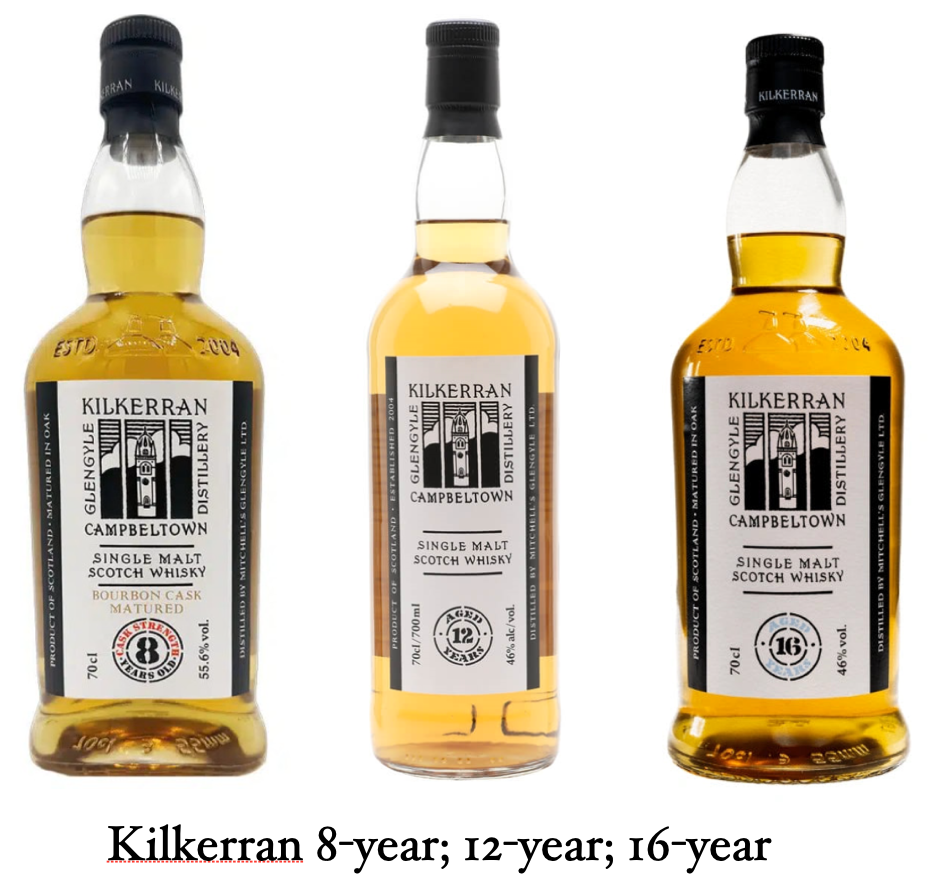
The final turn in the story reconnects William Mitchell’s nineteenth-century decision with the modern whisky landscape. In 2000, Glengyle was purchased by Mitchell’s Glengyle Ltd. under the leadership of Hedley G. Wright, William Mitchell’s great-great-nephew. With that acquisition, the distillery returned to the extended Mitchell family line. After a four-year rebuild, distillation resumed in 2004. The whisky produced there, however, is no longer bottled under the Glengyle name. Instead, the single malt is released as Kilkerran, a name drawn from an older Gaelic form of “Campbeltown.”
This brings the story full circle. William Mitchell was a member of Campbeltown’s most enduring distilling dynasty, a co-owner of Springbank in its formative years, and the founder of Glengyle after a decisive family rupture. Through that act, he became, perhaps unknowingly, an ancestor in business to the twenty-first-century revival that restored Campbeltown to three working distilleries once again. In Scotch whisky, that is a rare kind of immortality: not a monument or a signature, but a stillhouse that went dark, endured, and was lit again, carrying the Mitchell name back into the same streets where William Mitchell once chose to build something of his own.
Sources:
Springbank Distillery, “Story”/timeline, springbank.scot
Kilkerran / Glengyle Distillery website, “Glengyle Distillery History”, kilkerran.scot/the-glengyle-distillery
ScotchWhisky.com (Whiskypedia), “Glengyle”
ScotchWhisky.com (Whiskypedia), “J&A Mitchell & Company”
Contributed by Tracy McLemore, Fairview, Tennessee USA