Cyrus Noble

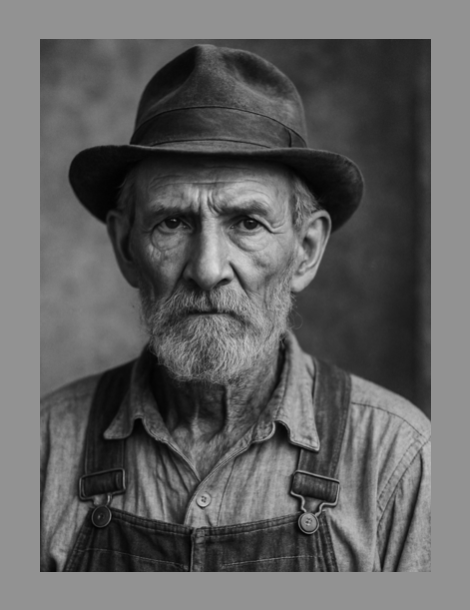
There are no known photos of Cyrus Noble. Above is an AI-generated image of Noble based on facts known about his life.
Cyrus Noble was a 19th-century Ohio distiller whose name would travel far beyond his home county, riding west on barrels of whiskey and ending up, improbably, on modern bottles of Kentucky bourbon. The surviving records about his life are fragmentary, but together they sketch the career of a talented small-town blender whose whiskey became famous from the gold fields of California to the mining camps of Nevada.
The clearest biographical details place Noble in and around Clinton, Ohio, not far from Lynchburg in neighboring Highland County. Later research into local newspapers and records shows that he was born in Clinton and lived in the Lynchburg area his whole life. By the 1840s Noble was already involved in local civic and moral reform movements. A county history of nearby Clermont County records a “Cyrus Noble” among the charter members of Boston Division of the Sons of Temperance. The Sons of Temperance promoted abstinence from spirits at a time when whiskey making and whiskey drinking were common in Ohio farm country. That apparent irony, that an eventual whiskey distiller began his public life in a temperance lodge, would become one of many quirks surrounding Noble’s story.
Later, Noble surfaces in educational records. An Ohio “Teachers’ and School Officers’ Directory” lists him as clerk of the Hillsborough school board in Highland County, working alongside other local officials responsible for the town’s schools. These scattered references suggest that before he became known for whiskey, Noble was already trusted in his community as a civic-minded organizer and record-keeper.
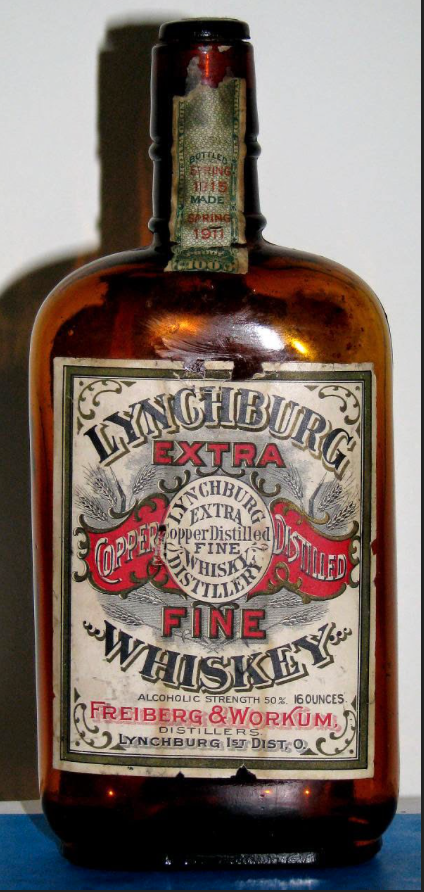
Like many ambitious Americans of his generation, Noble was drawn westward by the California Gold Rush. He tried his luck in the California gold fields, but unsuccessfully; dejected, he returned home to Ohio. Still needing a livelihood, Noble took work at the Freiberg & Workum operation in Lynchburg, Ohio. The Cincinnati-based firm had acquired the former Bowen Distillery there in 1857 and operated it as one of several country distilleries supplying their wholesale liquor house. In Lynchburg, Noble’s talents for tasting and blending whiskey were soon recognized. By 1871, Noble was superintendent of the Lynchburg plant. The distillery operated on a modest scale of roughly 200 bushels a day in the 1860s, but it produced a growing portfolio of brands for Freiberg & Workum, including J. A. Bowen whiskeys, “Lynchburg Rye,” “Highland Pure Rye,” and later “Clinton” brand whiskey.
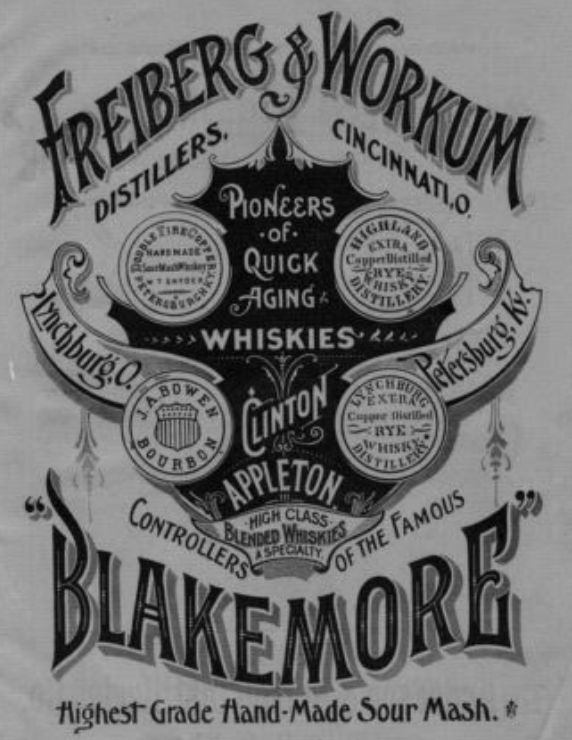
Like many ambitious Americans of his generation, Noble was drawn westward by the California Gold Rush. He tried his luck in the California gold fields, but unsuccessfully; dejected, he returned home to Ohio. Still needing a livelihood, Noble took work at the Freiberg & Workum operation in Lynchburg, Ohio. The Cincinnati-based firm had acquired the former Bowen Distillery there in 1857 and operated it as one of several country distilleries supplying their wholesale liquor house. In Lynchburg, Noble’s talents for tasting and blending whiskey were soon recognized. By 1871, Noble was superintendent of the Lynchburg plant. The distillery operated on a modest scale of roughly 200 bushels a day in the 1860s, but it produced a growing portfolio of brands for Freiberg & Workum, including J. A. Bowen whiskeys, “Lynchburg Rye,” “Highland Pure Rye,” and later “Clinton” brand whiskey.
According to trademark records, in 1863, a whiskey bearing Noble’s own name entered the market. Soon Noble’s popular whiskey began to spread far beyond Ohio, while Noble himself appears to have lived a comparatively quiet life in the Clinton–Lynchburg vicinity for his entire life, dying there in 1901 at the age of 75. His obituary described him as one of the wealthiest men in his community, a high-ranking Mason, and a member of the Independent Order of Odd Fellows.
Even as Noble stayed in Ohio, his whiskey headed west. In the early 1870s, Ernest Reuben Lilienthal, a young lawyer from Cincinnati, set up a liquor-wholesaling firm in San Francisco that specialized in brands from Freiberg & Workum. Lilienthal & Co., and later Crown Distilleries, marketed “Cyrus Noble” as one of their premium whiskies. Museum descriptions of the Lilienthal firm note that “Cyrus Noble” and “W. A. Lacey” were principal brands in their stock.
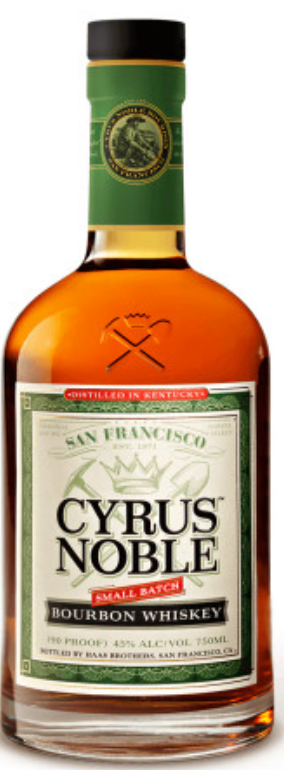
Through the late 1800s and early 1900s, the “Cyrus Noble” name passed from Freiberg & Workum’s Ohio distillery to Lilienthal’s West Coast operations and then into the hands of San Francisco’s Haas Brothers, a wholesaling firm that eventually acquired the trademark after Prohibition. In the early 20th century the brand was promoted heavily across the West, including a series of collectible figural decanters produced for Haas Brothers that later appeared in congressional remarks about Nevada mining memorabilia. After periods of dormancy in the later 20th century, the brand was revived in the early 2010s. Modern Cyrus Noble bourbon is marketed as “Born in Kentucky, raised in San Francisco,” a 90-proof Kentucky straight bourbon distilled in Nelson County and bottled by Haas Brothers for the San Francisco market. Contemporary descriptions emphasize that it is made from a mash bill of roughly 75 percent corn, 17 percent rye, and 8 percent malted barley, aged about five years, and crafted in small batches that echo the 19th-century recipe. Bardstown Bourbon Company in Kentucky is one of the modern distillers that has produces whiskey for the label.
Today, the whiskey that once left his Lynchburg distillery in wooden barrels continues to flow, now from Kentucky rickhouses into bottles that still carry his name. In that sense, the former teetotaler from Clinton, Ohio remains present wherever someone pours a glass of the extraordinary bourbon that preserves his curious legacy in liquid.
Sources:
Cyrus Noble Kentucky Bourbon official site, cyrusnoble.com
Federation of Historical Bottle Collectors, “The Story of Cyrus Noble Whiskey Bottles”, Kitty and Russell Umbraco, Winter 2003, fohbc.org
Dram Devotees, “Cyrus Noble’s Three Sworn Enemies”, Laura Fields, November 24, 2025
Federation of Historical Bottle Collectors, “Lilienthal & Co.", fohbcvirtualmuseum.org
San Francisco Chronicle, “Cyrus Noble, forgotten whiskey…makes a comeback”, Esther Mobley, July 24, 2023
Vine Pair, “9 Things You Should Know About Bardstown Bourbon Company”, August 18, 2023
Contributed by Tracy McLemore, Fairview, Tennessee