Ian Palmer

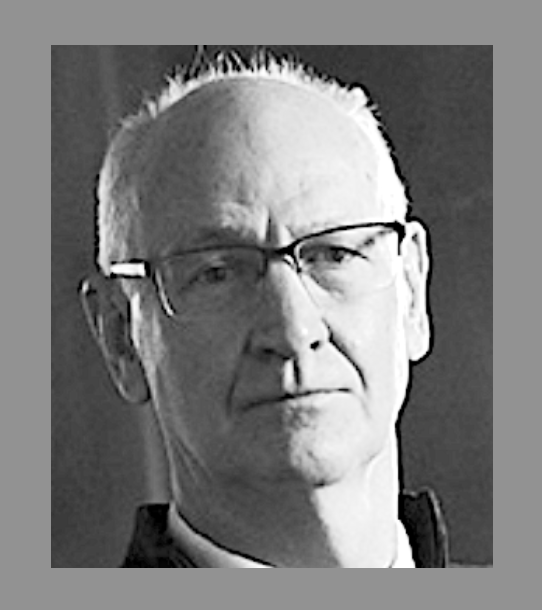
Ian Gordon Palmer was born in November 1957, and grew up in the Scottish Highlands, a setting that placed him near distilling culture from an early age. However, his first entry into whisky came through engineering rather than heritage. He took his first job in a distillery at eighteen when as an engineering student, an early combination that shaped the rest of his working life. His formal whisky career began in 1978, when he joined Invergordon Distillers at the large grain distillery in Invergordon. Grain distilling is rarely glamorous, but it is where Scotch teaches discipline: continuous production, energy management, yields, consistency, and scale. It was an environment well suited to someone trained to think in systems. When Invergordon later became part of Whyte & Mackay, Palmer moved with the organization, transferring to Edinburgh to oversee whisky bottling operations, and then advancing through a succession of senior production and operational roles.
Over time, he became part of the company’s production leadership, serving as Operations Manager at Invergordon Distillery, and later as Group Distilling Manager for Whyte & Mackay. His responsibilities across distilleries included The Dalmore, Jura, Bruichladdich, Fettercairn, and Tamnavulin. These were not symbolic posts; they placed him inside multiple production philosophies and equipment regimes, and forced him to solve problems that ranged from flavor control to stock planning, safety, and regulatory compliance. His responsibilities in those days also extended beyond distillery gates. From 1999 to 2003 he served as a director of the Scotch Whisky Research Institute, placing him inside the formal research body that underpins much of the industry’s technical knowledge. At the same time, he held various company directorships within the Whyte & Mackay group, confirming his role at the level where production strategy and corporate governance overlap.
By the late 2000s, Palmer had shifted from running inherited plants to building new ones. He became associated with Glen Turner and with the development of the Starlaw grain distillery, a large modern facility built for the French group La Martiniquaise. The project placed him at the center of distillery commissioning: planning layout, selecting equipment, supervising contractors, and guiding a plant from drawings to spirit. It was precisely the preparation required for the leap he would soon make on his own account.
That leap did not come early. Palmer has been unusually candid about the personal timing behind it. He married Linda, who later served briefly as a director of his new company, and together they raised two children. Only when both children were grown and had left home did he feel able to risk building a distillery. In his words, the project waited until family obligations no longer made failure intolerable.
The corporate foundation of InchDairnie was laid in 2011, when Palmer established John Fergus & Co Ltd, the company that would own and build the distillery. The name came from a historical firm linked to a flax mill site he first investigated for the project, and although the final location changed, the name remained. It reflected his instinct to anchor new ventures in existing industrial geography rather than inventing heritage.
Construction began in 2014 on a greenfield site near Glenrothes in Fife, close to Kinglassie. The build moved quickly. After years of planning, first spirit ran in December 2015, and in May 2016 the distillery was formally unveiled as a working production site. InchDairnie did not open as a visitor attraction; it opened as a distillery designed to produce spirit for the blending trade while quietly laying down stock for its own future bottlings. The technical design revealed Palmer’s philosophy. InchDairnie installed a hammer mill and a mash filter rather than a traditional mash tun, giving it flexibility to work with a wider range of cereals and to control extraction with precision. The stillhouse included a Lomond-style still engineered to allow tighter control of reflux and spirit character. These were not decorative decisions. They were made so that fermentation length, grain choice, distillation geometry, and cut points could be manipulated systematically. Commercially, the model was conservative and realistic. While the distillery matured its own stocks, it supplied spirit into the blending market, working particularly with MacDuff International to provide fillings for blends such as Islay Mist, Lauder’s, and Grand Macnish. That cash flow allowed InchDairnie to survive the long unprofitable years that defeat many new distilleries.
Once the plant was stable, Palmer began using it to explore cereals rarely seen in modern Scotch. In 2017, InchDairnie distilled spirit from malted rye and barley, and later that year produced heavily peated malt destined for the future KinGlassie range. In 2019, the distillery distilled an oat spirit, widely reported as the first time oats had been used for Scotch whisky making in over a century. Each experiment relied on the equipment choices he had made years earlier.
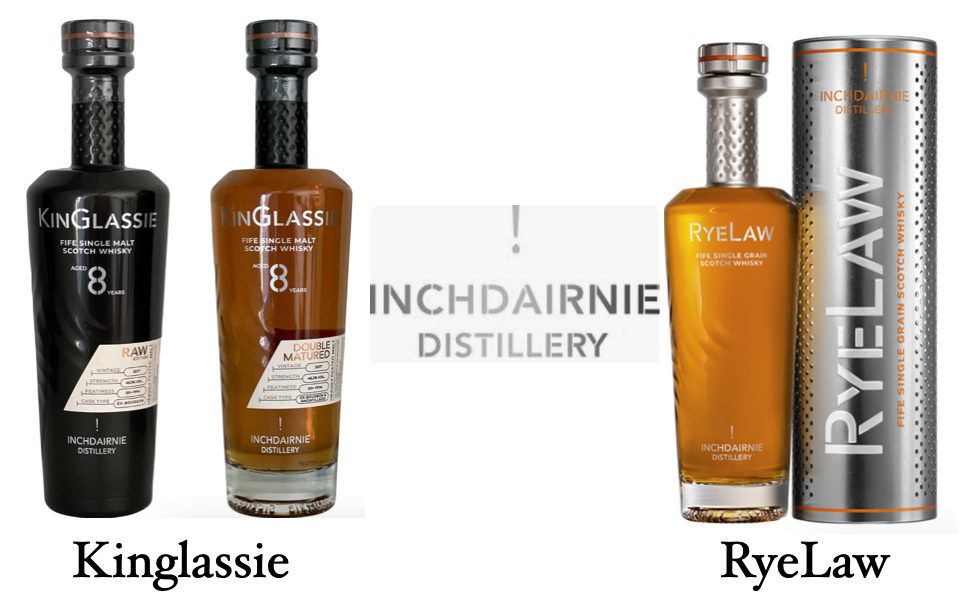
The first public expression of that work came in April 2023, when InchDairnie released RyeLaw, a single-grain Scotch whisky made from 53% malted rye and 47% malted barley. The formulation deliberately crossed the 51% rye threshold used in American law, while remaining entirely within Scotch regulations. Two years later, in May 2025, InchDairnie released its first core single malts under the KinGlassie name, marking the moment when spirit first distilled under Palmer’s supervision began to emerge as mature whisky.
In 2024, Palmer handed over Managing Director responsibilities to Scott Sneddon, remaining as founder and guiding presence. The distillery’s own announcement summarized his career legacy, not in brand language but in production language: the cereals he enabled, the equipment he installed, the processes he made possible. InchDairnie stands as the final expression of that career: a distillery designed by someone who had spent forty years learning how whisky is actually made, financed, and sold, and who waited until the moment was right to build one that could test what Scotch might still become.
Sources:
UK Companies House/Gov.UK, “Officer record for Ian Gordon Palmer…”
Rest Less, “Risking it All: What Led Me to Open…?”, www.restless.co.uk
InchDairnie Distillery official website, “Our Founder Ian Palmer”, www.inchdairnie.com
Spirited Matters, “Inchdairnie Distillery – Part One: Who?”, www.spiritedmatters.com
The Spirits Business, “InchDairnie ‘first’ Scotch maker…”, Owen Bellwood, 11 June 2019
Dramface,“KinGlassie Launch Coverage”, Norrie Newdesk, 7 May, 2025
Contributed by Tracy McLemore, Fairview, Tennessee USA