Jacob Rieger

Jacob Rieger’s life fits the classic American pattern of immigration, reinvention, and relentless work, except that fate conspired with his chosen trade to put him at the very center of Kansas City’s rowdiest, fastest-growing neighborhood at exactly the moment the city was learning how to sell its concept of barely restrained civility to the rest of the nation.
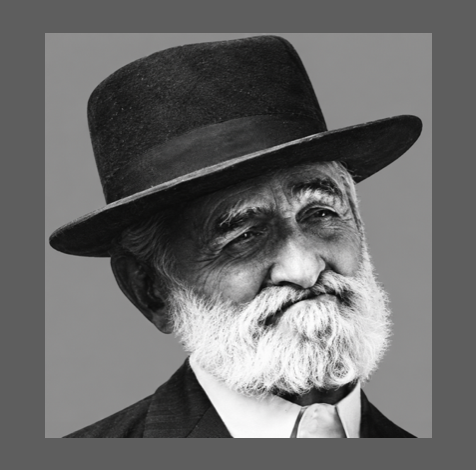
Rieger was born December 20, 1827, in Görz/Goritz, Austro-Hungarian Empire. Not much is known of his early life, but in 1877, he emigrated to the United States. After a long ocean crossing, the family arrived in New York. Rieger, his wife Mary, their 7-year-old son Alexander, and Alexander’s younger sister, Sallie, spent a few years in Ohio before they made their way west, eventually settling in Kansas City, Missouri. There, Jacob opened a grocery store, a practical business for a new immigrant family, and one that put him in daily contact with the rhythms of a booming river-and-rail city. At that time in history, Kansas City was not bashful about appetite, industrial, commercial, or recreational, and the West Bottoms district was becoming famous for commerce tied to the stockyards and rail connections. That energy created a certain kind of opportunity; it was one where thousands of workers, buyers, and travelers converged, and where there would always be demand for drink. So, in 1887, at the age of 60, Jacob Rieger made the leap that would define his legacy. He acquired a stall in the West Bottoms district, already known as the ‘Wettest Block in the World,’ and founded J. Rieger & Co. distillery. The lively area was home to many saloons, brothels, casinos and liquor commerce, so Rieger knew that his whiskey had to be better than just good to survive.
Survive it did, and within a few years, Riegers whiskey became one of the most successful, high-volume, and widespread spirits in the region, adopting the long-running slogan, “O! So good!” Rieger’s success became inseparable from his family. His son Alexander Rieger grew into the business and ultimately carried it forward when Jacob turned operations over to him in 1890. Where the main point of Jacob’s story was initial capital and founding of the company, Alexander’s was growth, and that expansion was not small. Alexander was a savvy businessman who grew the brand into the largest mail-order whiskey house in the United States with over 100 alcoholic products ranging from their signature whiskies to gins, rums, and even stomach bitters. Alexander developed a pleasing prospectus, combining artful advertising with price lists and a convenient mail-order system; at its peak, the catalog reached over 250,000 customers.
Alexander was also an imaginative proprietor. In 1914, when flooding forced Union Station to relocate elsewhere, he opened The Rieger Hotel just blocks away. That establishment became one of the nations first “budget” inns, offering less-wealthy train travelers an alternative to more opulent uptown rooms. Then, cementing his legacy, Alexander Rieger commissioned a mural on the south side of his hotel featuring a giant bottle of Rieger’s Monogram Whiskey, a mural that still stands to this day, a beloved KC landmark.
By 1910, Jacob Rieger was in his 80s, now an aging founder whose name still fronted the business even as leadership and public identity increasingly shifted away from him to his son. By 1914, public records identified Alexander as “sole owner” of his family enterprise, with Jacob by then fully retired from his own company. Just over one year later, on December 26, 1915, Jacob Rieger died at the age of 88. He was buried at Elmwood Cemetery alongside his wife Mary, who had died seven years prior. Jacob’s death came as Kansas City’s good times were still in overdrive, yet no one knew that there were only a few good years left before the legal climate would undo the industry Rieger helped build.
Then, suddenly, the era that had ushered in respite from war, good times and good drink vanished overnight when the 18th Amendment was ratified, and federal Prohibition was enacted. Once manufacturing or selling spirits became illegal nationwide, J. Rieger & Co., along with countless other distilleries, soon closed; few could survive a total legal shutdown. Alexander Rieger died in 1936, and the original J. Rieger & Co. distillery building was razed in the 1950s. For 95 years, the original distillery lived in memory but not place, another Kansas City story partly swallowed by cultural changes, redevelopment, and time.
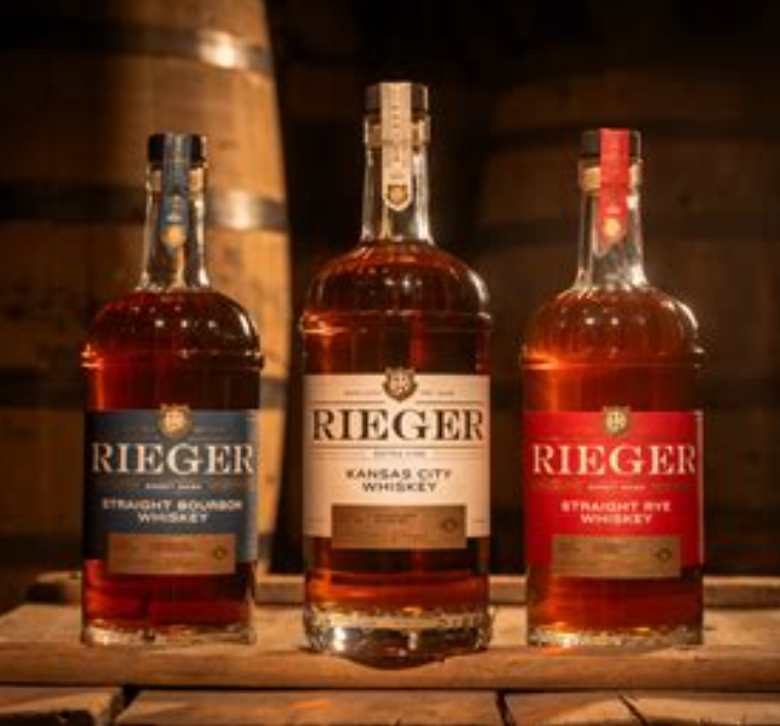
In 2009, Ryan Maybee, a Kansas City hospitality entrepreneur who owns an award-winning bar in the basement of the original Rieger Hotel, had the idea to resurrect the brand. Fascinated with the building’s connection to the pre-Prohibition distillery, Ryan was determined to restore its legacy. A chance meeting with Andy Rieger, Jacob’s great-great-great-grandson, closed the circle. Over the next few years, Andy and Ryan developed a business plan for the distillery, purchasing the original trademark (which had expired in 1922), and developing the modern J. Rieger & Co. brand with the distillery’s original name, logo and slogan. In 2014, J. Rieger & Co., was reestablished as a legal distillery again. In the beginning, the modern revival leaned on expertise from respected figures in the spirits world, including the late Master Distiller Dave Pickerell and distiller Tom Nichol, as part of training and product development around the new operation.
In that sense, then, Jacob Rieger’s story has two endings: the historical one in 1915, when the founder’s role passed fully into memory, and the civic one in 2014, when two Kansas Citians chose to re-adopt the name as part of its modern spirits identity. Now, because of the love that has been maintained for the cultural icons left by the Rieger family, the arc of what Jacob built is finally back in place after nearly 100 years of existing only on some yellowed paperwork.
Sources:
J. Rieger & Company official website, “Our History/Our Origins”, jriegerco.com
The Pitch Kansas City, “J. Rieger & Co.’s legacy runs deep into the city itself”, June 19, 2022, thepitchkc.com
Martin City Telegraph, “J. Rieger & Co…”, March 10, 2018, martincitytelegraph.com
Those Pre-Pro Whiskey Men! (blog), “Preserving the Memory of the KC Whiskey Riegers”, September 14, 2014, pre-prowhiskeymen.blogspot.com
KC Discovery, “A Tale of Two Whiskeys”, June 8, 2022, kcdiscovery.com
Clio, “Kansas City Crossroads Walking Tour”, August 30, 2022, theclio.com
Contributed by Tracy McLemore, Fairview, Tennessee