
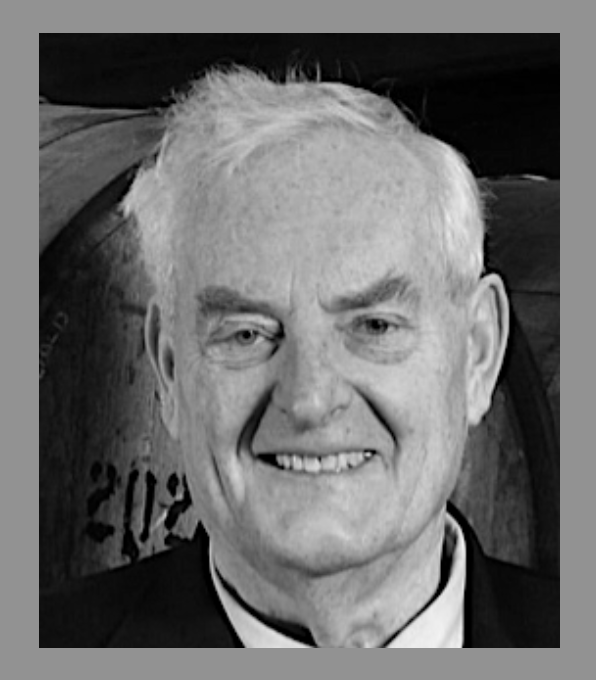
George Stewart


The idea of establishing a distillery in Falkirk did not arrive as a single moment of inspiration. Stewart has described it instead as a long campaign that stretched across more than a decade. The family decided in 2009 that they wanted to enter the whisky industry with a distillery of their own. Planning permission was granted in 2010. What followed was not a smooth glide toward construction, but a series of delays and complications that became central to the distillery’s origin story.
By the time Falkirk Distillery opened its doors, George Stewart was not a first-time entrepreneur, nor a late convert chasing a fashionable whisky boom. He came from a family that had operated businesses in Stirlingshire and West Lothian for more than fifty years, a span that implies something quieter and more durable than speculation: steady capital accumulation, local reputation, and a working culture shaped by long horizons rather than short cycles. When Stewart eventually committed to building a distillery, it was not a leap into the unknown. It was the extension of a life spent building things properly and expecting them to last.
George Stewart was born on 6 June 1945. His professional background was in electrical engineering, and that training would later become one of the defining fingerprints on Falkirk Distillery. Engineering, for Stewart, was not abstract theory; it was applied craft. He personally designed the production hall, involved himself in control systems, wiring, and layout, and took particular pride in what he described as the “human machine interface” that allows the distillery to be operated efficiently by a small team. Falkirk’s technical heart, in other words, reflects Stewart’s own instincts: robust, logical, and built for reliability rather than show.
The idea of establishing a distillery in Falkirk did not arrive as a single moment of inspiration. Stewart has described it instead as a long campaign that stretched across more than a decade. The family decided in 2009 that they wanted to enter the whisky industry with a distillery of their own. Planning permission was granted in 2010. What followed was not a smooth glide toward construction, but a series of delays and complications that became central to the distillery’s origin story.
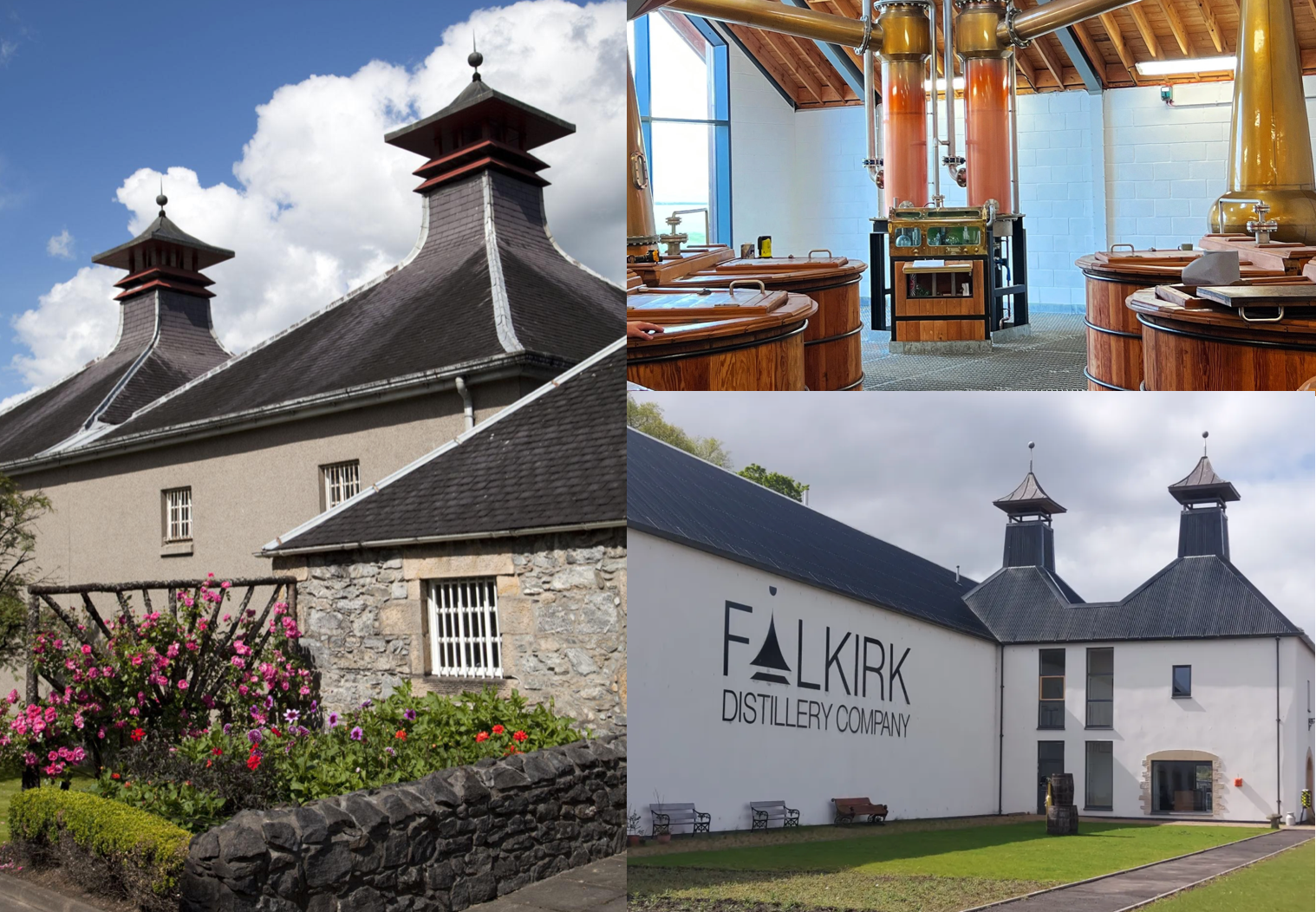
One of the earliest challenges was the site itself. Falkirk sits close to the Antonine Wall, the Roman frontier that cuts across central Scotland. That proximity added layers of archaeological and heritage scrutiny to the planning process. Years later, just as progress began to gather momentum, the global pandemic arrived, slowing construction, disrupting supply chains, and placing further strain on timelines. Stewart persisted through all of it. When the distillery finally became fully operational in July 2020, he summed up the experience with characteristic understatement and humor, calling it “a dream—or perhaps a dram—too many.”
From the outset, Stewart was clear about what Falkirk would and would not be. It would not be a gin-led facility with whisky as a future aspiration. It would not be a multi-category spirits plant hedging its bets. Falkirk was designed as a single-malt distillery, full stop. The intention was to produce malt whisky from day one and to shape every design choice around that purpose.
That philosophy extended to the physical fabric of the distillery. Rather than purchasing entirely new equipment, the Stewarts acquired key components from the closed Caperdonich Distillery in Speyside, including two stills, washbacks, and a large mash tun. The result was a stillhouse that embodied a deliberate contrast: new walls and infrastructure built around machinery with a previous whisky life. Stewart described this as “new bookended by the old,” and it became a defining feature of Falkirk’s identity. The distillery was modern in execution, but anchored in tangible Scotch history.
Stewart also understood that legitimacy in Scotch whisky is not conferred by architecture alone. It is earned through relationships, reputation, and continuity. One early story he shared captured that sensibility. During the first distillation, John Grant Senior of Glenfarclas Distillery provided Falkirk with a sherry hogshead free of charge. Stewart regarded the gesture as both kindness and symbolic passing of the torch. Some traditions suggest the first cask should be sold. Stewart chose instead to keep it. The barrel remains part of Falkirk’s internal lore, representing not only a starting point, but the kind of whisky world Stewart wanted to belong to: collegial, respectful, and rooted in shared heritage.
Operational leadership at Falkirk reflects the same blend of experience and restraint. The distillery is managed by Graham Brown, whose background includes work at Distell, Deanston, and Tobermory. Stewart has described the spirit style he wanted as a “light Lowland malt,” approachable, balanced, and intended to appeal across a wide spectrum of drinkers rather than chasing extreme profiles. This positioning places Falkirk firmly within the Lowland tradition of accessibility, while still allowing room for character and development over time. Family, however, remains the distillery’s central axis.
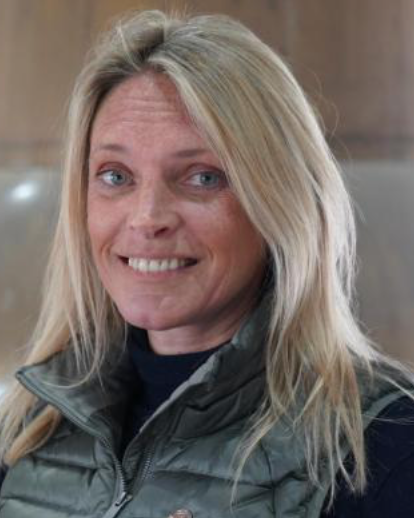
George Stewart owns and operates Falkirk alongside his daughter, Fiona Stewart, and his son, Alan Stewart. Fiona serves as a director of the company, and trade reporting consistently frames Falkirk as a strictly family-run enterprise. Stewart has often spoken publicly about his wife’s reaction when he first proposed building a distillery. She told him he was “mad.” While her name is not widely publicized, her skepticism has become part of the greater story, a reminder that even carefully planned dreams look unreasonable from the outside. The financial commitment behind Falkirk underscores the seriousness of that dream. The total project cost came in just under £9 million, all funded privately by the family. There were no large corporate partners and no staged exit strategy. Falkirk was conceived as a generational asset, not a short-term vehicle.
Fiona Stewart
As the distillery settled into production, Stewart and his family began to link Falkirk’s identity to broader community engagement. In November 2021, a motion lodged in the Scottish Parliament welcomed Stewart’s donation of a cask, which was described as the 40th cask of “Cadger’s Whisky,” to be raffled in support of Strathcarron Hospice. The motion noted the limited number of raffle tickets and the specific draw date, treating the gesture not as marketing, but as civic participation. That pattern continued. In 2024, a release carrying the name “George Stewart” was tied to his birthday and paired with the donation of another cask, this time to Prostate Scotland, to raise awareness and funds. These actions place Stewart in a long line of Scottish distillers who have understood their businesses as social actors as well as commercial ones.
The most visible milestone arrived in December 2023 with the launch of Falkirk Distillery’s first whisky. Coverage described the release as marking Falkirk’s return to whisky production after decades without a working distillery. The moment was repeatedly framed around George Stewart and Fiona Stewart, father and daughter, standing as representatives of a project more than eleven years in the making. It was not presented as a triumphant disruption, but as a quiet restoration.
Seen in full, George Stewart’s story does not follow the familiar arc of flamboyant founder or celebrity distiller. It is the story of a trained engineer who applied industrial discipline to a traditional craft, of a family that committed private capital to a long-term vision, and of a distillery designed to look backward and forward at the same time. Falkirk Distillery exists because Stewart believed that careful planning, inherited knowledge, and patient execution still mattered in Scotch whisky. In that sense, his legacy is not defined by volume, nor by branding reach, but by continuity. He built a distillery intended to outlast him, placed it in the hands of his children, and anchored it in both physical and cultural tradition. For a man who spent a lifetime designing systems meant to run reliably, Falkirk Distillery may be his most personal system of all: a working machine for turning local grain, inherited copper, and family persistence into something that carries time itself inside it.
Sources:
Whisky Magazine, “Production begins at Falkirk Distillery,” 15 Feb 2021, www.whiskymag.com
Scottish Licensed Trade News, “Distilling a new whisky legacy,” Gillian McKenzie, 5 Nov 2020, sltn.co.uk
Undiscovered Scotland, “Falkirk Distillery”, www.undiscoveredscotland.co.uk
Scottish Financial News, “Falkirk Distillery unveils its first whisky release,” 21 Dec 2023, www.scottishfinancialnews.com
Barrel & Brand, “New George Stewart Release Whisky,” Kevin Blair, 14 Aug 2024
The Scottish Parliament, “Strathcarron Hospice, 40th Cask for 40th Anniversary”, 16 Nov 2021, www.parliament.scot
Inside the Cask, “How to Buy a Cask of Scotch Whisky from…Falkirk Distillery,” Andre de Almeida, 3 Jan 2021, insidethecask.com
Contributed by Tracy McLemore, Fairview, Tennessee USA