
Robert Stein

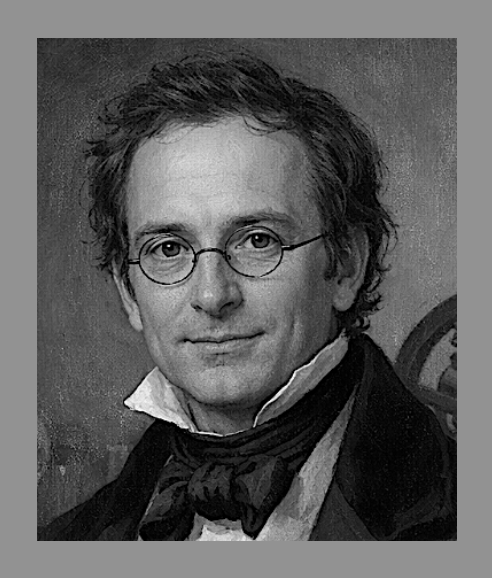
There are no known photographs of Robert Stein known to exist. Above
is an AI-generated image of him based on facts known about his life.
Robert Stein, who was born on 11 May 1780, is one of those early industrial whisky figures whose influence is unmistakable. He belonged to the Stein distilling dynasty of Kilbagie in Scotland’s Lowlands, a family that, at the time, owned and operated major sites near Alloa and Clackmannan, with many others to follow in years to come.
Robert is most certainly best remembered for pushing whisky distillation away from small batch work and toward something closer to an industrial rhythm. Fortune intervened to ensure that he was alive squarely in the generation that saw Scotch whisky move into a modern national industry. Therefore, Stein’s early experimentation was not the work of the small craft still, but became an ambitious, well-capitalized Lowland network, since the Stein family’s holdings and partnerships spanned several distilleries, and even included shipping and related trades. The Steins already had developed a reputation for scale and technical drive, and when Robert Stein himself bought Kilbagie Distillery in 1793, he was directly tied to one of the key sites associated with still experimentation.
Meanwhile, On 21 April 1816, Robert Stein married his cousin Mary Ann Bruce, who was 19 years his junior. Eleven months later, the newlyweds had a daughter, whom they named Magdalene. Soon 12 other children followed, although two did not survive past infancy, as was the unfortunate outcome too often in that day. Five of Robert’s children were sons, and it is likely that most of the Stein men were involved as distillers for some of the family’s many holdings. The Steins were also directly related to the Haig family, another large distilling clan from Fife, as well as though marriage to the Jameson distillers of Ireland, creating a distribution source for Robert’s new invention should it be proven successful.
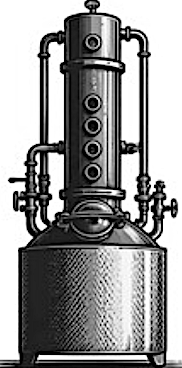
So in 1826, Stein patented his revolutionary still. The apparatus was capable of near-continuous distillation, which meant spirit could be produced much faster and more efficiently than had previously been the case with a traditional pot still. This was largely because pot stills had to be cleaned and recharged between batches. The results were dramatic; a large pot-still distillery such as then-giant Macallan utilized at the time would likely produce around 5,000 gallons per year; but a Stein still could theoretically produce 150,000 gallons during the same timeframe—30 times as much.
The innovative device itself consisted of a column about 20 or 30 feet (6 to 9 meters) tall, which was divided into a series of small connected chambers by plates constructed of a woven cloth made of linen and horsehair. Preheated wash was then scattered as a fine fist into the chambers where it came into contact with steam. The alcoholic vapor that resulted rose up the column until it condensed as spirit, while the water and solids in the wash attached to the haircloth dropped down and were removed at the foot of the still. The whisky produced from this still was bland in flavor, but high in strength at about 95% ABV, thus not only in greater quantities over a given time, but also at much higher concentration than any pot still could ever achieve. Though Stein’s early still pointed toward continuity, it was not yet the sleek, fully continuous industrial column system most people picture today, and still had some practical limitations that refiners such as Aeneas Coffey would later solve.
The heart of Stein’s invention is captured in the paperwork trail. In official patent reporting, one dated 13 December 1827 (No. 5583) is recorded as being granted to Robert Stein of Regent Street, for an improvement in “Applying Heat to Distillation.” A second patent, dated 4 December 1828 (No. 5721), is likewise recorded to Robert Stein of Regent Street, Middlesex, simply for “Improvements in Distillation.”
Stein installed his first continuous still at his operation at Kilbagie. After his first patent registration, he petitioned the Excise to allow experiments at the Wandsworth distillery in London; the Excise later also authorized trials at his brother’s Kirkliston distillery near Edinburgh in January 1828, and the trials proceeded in August 1829. The Kirkliston tests were rapidly deemed successful, and on 12 May 1830, the first operational patent still in Scotland outside a Stein domain was installed and licensed at Cameronbridge distillery in Fife (a Haig family distillery). That site that would become legendary for grain whisky, and illustrates why Stein’s work ended up entwined with the later rise of blends and mass-market Scotch. Continuous or semi-continuous apparatus helped make grain spirit abundant, and plentiful grain spirit helped make blending economically and practically scalable.
After Cameronbridge, Stein stills’ concept demonstrated what needed proving: that larger-scale, more efficient distillation could be brought under Excise rules and made to work in practice. In that sense, Stein’s achievement was both technical and institutional. Factually, however, Stein’s name almost always appears alongside Aeneas Coffey, because Coffey’s 1831 patent became the dominant commercial form of the “patent still.” But the relationship between the two is best understood as progression rather than replacement. While he did not invent the continuous still, Coffey’s design took key elements of Stein’s apparatus and improved them markedly, most notably by adding a second column (a rectifier) and simplifying aspects of preheating, which created the form that became the industry standard.
By the time Robert Stein died in July of 1854, whisky was no longer only a regional craft, it was becoming a modern industry with expanding markets, tighter regulation, and growing technical sophistication. Stein’s patent still was poised right at that turning point: not the final answer, but the working prototype that helped move Scotch toward continuous production and the grain-spirit scale that would later underpin blended whisky’s global rise.
Further later refinement by Coffey has forever attached the latter’s name more closely with the invention, but it is important to recall that Robert Stein’s role had been first—larger, riskier, more revolutionary and more game-changing to 19th-century Scottish farmer-distillers than Coffey’s mere refinement of what had already been proven successful.
Sources:
Spirits & Distilling, “Aeneas Coffey”, Charles MacLeanSee, spiritsanddistilling.com
clackmannanshire.scot, “The Stein Family”, 22 April 2025
clackmannanshire.scot, “Robert Stein Column Still Patent—The Repertory of Patent Inventions (1830)”, 03 February 2024.
scotchwhisky.com,“Whisky heroes: Aeneas Coffey”, Neil Wilson, 11 September 2018
Contributed by Tracy McLemore, Fairview, Tennessee USA