

Andrew Usher, Jr.

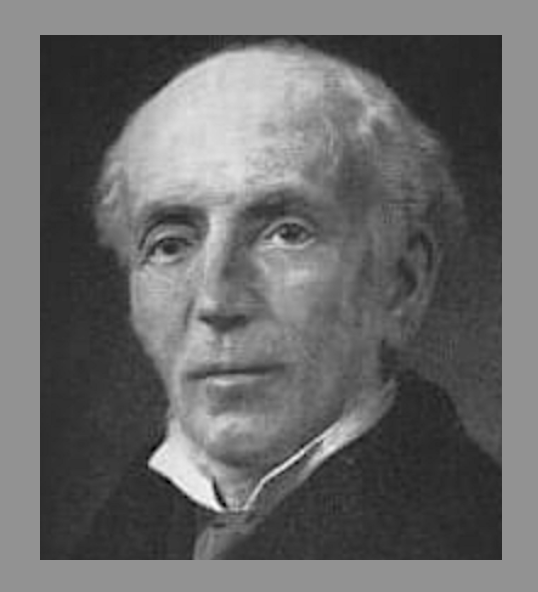
Andrew Usher, Jr., was born in Edinburgh on 5 January 1826, and became one of the most influential whisky merchants of Victorian Scotland. He was perhaps best known for helping turn blending from a hidden, behind-the-counter practice into a proudly repeatable, branded product that could travel far beyond Scotland.
Usher’s whisky story began before he did, when his father, Andrew Usher, Sr., entered the wines-and-spirits trade in Edinburgh in 1813. The elder Usher built relationships with distillers at a time when reputable supply mattered as much as demand. By the early 1830s, he was also associated with brewing in Edinburgh, a reminder that many 19th-century “whisky men” moved across beer, wine, and spirits as opportunity allowed or demand dictated.
Andrew Usher, Sr., and his wife, Margaret Balmer Usher, had a large family of 12 children, and in 1831 he established his two eldest sons, James and Thomas, in a brewery on Merchant Street. Against that backdrop, third son Andrew Usher, Jr., grew up with a front-row seat to a commercial drinks business rather than an idealized distillery apprenticeship. Favorably for him, his whisky coming of age occurred just as Scotch was starting to shift: rail transport improved, urban markets expanded, and a new consumer class wanted not only a better drink, but consistency—things traditional single-cask bottlings could not reliably and repeatedly deliver. In the late 1840s, Andrew Usher, Jr., became a partner in the family’s Edinburgh business, named predictably, Andrew Usher & Co. His brother John, who was 2 years younger, also joined the firm, and the pair would later be linked in many of the company’s largest moves.
The house’s most famous early whisky was tied to a name that already carried weight: Glenlivet. In 1853, Usher began producing a special batch connected with The Glenlivet that became known as “Old Vatted Glenlivet” (also called “Usher’s Old Vatted Glenlivet”). The “vatted” style designation points to a period when the industry was experimenting with marrying whiskies to create a consistent house character, an approach that helped pave the way for what consumers would thereafter understand as “blended” Scotch.
The house’s most famous early whisky was tied to a name that already carried weight: Glenlivet. In 1853, Usher began producing a special batch connected with The Glenlivet that became known as “Old Vatted Glenlivet” (also called “Usher’s Old Vatted Glenlivet”). The “vatted” style designation points to a period when the industry was experimenting with marrying whiskies to create a consistent house character, an approach that helped pave the way for what consumers would thereafter understand as “blended” Scotch.
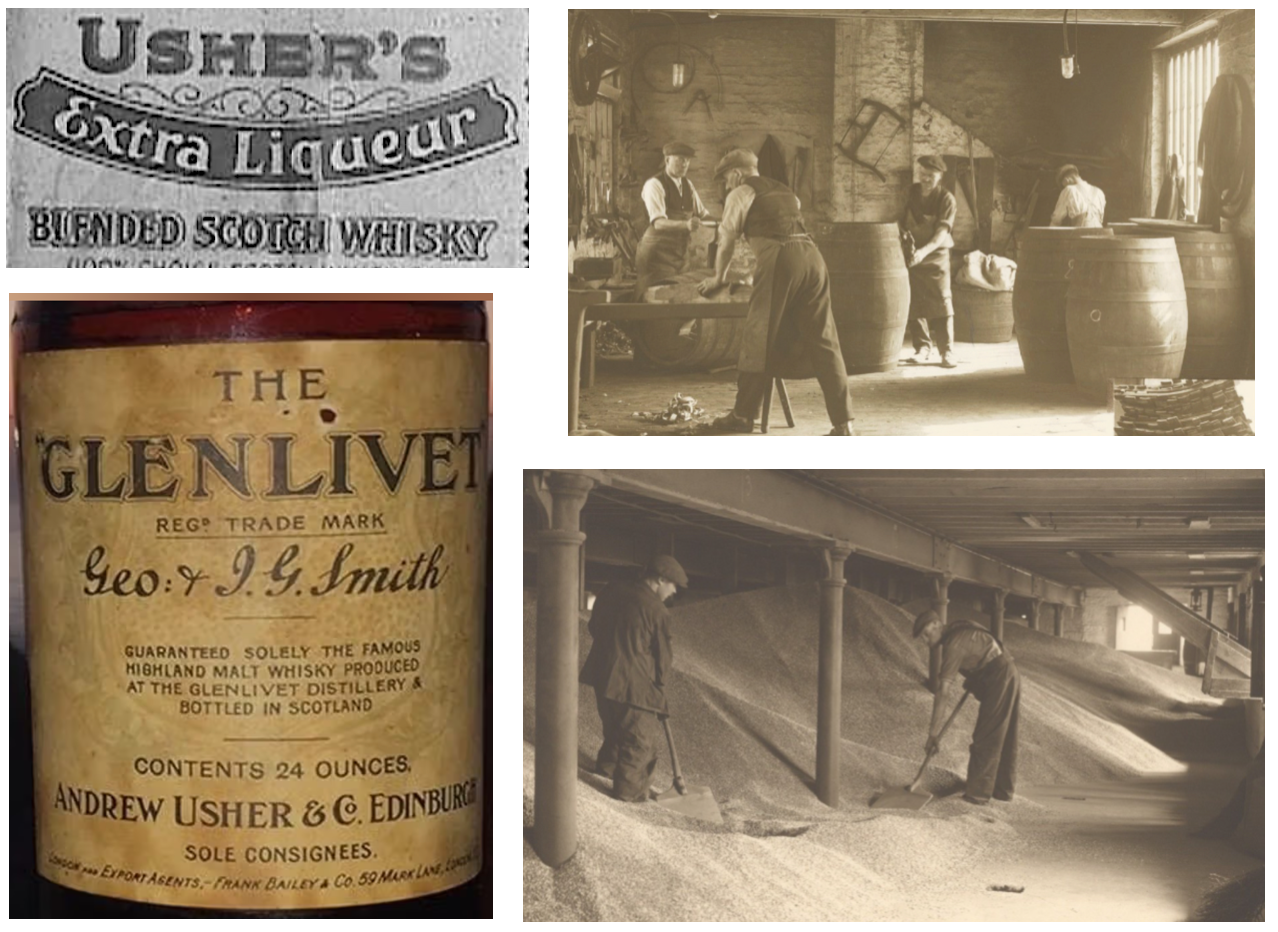
Early on, the Ushers had the foresight to understand that merchants who built brands often ran into the same problem: supply. So in 1859, Andrew Usher, Jr., and John Usher bought the Glen Sciennes distillery, renaming it the Edinburgh Distillery, and thereby giving their blending house a direct single-malt source that was under their control. They also built a major warehousing and bottling complex at St Leonard’s, among the largest in the UK at the time, which was an industrial answer to the problems of standardization and scale. For these reasons, Usher, Jr., is still known as the “father of blending whisky,” not because he was the first person ever to mix spirits, but because he was instrumental in making it acceptable and commercially legible. In doing so, he created a legitimate, branded product with distribution and staying power—and lots of customers
Yet Andrew Usher Jr’s most strategic step came in 1885. In that year, he became one of the founders of the North British Distillery Company in Edinburgh, along with partners William Sanderson and John M. Crabbie. The goal of the partnership was to explicitly strengthen blender-controlled access to grain whisky, which was then, and still is, the essential backbone of most blends. North British opened in 1887, with Usher serving as the company’s chairman for the remainder of his life. Whatever romantic aura later attached to blending, the North British acquisition was pure business realism that was put in place to monopolize grain supply and in turn, control the supply of alcohol that came from that grain.
Sadly, for all his corporate success, the record of Andrew Usher, Jr’s private life is marked largely by family bereavement. He had married Elizabeth Langmuir Miller in August of 1850, and they had six children. But Elizabeth died suddenly in June 1876. Andrew then married Marion Blackwood Murray two years later, and had two more children. But tragically, at least 4 of the 8 Usher children died as infants or toddlers. Despite his personal losses, Usher was philanthropic. In 1896, he donated £100,000 (the equivalent of £17 million in 2025) to fund a major concert hall for the city of Edinburgh, a gift that was to be named Usher Hall in his honor. Unfortunately, Usher, Jr., died on 1 November 1898, and did not live to see the building completed. However, because of the gift, the blender’s name became, at least in Edinburgh, forever associated with a cultural landmark.
After the Usher brothers’ era, the independent firm did not remain so for long, as Andrew Usher & Co. was abruptly acquired by DCL (Distillers Company Limited). The Edinburgh Distillery was then sold in June 1919, and that same year Andrew Usher & Co. was then merged with J & G Stewart, Ltd.
To that end, Andrew Usher, Jr.’s reputation ultimately rests, not on a still-productive company, but on his vision as well as his long term execution of that vision. Usher lived in the era when Scotch rapidly stopped being mostly local and became something that could be made consistently, named confidently, and sold broadly. His life’s work helped wrestle those goals across the threshold for future generations of blenders and drinkers alike.
Sources (websites)
Grange Cemetery/Grange Assoc., “19 Andrew Usher (1826–1898)”, grangeassociation.org
Scotch Whisky Magazine, “Whisky heroes: Andrew and John Usher”, Iain Russell, 07 June 2017 scotchwhisky.com
Whisky Magazine Issue 27, “The Godfather of Blending”, Gavin Smith, 16 November 2002
North British Distillery official history, “1885 to present day”, thenorthbritish.co.uk
The Glenlivet official website, “The Mystery Whisky Bottle”, theglenlivet.com
The Scotsman food & drink, “The lost whisky…”, Sean Murphy, 27 September 2017
Contributed by Tracy McLemore, Fairview, Tennessee USA