Bessie Williamson

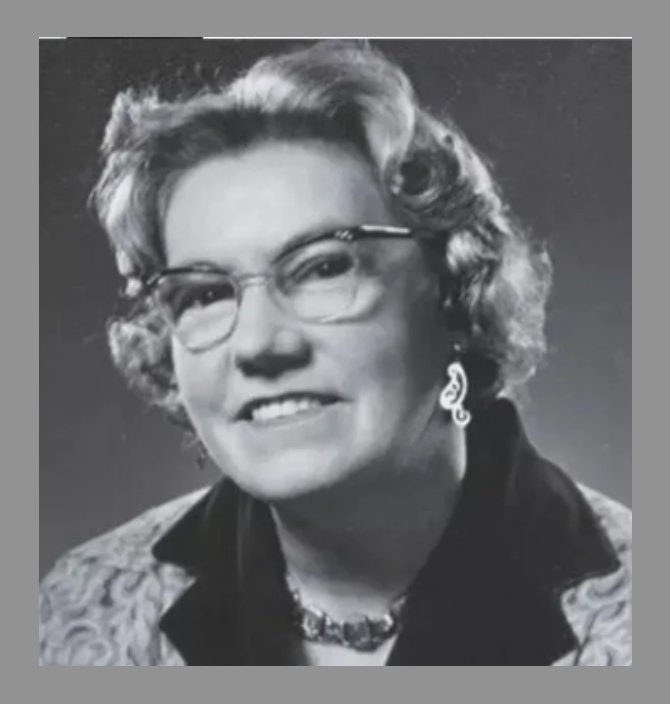
Elizabeth “Bessie” Leitch Williamson was born in Glasgow on 22 August 1910, the daughter of Agnes Whyte Paton and John Williamson, a mercantile clerk. Tragically, Bessie’s childhood was shaped largely by war and loss. During the First World War her father served with the British Army and was killed in France in 1918, leaving Agnes to raise the children alone. As a young adult, Bessie’s ambitions were to become a teacher, so she set out down that career path by attending the University of Glasgow in 1927.
Though she graduated in 1932 with an MA, Bessie’s path was not effortless. She spent longer than the standard course length, and she supplemented her education with practical skills, including night classes in secretarial and clerical work. Like many young women between the wars, she also needed paid work. Before Islay entered her story, she worked in an office setting in Glasgow, employment that built the shorthand, organization, and calm competence that would later matter far more than anyone could have guessed.
In the summer of 1934, she traveled to Islay on holiday with a friend. On the island she learned of a temporary opening at Laphroaig for a shorthand typist—work meant to last only a few months—but immediately the 24-year-old secretary was hired.
Laphroaig at the time was owned by Ian Hunter, a demanding man with a reputation for being difficult to please. Yet she proved unusually capable, and Hunter trusted her with more responsibility than was typical for a woman in the whisky trade of that era. She moved quickly beyond clerical duties into the practical business of keeping a distillery running: managing the office, handling correspondence, and becoming the person who knew where every thread led: stocks, shipments, staff, and the thousand small decisions that kept production at a busy distillery from wobbling—and problems off Hunter’s desk.
A crisis accelerated that rise. In 1938, Hunter suffered a stroke. Around the same time, Bessie began traveling on business, including work connected to the United States, an unusual role for a distillery employee from an island operation. With Hunter’s health limiting his day-to-day involvement, she effectively became the steady hand on the wheel. Then came the Second World War, and with it, a different kind of pressure. Laphroaig’s site was used as a barracks and ammunition store, and whisky production was disrupted. Williamson’s responsibilities were not romantic; they were logistical and high-stakes, such as managing the premises, protecting the distillery’s interests, and keeping the place intact so that production could resume afterward. In that period she was already acting as the distillery’s operational guardian, doing the unglamorous work that prevents a business from being ruined by events outside its control.
By 1944, she had been entrusted with running the distillery due to Hunter’s continuing health problems. Laphroaig’s corporate structure also evolved in the postwar years: D. Johnston & Co. became a limited company around 1950, and Williamson held an official role at the company level. What had begun as a secretarial post had, over a decade, become something akin to outright leadership.
The decisive moment arrived in 1954, when Ian Hunter died. In his will he left Williamson the distillery business and key associated properties, including Ardenistiel House and the small island of Texa. With that bequest, she became the owner-manager of Laphroaig and, as later accounts would emphasize, a singular figure in twentieth-century Scotch whisky: a woman running a distillery in an place and time that overwhelmingly expected men to occupy the top rung. But everyone knew that Bessie’s ownership was not merely symbolic. Laphroaig flourished under her leadership, and she became a public face for Scotch whisky abroad. In the early 1960s she was involved with the Scotch Whisky Association as an overseas spokesperson, giving lectures and promoting Scotch, work that mattered at a time when single malt was gaining greater attention, particularly in post-war America. She demonstrated the distillation process using a scale model, translating the technical into the memorable for buyers and audiences far from Islay.
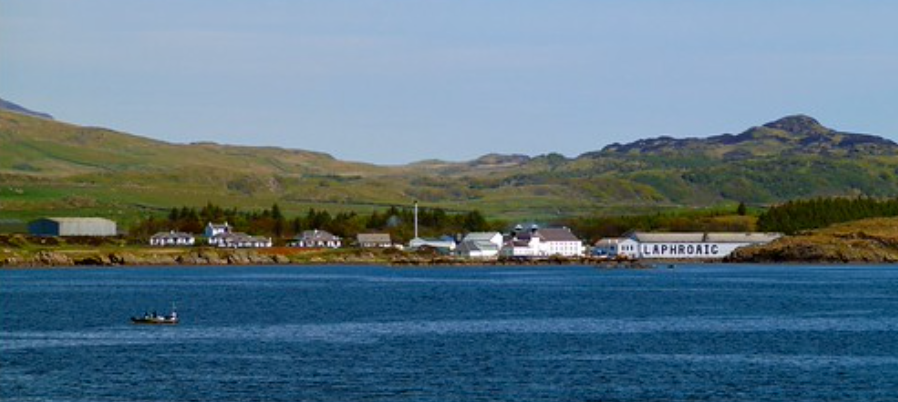
The view looking inland toward Laphroaig distillery
Those tours also changed her personal life. At the age of 51 in 1961, she married Wishart Campbell, a Canadian entertainer and baritone singer whom she met during her North American work. They married in Glasgow and lived at Ardenistiel. The popular Campbell had a showman’s presence and did nothing to discourage the island gossip that followed him; meanwhile, Bessie continued to lead the business, and both took on an active role in community life on Islay.
Regarding civic engagement on tiny Islay, Bessie’s was substantial. She was prominent in the Scottish Women’s Rural Institute locally, and helped raise money for causes on the island. In 1963, Williamson received the Order of St. John for her charity work. Within the company, even when corporate realities pushed her toward outside investment, she maintained a reputation for loyalty to workers and for keeping older employees on when formal pension structures were lacking.
From the early 1960s onward she gradually ceded ownership in stages. In 1962, she sold a portion of her shares to interests connected with Long John Distillers, seeking the investment needed for upgrades and growth. Further transfers followed in 1967 and 1972, while she remained chairman/managing director through her retirement. Laphroaig modernized in those years, including changes to facilities and capacity, with Williamson still at the helm during significant transitions.
Bessie Williamson retired in the early 1970s after a nearly 40-year career with Laphroaig, climbing from a temporary bottom rung to the top office. Even after retirement, she remained close to the distillery and its people, until her death in May of 1982. In the end, Bessie’s story is not that of a mythical legend built from mist and peat; it is a verifiable record of solid administrative skill transformed into leadership, and that leadership building, then amplifying, a global whisky name.
Sources:
Laphroaig whisky official website/history, “Bessie”, laphroaig.com
ScotchWhisky.com, “Whisky heroes: Bessie Williamson”, Iain Russell, 24 May 2016
OurWhisky Foundation,“Bessie Williamson: Laphroaig’s guardian angel”, Becky Paskin, 21 March 2024, ourwhiskyfoundation.org
LaphroaigCollector, “Review of Book ‘The Legend of Laphroaig’”, 06 January 2018, laphroaigcollector.com
Contributed by Tracy McLemore, Fairview, Tennessee USA