David Wood

David L. Wood’s public story is the kind that Oklahoma City seems to generate more often than it gets credit for: a long apprenticeship in unglamorous, detail-heavy work dealing with inventory, customer needs, logistics, and branding, followed by a late pivot into a craft business which requires both patience and nerve. The arc is not sudden, it is cumulative. Wood’s personal arc began with books, moved through distribution and systems thinking, and eventually landed in whiskey.
David Wood was born on September 16, 1961, one of three children of Duane and Jean Barnes-Wood. His mother founded and operated Jean Barnes Books in Oklahoma City, a small but durable independent bookstore that would remain in business for nearly fifty years. For Wood, the store became something more than a family enterprise, it became a working classroom in how niche businesses survive, adapt, and build loyal audiences. By the early 2000s, Wood was already functioning as an owner-manager inside that world. He spoke in concrete terms about sales channels, customer behavior, and the pressures facing specialty retail as consumer habits shifted. The romantic idea of a quaint, quiet bookstore gave way to a more pragmatic reality: foot traffic alone could no longer carry the business. In October 2002, Wood made a decisive move and closed the public storefront, transitioning the operation away from traditional walk-in retail. What replaced it was not retreat but reconfiguration. Jean Barnes Books had already become unusually distributed for its time. Much of its volume came from phone orders, internet sales, and, most importantly, conference selling. Wood and his team traveled to dozens of conferences each year, largely serving social workers and related professional communities. Those conferences were not just sales opportunities; they were relationship engines. They created repeat customers, institutional trust, and a feedback loop about what people actually needed.
During that period, Wood demonstrated a habit that would reappear years later in distilling: he built systems around product categories rather than merely stocking shelves. He launched a large catalog called Creative Solutions, tailored specifically to the professional fields the bookstore served. He also developed a publishing sideline that produced dozens of titles after observing small publishers collapse and niche books become harder to source through mainstream channels. The response was not complaint but construction. If the supply chain was breaking, Wood helped rebuild part of it himself. The work was quiet, operational, and deeply unglamorous, but it was also formative.
Over time, Wood moved through other professional terrain: warehousing, distribution, and logistics, while continuing to think about how products move, how customers discover them, and how regulated or specialized goods find their audience. He later described the “spark” for a distillery as dating back to his early days in retail, long before spirits were part of his life in any meaningful way. But the specific moment that crystallized the idea came years later and hundreds of miles away. While dropping his son off at Ohio State University, Wood visited Watershed Distilling in Columbus, Ohio. The visit did not instantly turn him into a distiller. Instead, it gave shape to a question he had already been circling: what would it look like to build a craft business rooted in Oklahoma, one that combined manufacturing, branding, hospitality, and long-term patience?
Wood had spent years parsing the distilling and brewing world, learning how spirits businesses were planned, funded, and regulated. He had lived through the realities of acquiring, moving, and selling goods that carried both practical constraints and trust-based value. By the time he seriously considered distilling, he understood that whiskey was not a startup in the usual sense. It was a long game. By late 2021, imagination turned into action. Wood raised capital and signed a lease in November on a bow-truss building that had once housed the Ritz Theater in Oklahoma City’s Britton District. The structure offered something unusual but essential: ceiling height. He then located a handmade Vendome distilling system offered at a bargain from a former distiller in Nevada. The 500-gallon copper still had been built in Kentucky bourbon country, used at a ranch-based distillery out west, and had already been broken in producing mostly whiskey before being transported to Oklahoma. It was not decorative hardware. It was solid whiskey-capable infrastructure. That choice revealed a strategic truth. Woodworks Distilling Co. was going to be a whiskey distillery even if it could not immediately sell its own aged whiskey.
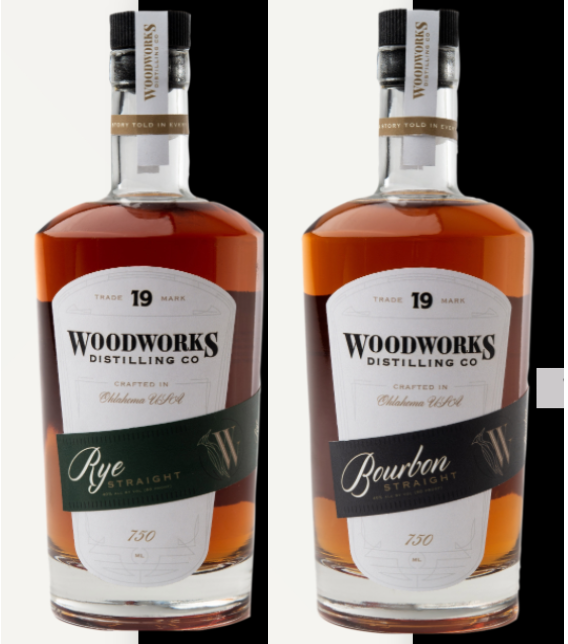
Woodworks explains that it “scoured the continent” for whiskeys that fit its desired taste direction, and bottled them as the ‘Preface Series.’ On January 8, 2023, the distillery secured its license and began to distill. It would be months before it could offer its own rye and bourbon. In the meantime, it secured high-end rye and bourbon from MGP to give customers an early sense of house style. Its initial MGP-sourced Preface rye bottlings have a mash bill of 95 percent rye, while bourbon contains 21 percent rye. Both bills signal spice, structure, and a clear flavor direction to keep customers interested while the Oklahoma-made whiskey finally started its long maturation.
By September 2023, the larger operation had taken shape. Wood recruited veteran whiskey-maker David Alexander, an experienced distiller brought in after investors suggested the project needed a someone with a “pedigree.” Wood’s own focus remained consistent with his past. He obsessed over customer experience of place. He designed a tasting room meant to feel like a dimly lit, relaxed speakeasy. He treated branding as something learned over time rather than imposed all at once. Meanwhile, early market feedback arrived in measurable form. Vodka was the top seller by the drink, but Bourbon was the top seller by the bottle. For a distillery still in the beginning stage of its whiskey life, it was important to note those preferences. People were already telling Woodworks what they wanted to drink there, and what they wanted to take home.
The company continued to build anticipation through limited, participatory concepts. In late 2023, Woodworks promoted a Bourbon-Making Kit built around a small toasted oak cask and bottles of Rough Draft Un-Aged American Whiskey. Customers were encouraged to “taste the future” by aging it themselves “before we do.” The idea echoed Wood’s earlier career: structured experiences, curated pathways, and products that invite engagement rather than passive consumption.
Seen end to end, Wood’s story is not one of sudden reinvention. It is one of accumulation. Book catalogs become whiskey programs. Conference tables become tasting-room bars. Publishing sideline becomes transparent sourcing philosophy. The materials change. The methods remain. And inside the former Ritz Theater, copper now gleams where film once flickered. Barrels quietly count years instead of pages. The work is slower than retail ever was. It is also, in a strange way, familiar. After all, Wood spent decades learning how to build something that lasts in industries where lasting is never guaranteed. Whiskey simply gave him a medium that demands patience by design. And so, in a building made for long sightlines and heavy beams, a man who grew up among shelves and invoices now waits alongside barrels, confident that time properly planned for still does most of the best work.
Sources:
The Journal Record, “Jean Barnes makes transition”, October 7, 2002
The Journal Record, “Speak-easy-style distillery energizes former Ritz Theater space”, Kathryn McNutt, September 1, 2023
Woodworks Distilling Co. official website, (multiple stories), woodworksdistilling.com
DeMuth Funeral & Cremation Society, “Duane C. Wood Funeral Notice”, January 19, 2025, demuthfuneralandcremationsociety.com
Contributed by Tracy McLemore, Fairview, Tennessee