J.P. Jerome


John P. “J.P.” Jerome belongs to the generation that helped give Michigan craft distillingrealweight. His route into whiskey began in science, in farm-country experimentation, and in a long friendship network that proved unusually durable in business, and by the time Detroit City Distillery opened in Eastern Market in 2014, Jerome had already built the technical habits that would define his work.
As a teenager, Jerome was already making alcohol with the same group of friends who would later become his business partners. The early versions were rough, however, but what mattered was not polish, but the formation of habit. Fortunately, Jerome learned from his failures and kept improving. Detroit City Distillery was ultimately founded by Jerome and seven childhood friends he had known since his was three, an origin story that was not a marketing invention but the actual structure of the company. The result was an enterprise that rested on a friendship base formed long before anyone signed a lease or filled a barrel.
Jerome then built the academic and scientific foundation that made him especially valuable inside that group. He graduated from the University of Michigan in 2005 with a degree in anthropology and zoology, then moved into professional brewing work at Bell’s Brewery as a quality-control laboratory technician. That position gave him direct exposure to production discipline, laboratory standards, and the way technical precision shapes a beverage business. He did not leave science behind after that experience, he deepened it, later earning a Ph.D. in microbiology from Michigan State University.
The business itself came together after college, when a campfire idea among friends hardened into a real plan. One of the group, Michael Forsyth, was working on business development in Detroit, and had the idea for settlement on Eastern Market as the distillery’s home base. So the group leased an empty brick shell and began building a distillery and cocktail operation from the ground up. Detroit City Distillery opened in August 2014 in what was a former slaughterhouse.
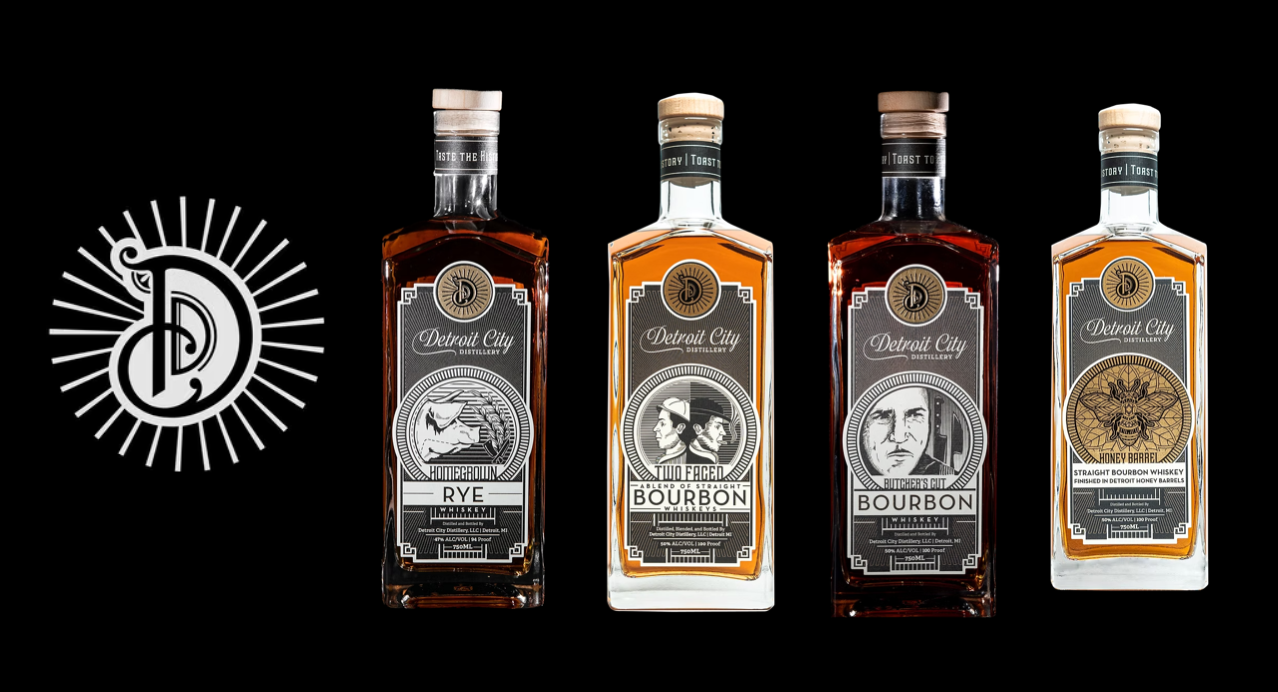
Its early spirits lineup already showed that Jerome and his partners intended to be more than a tasting-room novelty. At opening, the distillery was pouring Bloodline Whiskey and Two-Faced Bourbon. Jerome emphasized local sourcing from the start, noting that the distillery bought organic corn for bourbon within an hour’s drive of the market and could source cocktail ingredients right outside its door. That commitment became a permanent feature of the whiskey program. Detroit City’s spirits philosophy later stated the point plainly: the company makes young, high-proof whiskies to elevate organic, locally grown Michigan grains, and at times even grows its own wheat for whiskey.
Jerome’s whiskey-making developed along two tracks at once: technical control and narrative control. He understood that craft whiskey had to taste good, but he also understood that it needed identity. That is where his best-known bourbon, Butcher’s Cut, becomes central to his story. Jerome built the whiskey around family history and material specificity. The label honors his grandfather, a butcher in Detroit’s Eastern Market after World War II, whose life Jerome tied directly to the former slaughterhouse which he transformed into a distillery. The bourbon itself reflects that same specificity: corn and rye from Washtenaw County,barley from Pilot Malt House in Kent County, and hand-smoked Michigan northern oak. The mash bill is 68 percent corn, 27 percent rye, and 5 percent specialty roasted barley malts. Detroit City did not merely talk about local whiskey; under Jerome, it made local whiskey legible in the bottle.
That combination of science and story helped the company expand. Jerome has said Detroit City’s first true in-house momentum came when the business moved from being a successful cocktail bar into wider distribution in 2016. By 2022, Detroit City was distributing to 31 states and nine European countries. But expansion also required physical space, so the partners took over the old Stroh’s Ice Cream factory, developing it into ‘The Whiskey Factory,’ which became both a production site and an event venue.
JP’s role also widened beyond the distillery gates: He has served as vice president of the Michigan Craft Distillers Association, placing him in a leadership position within the state’s larger craft-spirit sector. The posting showed that he is not simply a distiller running stills in one building; he is part of the generation that helped normalize craft distilling as a serious Michigan industry. Importantly, that industry ties together Michigan’s agriculture, tourism, manufacturing and production sectors, and thus its statewide market identity. The clearest measure of Jerome’s career, though, remains in the whiskey itself. He built Detroit City Distillery on friendship strong enough to survive debt, risk, and growth. He brought laboratorytraining into a business that often mistakes romance for rigor. He anchored his spirits in Michigan grain, Detroit geography, and inherited family memory, and he stayed with the hard part of whiskey-making: laying down spirit,waiting on barrels, and turning local raw material into bottles that could stand on their own. Detroit City Distillery did not become one of Michigan’s best-known craft whiskey names by accident; it became that because JP Jerome treated whiskey as both a science and a civic product, something made with precision but meant to echo the vibrance of an entire city.
Sources:
University of Michigan Detroit Center, “Alum J.P. Jerome…Detroit City Distillery,” Mickey Lyons, October 26, 2022
Small Batch Standard, “Detroit City Distillery Case Study,” website, sbstandard.com/about/case-studies/detroit-city/
Hour Detroit, “Detroit City Distillery is 10-Year Aged”, Mickey Lyons, December 17, 2024, www.hourdetroit.com
DBusiness, “Detroit City Distillery Opens Friday…”, Izzi Bendall, August 28, 2014
Detroit City Distillery official website, “Butcher’s Cut Bourbon”, detroit-city-distillery.com
Michigan Craft Beverage Council, “MCDA Names 2023 Board of Directors,” January 26, 2023
Contributed by Tracy McLemore, Fairview, Tennessee