Colin Keegan


Colin Keegan was born in June of 1965 in northern England; unfortunately, not much public information on his early life has been made available, however, as an adult, he moved to the USA. In 1992, Keegan settled in Santa Fe, New Mexico, with his wife Suzette and their daughter Phoebe. For more than fifteen years, he practiced architecture there, developing a reputation for precision, structural thinking, and an appreciation for materials. But when the economy took a downturn in the late 2000s, Keegan became determined to turn distilling from his long-time hobby into a business. In 2010, Keegan opened Santa Fe Spirits.
Northern New Mexico offered a landscape and climate unlike any other whiskey-producing region in the United States. High elevation, dry air, and dramatic temperature swings created a distinctive environment for aging spirits. At the same time, the region possessed its own cultural and agricultural identity, shaped by centuries of local practice. Keegan began to consider whether a whiskey could be made that truly reflected this place. The idea that would define his career emerged from that question. In Scotland, peat smoke had long been used to dry malted barley, imparting a distinctive flavor to whisky. Keegan saw a Southwestern parallel in mesquite, a native wood deeply embedded in the region’s culinary traditions. Instead of replicating Scotch whisky, he envisioned an American single malt that would use mesquite smoke to express a uniquely New Mexican identity.
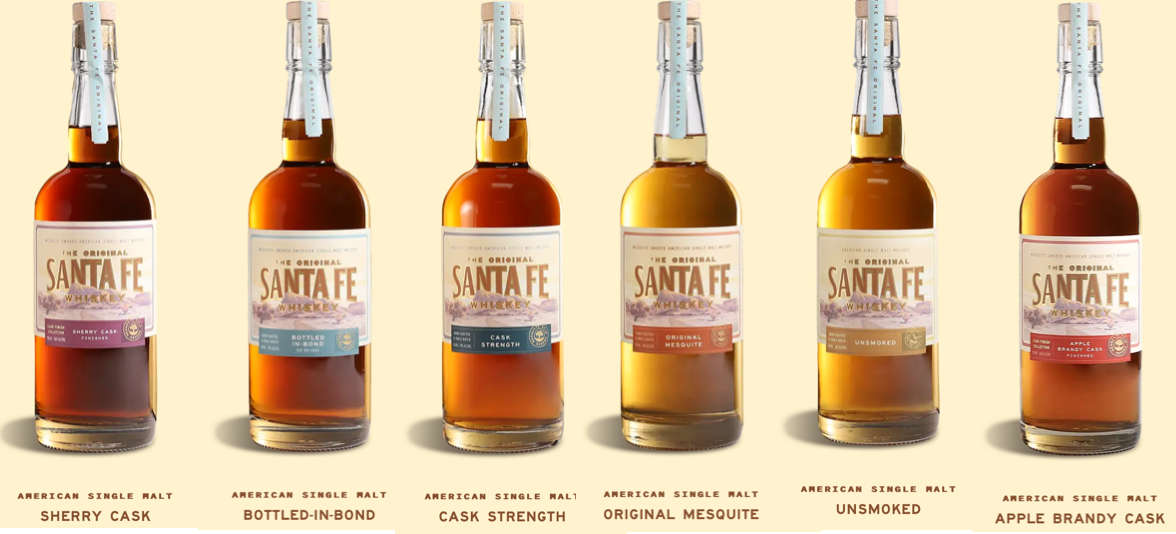
The distillery’s first whiskey, Colkegan Single Malt, embodied Keegan’s vision. Made from malted barley that was smoked with mesquite, the whiskey introduced a flavor profile that was at once familiar and entirely new. It retained the structural elements of single malt whiskey while expressing the desert environment in which it was produced. The name “Colkegan” itself combined Keegan’s own name with a nod to tradition, signaling both personal authorship and continuity with established whiskey-making practices.
From a production standpoint, Keegan approached distilling with a designer’s sensibility. Equipment selection, fermentation methods, and barrel management were all treated as interconnected components of a larger system. The high-altitude conditions of Santa Fe accelerated certain aspects of maturation, while the arid climate influenced evaporation and concentration within the barrel. Rather than attempting to replicate Kentucky bourbon or Scotch whisky conditions, Keegan embraced these differences, allowing the environment to shape the final product.
As the distillery grew, Keegan expanded the range of spirits produced under the Santa Fe Spirits name, but whiskey remained central to its identity. The company also maintained a strong connection to local agriculture, sourcing ingredients with an eye toward regional authenticity. This emphasis aligned with broader trends in American craft distilling but was particularly pronounced in Keegan’s work, where the concept of place was foundational rather than incidental. Over time, Santa Fe Spirits developed a dual leadership structure. While Keegan remained the founder and guiding force behind the distillery’s philosophy and product direction, operational responsibilities increasingly involved a lead distiller. Natalie Dale emerged as a key figure in this phase, bringing her own experience to the production side of the business. This transition reflected the maturation of the distillery itself, moving from a founder-driven startup to a more structured operation capable of sustaining growth.
Despite this evolution, Keegan’s influence remained evident in the distillery’s core identity. He recently renamed the ‘Colkegan’ whiskey line, simply “Santa Fe Spirits” to better capture the essence of the Southwest and align with the distillery's vision for the future, while still maintaining the same beloved liquid. The rebranding emphasizes regional pride and authenticity. Still, the distillery retains its emphasis on mesquite-smoked malt, the commitment to grain-to-glass production, and the focus on expressing the New Mexican environment all traced directly back to Keegan’s original vision.
Keegan’s work also contributed to the broader development of New Mexico’s distilling industry. When he founded Santa Fe Spirits in 2010, the state’s modern craft distilling sector was still in its infancy. Over the following years, a small but growing number of distilleries emerged, many of them connected through organizations such as the New Mexico Distillers Guild. Within this context, Keegan’s distillery stood out not only for its early establishment but also for its clear and distinctive identity.
In the end, Keegan’s approach to whiskey helped define what a regional American single malt could be outside of traditional centers. Rather than treating whiskey as a standardized product, Keegan demonstrated that it could serve as a medium for expressing local materials and environmental conditions. This perspective aligned with broader movements in craft food and beverage production, where provenance and authenticity has become increasingly important. Colin Keegan’s career can then be understood as a continuous exploration of how materials, environment, and human intention intersect. Whether designing buildings or crafting whiskey, he approached each endeavor with a focus on structure, balance, and place. Through Santa Fe Spirits and the creation of Colkegan Single Malt, Keegan has established a lasting contribution to American whiskey, one defined not by imitation but by adaptation to the land in which it was made.
Sources:
Edible New Mexico, “Santa Fe Spirits: An Interview with Colin Keegan”, ediblenm.com
SantaFe.com, “Spirits Made in the Land of Enchantment”, www.santafe.com
Santa Fe Spirits Distillery official website, “About |Our Story”, santafespirits.com
New Mexico Distillers Guild, “Member Directory”, www.nmdistillers.org
Contributed by Tracy McLemore, Fairview, Tennessee