Chad Munger


Chad B. Munger was born July 14, 1965, and long before he began chasing “extinct” rye strains across archives, seed banks, and even shipwreck sites, he had already built a career grounded in analysis, communication, and the practical mechanics of making organizations function effectively. Munger earned a Bachelor of Arts in English from Michigan State University in 1988, training that emphasized clear thinking, persuasive writing, and disciplined analysis; skills that would carry forward through each stage of his professional life. After graduation, he briefly enrolled in graduate school at Duke University, but left almost immediately when it became clear it was not the right fit. He relocated to Chicago, and on the very night he arrived, everything he owned was stolen from his car. The episode marked an unceremonious beginning, yet it also opened the chapter that would define his first career and, ultimately, his path into spirits.
In Chicago, Munger entered the nonprofit healthcare sector at the American Academy of Orthopedic Surgeons, beginning as a research assistant. Over the next five years, he advanced to Director of Research and Scientific Affairs. The role required precision, organization, and the ability to communicate complex information clearly to physicians and institutions. His rise was rapid, driven in part by his capacity to translate dense material into usable, structured language.
Rather than drifting gradually toward entrepreneurship, Munger made a deliberatetransition. Recognizing an opportunity to build a commercial partner that could serve his organization as a client, he left and founded Data Harbor, a software and consulting firm. The company specialized in web-based accreditation management systems for large training hospitals, positioning itself at the intersection of compliance, systems design, and institutional operations. Notably, Munger did not possess coding skills. Instead, he built the company by assembling capable teams, learning quickly, and focusing on client needs. The approach reflected a consistent theme in his career: identifying gaps, organizing talent, and constructing solutions that addressed real operational problems.
Munger’s personal and professional life intersect in his partnership with his wife, Tracy Hickman. Public records and institutional profiles consistently present them as a team. Both are Michigan natives, both attended Michigan State University, and both share a commitment to rooting their work in northern Michigan. When Mammoth Distilling was founded in 2013, it was the result of that shared vision.
The move north was not initially intended as a permanent shift. In 2008, Munger and Hickman inherited land in northern Michigan and planned to build a summer home. Over time, however, Munger spent increasing amounts of time there, eventually treating it as a primary residence. The transition brought a new challenge. Having left the dense professional and social networks of Chicago, he found that integrating into a smaller community could be difficult without longstanding local ties. Rather than remain on the periphery, he and Hickman began searching for a way to contribute meaningfully—creating jobs, building relationships, and embedding themselves within the local economy rather than remaining seasonal residents.
The idea of distilling did not emerge from a lifelong ambition or inherited tradition. Instead, it began with a moment of recognition. While waiting for a table at Maud’s Liquor Bar in Chicago, Munger encountered a patron who insisted on buying aviation cocktails for strangers. That individual worked for Death’s Door Spirits in Wisconsin, and the interaction introduced Munger to the concept of “craft” distilling. More importantly, it revealed a segment of the spirits industry where small producers could build distinctive, place-driven brands rather than compete directly with large-scale industrial operations. For Munger and Hickman, already searching for a business that could create local opportunity, distilling offered a practical and scalable solution.
Once committed to the idea, Munger sought formal training. Michigan State University provided a critical pathway through its artisan distilling program, connected to the work of Dr. Kris Berglund. The program offered foundational technical knowledge to individuals without extensive industry backgrounds. Munger enrolled, completed the compressed coursework, and emerged with both practical understanding and the momentum necessary to move forward. He placed an order for a still and began assembling the network required to transform the concept into an operating distillery.
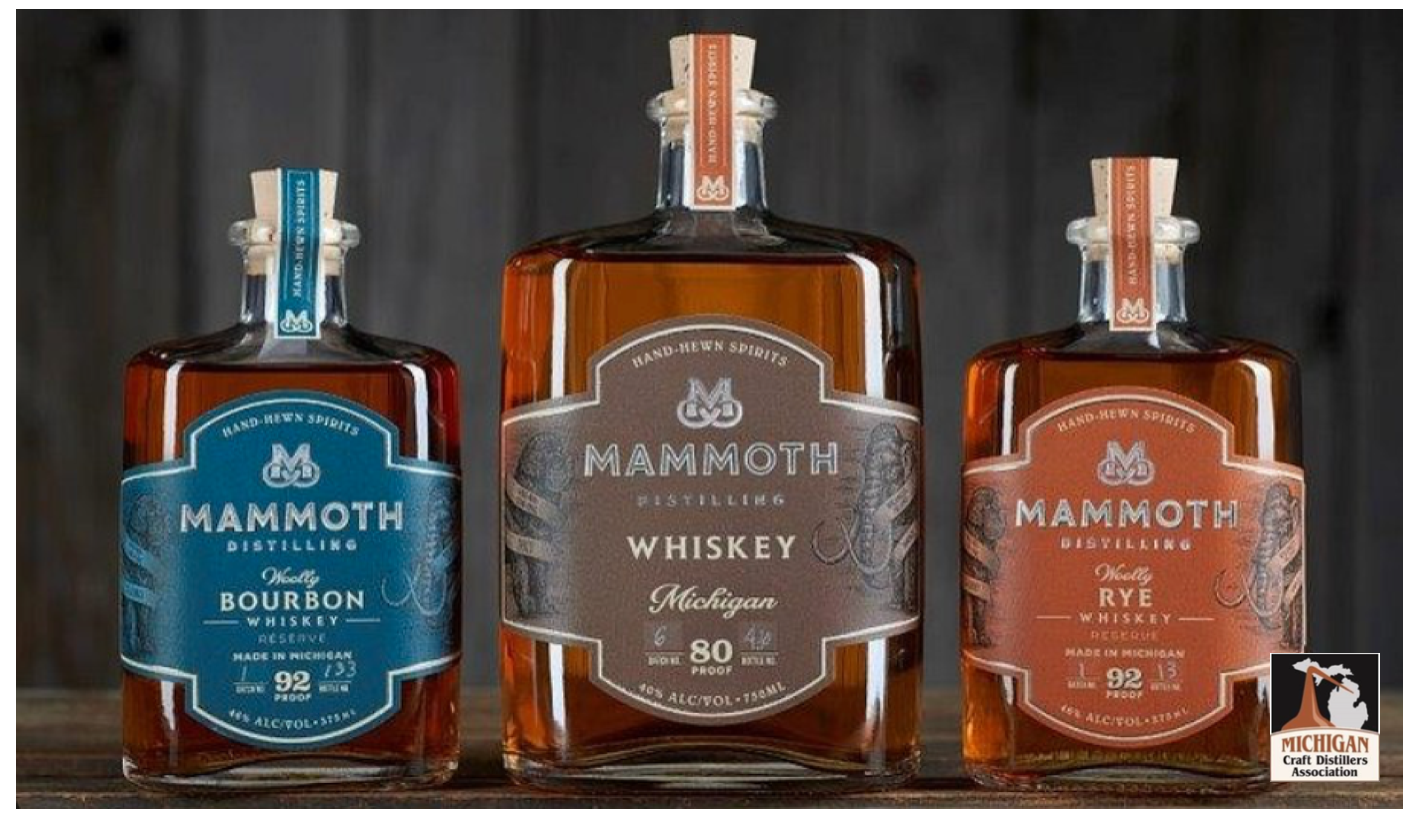
Mammoth Distilling was built on a central premise: that “place” could be distilled. Northern Michigan’s agricultural conditions, water sources, seasonal rhythms, and cultural identity were not treated as background elements but as defining characteristics of the product. This philosophy shaped the company’s development, from production decisions to brand identity. As Mammoth expanded, it established a network of tasting rooms across Michigan while maintaining production in Central Lake, consistently reinforcing its connection to the region.
Over time, Munger’s work evolved beyond building a distillery into an ambitious agricultural initiative: the revival of historic Michigan rye. The effort began when he discovered a 1934 Old Schenley rye advertisement in Vanity Fair that praised Michigan-grown Rosen rye. Intrigued, Munger and distiller Ari Sussman investigated further. Their research uncovered a deeper history tied to early twentieth-century agriculture, including both the strengths of the grain and its vulnerability to cross-pollination. The geographic isolation of South Manitou Island emerged as a potential solution, offering natural protection for maintaining genetic integrity.
Munger approached the project not as branding but as restoration. He framed Rosen rye as a historical reality worth preserving rather than an invention. The work expanded into a multi-year effort involving historians, university partners, and agriculturallogistics. Through this process, Mammoth’s whiskey identity became firmly rooted in rye, not only as a flavor profile but as a statement about Michigan’s agricultural heritage and its potential future.
Ultimately, Munger’s career reflects a consistent pattern: identifying opportunity, organizing people, and building systems that allow ideas to become operational realities. In that sense, Munger’s throughline is not simply technical or entrepreneurial, and his work at Mammoth Distilling extends beyond spirits production. He has described one of his greatest satisfactions as the ability to create opportunities for others by building a business that supports careers. The distillery, its agricultural initiatives, and its expanding footprint across Michigan function not only as a commercial enterprise but as a platform. Employees, collaborators, and local partners are able to establish their own paths within the structure he helped create. That outcome, more than any single product or project, ties together the trajectory of his career: a progression from organizing information to organizing institutions, and ultimately to building something durable enough that others can shape their own futures within it.
Sources:
Michigan State University College of Arts & Letters, “English Alum’s Company Among the Stops on the Spartan Bus Tour,” Kim Popiolek, Oct. 17, 2025, cal.msu.edu
American Mash & Grain, “Mammoth Distilling”, Meghan Swanson, December 12, 2021, www.mashngrain.com
Michigan Country Lines Magazine, “A Story 100 Years In The Making”, November 2022, www.countrylines.com
Men’s Journal, “Divers Recovered 145-Year-Old Rye From a Shipwreck…”, Brad Japhe, June 23, 2025
Mammoth Distilling official website, “Our Expanded Central Lake Production Campus Nearly Operational”, mammothdistilling.com
PBS, “MSU Commencements…Spring 2025”, Episode 15, www.pbs.org
The Times (London, UK), “How to Turn a Shipwreck into Very Expensive Whiskey”, Harriet Alexander, November 28, 2024
Contributed by Tracy McLemore, Fairview, Tennessee