Stephen Paul


Stephen Paul was born on May 1, 1951. His family history in the Southwestern US goes back over a century, where his great-grandfather was a pioneer date farmer in Coachella, California. Stephen’s parents ultimately settled in Arizona when Paul was eleven. The Sonoran Desert was not merely a backdrop; it was formative, and Paul later recalled a strong personal attachment to the desert environment. As an adult, Paul earned a degree in education. He then spent approximately eight years teaching environmental education, an early career that reflects both intellectual curiosity and a practical engagement with the natural world. Teaching, however, did not fully contain his ambitions. He later entered architecture school, studying for two years. The discipline appealed to his sense of design and structure, but the long apprenticeship required to become a licensed architect proved less attractive. So instead of continuing down that path, Paul made a decisive turn toward craftsmanship. He left architecture school and founded a furniture company, Arroyo Design, alongside his wife, Elaine. This business would occupy the next three decades of his life and establish his reputation as a master woodworker. Arroyo Design specialized in mesquite furniture, a demanding medium derived from a dense, desert-grown hardwood. The company gained national recognition, with its work featured in several prominent design publications. The choice of mesquite as a medium wasnot incidental. It was local, difficult to work with, yet visually distinctive; these were qualities that aligned with Paul’s philosophy of creating objects rooted in place, and were part of the same philosophy would later carry into his whiskey.
The transition from furniture to whiskeybegan almost accidentally. In 2006, Stephen and Elaine were at home, cooking over mesquite wood scraps from their furniture shop and drinking Scotch whisky. Elaine posed a simple but transformative question: why not dry malted barley over mesquite instead of peat, as is done in Scotland?
That question became the foundation of Hamilton Distillers. Paul immediately began experimenting. He purchased a small five-gallon pot still from Portugal and began teaching himself the fundamentals of malting and distillation. Unlike many American distillers who focused on bourbon or rye, Paul was drawn to single malt whiskey, modeled on Scotch but adapted to the American Southwest. His defining innovation was the use of mesquite wood to dry malted barley, replacing peat and creating a distinctly regional flavor profile.
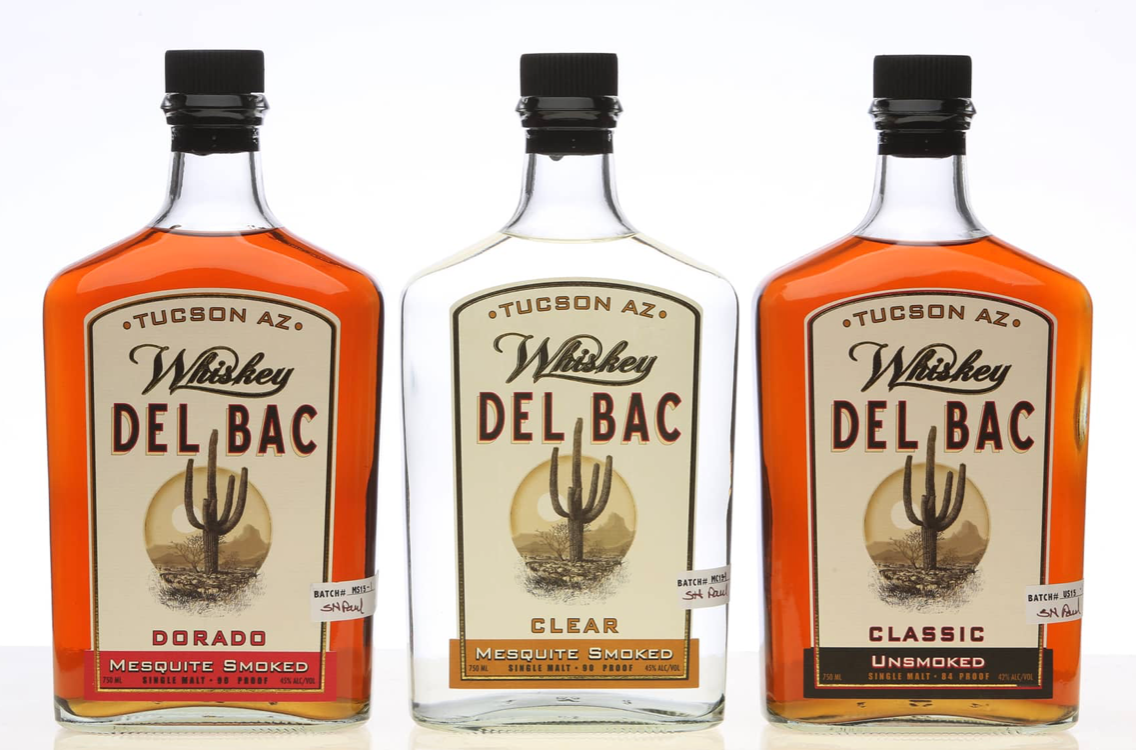
In 2011, Stephen Paul and his daughter Amanda formally foundedHamilton Distillers in Tucson, Arizona. The company’s flagship product, Whiskey Del Bac, was conceived as a “Southwestern American single malt,” grounded in local materials, climate, and culture. The early years were defined by experimentation and gradual scaling, but soon Paul expanded from his initial small 5-gallon still to a 40-gallon system. At about this time, Stephen was fortunate enough to meet Nancy Fraley, the Director of Research at theAmerican Distilling Institute. He began sending Nancy their distillate to review, receiving feedback and suggestions for improvement. Finally, in 2013, the distillery released its first three expressions:Dorado, Classic, and Clear. These whiskies established the core identity of Whiskey Del Bac, particularly Dorado, which showcased the signature mesquite-smoked character.
A significant expansion followed in 2014, when Paul raised capital to install a 500-gallon still and a 5,000-pound malt house. This system allowed Hamilton Distillers to control every stage of production in-house—malting, mashing, fermenting, distilling, aging, and bottling, an uncommon level of vertical integration in American craft distilling.
Hamilton Distillers quickly gained recognition. Whiskey Del Bac was named among the best distilleries in America by Esquire, and the company became the first craft distillery established in Southern Arizona since Prohibition. Its products earned a reputation for expressing terroir, a concept more commonly associated with wine but increasingly applied to whiskey. Throughout this growth, the business has retained its family-centered structure. Amanda Paul played a critical role in licensing, branding, and operations, relocating permanently from New York City to help grow the company alongside her father. The collaborativenature of the enterprise reflected the same partnership that had defined Stephen and Elaine’s earlier work in furniture.
In later years, Paul transitioned from day-to-day management, bringing in outside leadership while remaining deeply involved as president of the board and an active presence in the distillery’s operations. This shift allowed the company to continue expanding while preserving its founding vision.
Ultimately, what distinguishes Stephen Paul within the American whiskey landscape is not merely that he founded a successful distillery, but that he helped define a regional style. By insisting on local materials and adapting traditional methods to the Sonoran Desert, he demonstrated that American single malt whiskey could express place as clearly as its Scottish counterpart. And Paul’s life’s work forms a coherent arc, from teacher to designer to distiller, each stage rooted in the same environment and guided by the same principles. The desert, once the beloved setting of his childhood, became the defining element of his life’s work.
Sources
Visit Arizona, “Meet the Maker…”, Teresa K. Traverse, 2024, visitarizona.com
Whiskey Del Bac official website, “About Us”, whiskeydelbac.com
Flying Aprons Tucson, “Stephen Paul Founder…”, flyingapronstucson.com
Tucson Rotary, “Making Single Malt Whiskey in Baja Arizona", tucsonrotary.org
Visit Tucson (blog), “Taste Tucson in a Glass", Debbie Weingarten, www.visittucson.org
Mash & Grain, “Hamilton Distillers", 2020, www.mashngrain.com/distilleries/hamilton-distillers
Contributed by Tracy McLemore, Fairview, Tennessee