William Robertson


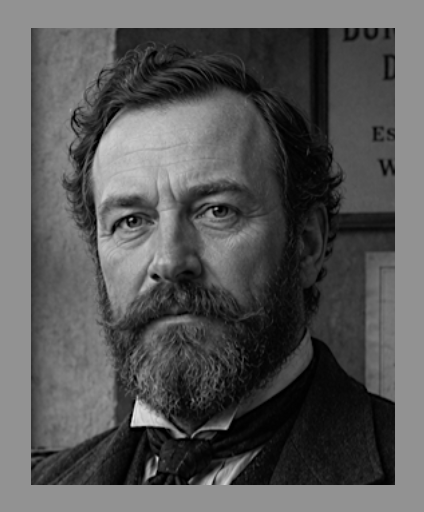
There are no actual photographs of William Robertson. Above
is an AI-generated image of him based on facts known about his life.
In 1833, William Alexander Robertson was born in Leven, Fife to his mother, Jane, and father, George. George was a ship’s captain, and died aboard ship in Quebec when William was only 14. At that point, young William was sent to relatives in Glasgow, where he entered the wine and liquor trade as a spiritsbroker with Daniel Lade & Co. Soon, Daniel Lade amalgamated with Bulloch & Co, at which time Robertson decided to go into business for himself. He set up a partnership with Robert Thomson, and the duo began importing wine from Bordeaux, France.
From a personal aspect, in 1859 at the age of 26, Robertson married Agnes Heatley, 22, and the pair ultimately had seventeen children. Also during 1859, Robertson & Thomson became agents for the Fettercairn Distillery and the Dutch Geneva distillers JH Henkes, but just one year later a riff between Robertson and Thomson broke up that partnership. At that point, William Robertson took John W. Baxter, his former clerk, into a new partnership, forming the firm of Robertson & Baxter.
By 1868, a downturn in the economy had resulted in the falling away of trade, and for a time Robertson & Baxter considered diversification into tea. However, Robertson was not convinced that this was the way forward, and instead became resolute in his pursuit of further wine agencies, acquiring the agency of another Bordeaux wine merchant, Cruse et Fils, in 1869. Robertson remained committed to the provision of quality products, but at that time began to seriously consider setting up his own distillery on the isle of Islay, however, a greater disaster was to follow: between 1878 and 1888, the vineyards of France, Spain and Portugal were destroyed by aphids. That was the last straw for Robertson, so, in 1878, he finally decided to more forward with his whisky distillery idea,and thus began a partnership with the Greenlees brothers, who were already established operators on Islay.
The Bunnahabhain Distillery, (which is derived from the Gaelic Bun na h-Abhainne, meaning “mouth of the river”), Argyll & Bute, took three years to build. He chose the remote site on the River Margadale, where construction also required building a small village, a pier, and roads to support the workers and transport goods. This approach was typical of the period, although it required significant capital and planning. Workers needed homes, access to provisions, and transport links, all of which had to be developed in tandem with the distillery. The result was a self-contained industrial community, with Robertson and his partners effectively acting as both industrialists and community builders.
Production at the distillery finally began in 1883. From the outset, Bunnahabhain differed subtly from other Islay distilleries. While Islay was already synonymous with a heavily peated whisky, Bunnahabhain developed a reputation for a milder style, shaped by its water source and production choices. The whisky from Bunnahabhain was originally intended to supply the high-quality blending stocks used for famous blends like The Famous Grouse and Cutty Sark. However, the independent ownership of Bunnahabhain did not last long. By 1887, just six years after its founding, the distillery passed into the hands of the Highland Distilleries Company. This transition reflects a broader consolidation occurring across the Scotch whisky industry at the time. Larger firms sought to control supply chains by acquiring distilleries outright. For Robertson, the sale likely represented either a strategic exit or the natural evolution of a capital-intensive enterprise requiring broader financial backing. Highland Distillers would go on to operate multiple distilleries and become a major force in Scotch whisky, supplying blends that were quickly gaining international recognition.
Robertson’s documented direct involvement in Bunnahabhain concluded with this period. And although Robertson himself does not appear to have been involved in later operational developments, the distillery he created continued to evolve. In 1894, Bunnahabhain introduced electric lighting, an early adoption of modern technology on Islay. Such advancements underscore the forward-looking nature of the original enterprise. Founders like Robertson werenot merely building traditional craft operations; they were establishing modern, industrial facilities designed to operate efficiently in an increasingly competitivemarket.
William Robertson died at the age of 64 on 30 August 1897 at Dowanhill Gardens, Glasgow. His decision to build on Islay—already home to several established distilleries—suggests that he and his partners recognized the island’s growing importance as a source of distinctivemaltwhisky. And even as Bunnahabhain developed a lighter whisky, it contributed to the diversity of Islay’s output.
Robertson’s legacy is preserved in the enduring operation of Bunnahabhain Distillery. The distillery has survived periods of closure and revival, changes in ownership, and shifts in global whisky demand, yet it continues to produce single malt Scotch whisky more than 125 years after its founding, and the village built to support the distillery remains tied to its operation, reflecting the lasting impact of the original enterprise. In this sense, Robertson’s contribution is best understood through institutional continuity. He was part of the generation that established the infrastructure of modern Scotch whisky production; distilleries, supply chains, and communities that continue to define the industry. The distillery he created—built in isolation, sustained by careful planning, and integrated into a rapidly consolidating industry—endures as a testament to that period in Scotch whisky’s long and stories history.
Sources:
Whiskyundfräuen auch für manner, “From Agnes to Edrington, Part II”, 12 February 2022, whiskyundfrauen.blogspot.com
Whizzky, “Bunnahabhain”, whizzky.net/distilleries
VCL, “A Look at the Bunnahabhain Distillery”, 27 February 2020, www.vclvintners.com
JISC Archives Hub, “Records of Robertson and Baxter Ltd…”, University of Glasgow Archive Services, archiveshub.jisc.ac.uk
Contributed by Tracy McLemore, Fairview, Tennessee USA