David Thompson


Professor David Thomson’s return to whisky began, in a way, with rejection. He grew up in Dumfries, born in 1954 into a family of shopkeepers. As a teenager he encountered whisky in a form that did neither it, nor him any favors—at about 16, in a caravan at Sandgreen near Gatehouse of Fleet, he was handed whisky, took a gulp, and promptly retched. He stayed away from it fiercely until his early twenties, when he was working in Cambridge. At that point, another Scot insisted, patiently, on teaching him to drink it: an “evening course” that stretched over several weeks. That slow conversion from disgust to appreciation was significant, because it trained him to think of flavor as something learned, tested, and refined rather than something automatic or disregarded.
Thomson’s professional life then took shape on the analytical side of taste. Before he became associated with a distillery, he worked as a cereal chemist and as a university lecturer in sensory and consumer science, training that sat directly on the fault line between raw materials, processing decisions, and what people actually perceive in the finished product. It was a career that treated “good” not as a vague compliment, but as something that can be defined, measured, and reproduced.
In 1972, he left Scotland as a young man and built his working life in England, and, together with Teresa Church, turned his research instincts into a business. In 1989, they started Mathematical Market Research (MMR) working from a spare bedroom in Benson, Oxfordshire. In the years that followed, MMR grew from that domestic beginning into an international consumer and sensory research company, with its own internal timeline recording expansions, new offices, and growth milestones. Even as MMR expanded, Thomson carried a quieter ambition back toward Scotland. He later described himself as an expatriate Scot looking for a project that would “anchor” his life back to his native land. His eventual whisky venture was not born from a desire to buy a fashionable brand; it was driven by the shock of realizing a local piece of industrial history could simply vanish.
One day Church gave Thomson a book listing closed distilleries, and Annandale was among them. That name hit with force because Thomson had grown up nearby without really ever thinking much about the distillery. The former owner had already secured planning permission to convert the site into holiday accommodations. If the conversion happened, the distillery buildings would survive only as a shell, with no return of whisky-making. Thomson’s curiosity and instinct made him step in.
In 2007, Thomson, together with Church, acquired the derelict Annandale Distillery and began a long, costly rebuild. They were not buying a turnkey operation. They were taking on a listed historic footprint that needed sympathetic restoration, while also requiring modern production equipment capable of making the kind of whisky they wanted to release. The restoration effort has been described in Scotch whisky reporting as a seven-year period of rebuilding and fitting-out, and the scale of the investment was repeatedly reported in the region of £10.5 million, supported in part by a £150,000 grant from Regional Selective Assistance. The result they aimed for was not just functionality, but permanence. They wanted a distillery that looked like a distillery again, and could keep looking like one a century later.
Thomson did not approach Annandale by letting equipment and tradition dictate the output and then discovering the spirit’s character afterward. He used the logic of his day job: decide what the end product should be, define its sensory position in a crowded market, then build the process to deliver it. In the years before Annandale returned to production, Thomson was already thinking in terms of flavor space; where existing malts sat, what attributes felt overrepresented, and what might be missing. He concluded there was room for two house styles that could share a common “Annandale character”: one unpeated and one peated, each distinct in personality but linked by a fruity through-line. To translate that plan into steel and copper, Thomson relied on a relationship that had begun decades earlier. He met Dr. Jim Swan at a sensory conference in London in the 1980s, and they had kept in touch. When Thomson needed a whisky-making plant designed for Annandale after the purchase, Swan was the first person he called.
On 9 November 2014, the first spirit came from Annandale’s revived stills, and on 15 November 2014 that first spirit was filled into cask number one to mature in the original 1830s warehouse. The point was not merely ceremonial, it was the end of a long period when the project existed mostly as scaffolding, invoices, and patience, and the very beginning of the even longer period when time in oak would be the deciding factor of whether the rebuilding had been worth it.
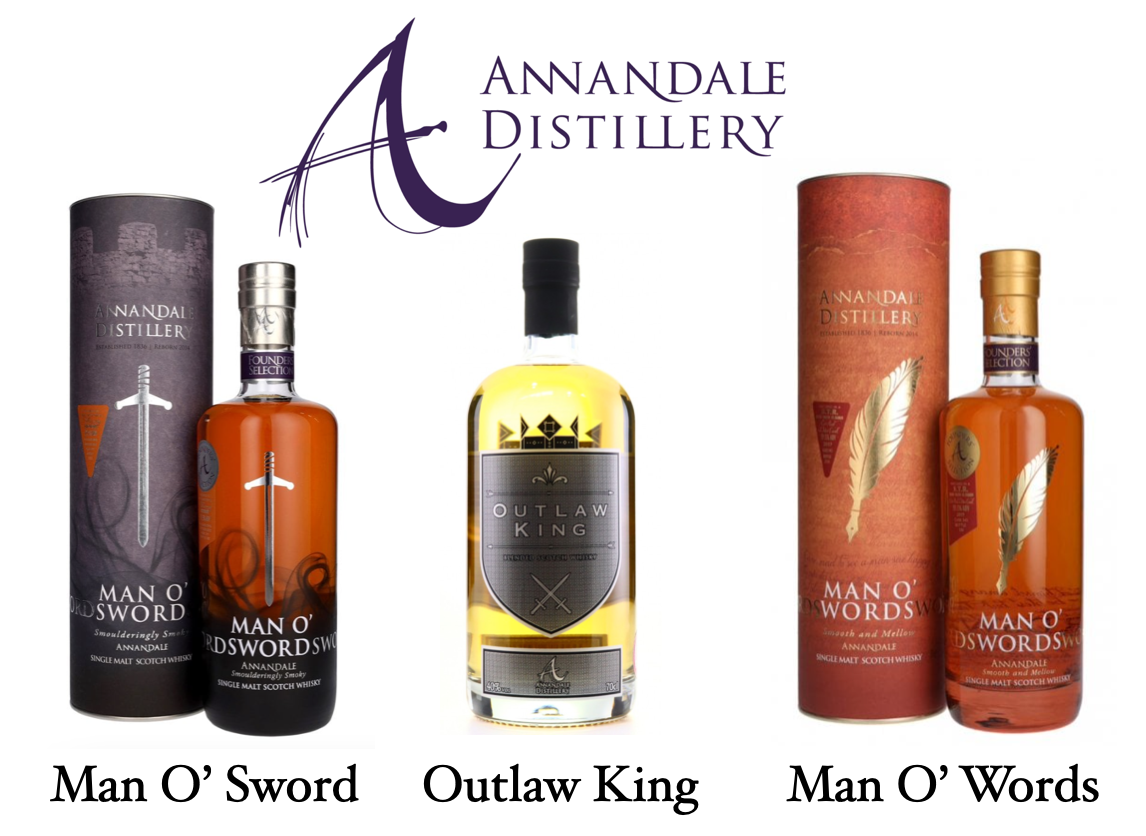
The whisky itself carried local history in its naming, but the choice of figures was strategic as well as respectful. Thomson wanted stories that were authentic to the region and could still resonate internationally. The unpeated whisky became Man O’Words, tied to Robert Burns; the peated whisky became Man O’Sword, tied to Robert the Bruce. The names also behaved the way Thomson’s mind tended to work: “Words” and “Sword” as anagrammatic pair, two expressions that mirror one another in concept while keeping their own identities in the glass. The first formal releases followed in 2018, drawing from early production casks.
Taken as a whole, Thomson’s whisky story is the story of a sensory scientist who learned, over time, to trust measurement without losing respect for craft; a businessman who built a global research firm from a spare bedroom; and an expatriate Scot who returned to Dumfries and Galloway with a plan that was equal parts heritage rescue and product design. Annandale’s modern whisky began with a decision made quickly: buy the site before it became a hotel. It then unfolded slowly, the only way whisky can: copper, oak, and years that may never be hurried.
Sources:
ScotchWhisky.com, “Five minutes with David Thomson…”, Gavin D Smith, 19 July 2018
Annandale Distillery official website, “David Thomson”, www.annandaledistillery.com
MMR Research, “Company/Our heritage”, mmr-research.com/company
ScotchWhisky.com, “Annandale’s whisky revived…”, scotchwhisky.com/magazine
The Scotch Whisky Experience, “Annandale Distillery”, www.scotchwhiskyexperience.co.uk
South of Scotland (blog), “A Spirited Couple”, Cat Thompson, scotlandstartshere.com
The Globe Inn, Dumfries (official website), “David & Teresa”, www.globeinndumfries.co.uk/david-theresa/
Contributed by Tracy McLemore, Fairview, Tennessee USA